

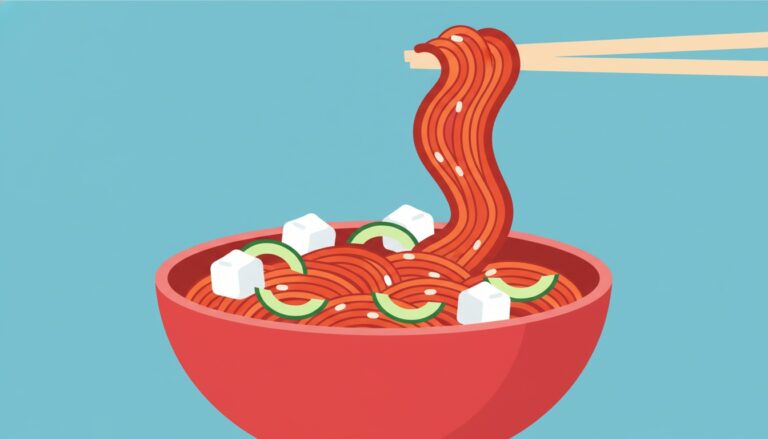
Introduction: The “Cold Shock” is Everything! 🧊
Hello! This is your Senior Editor at Daily Hangul.
Today, we are tackling a dish that defines Korean summers: Instant Bibim-myeon (비빔면).
I once had a student, Alex, who bought a pack of Paldo Bibim-myeon. He cooked it exactly like standard Ramyeon—he boiled it, kept the hot water, added the sauce, and ate it as a hot soup. The result? A weird, lukewarm, sour soup that tasted… terrible. He came to class the next day looking betrayed.
Unlike Ramyeon, Bibim-myeon requires a crucial step called “The Cold Shock.” If you miss the specific verbs related to this step, you aren’t just making a mistake; you are ruining the texture completely.
In this lesson, we will learn the essential B2-level verbs to cook these noodles perfectly and the cultural nuances that will make you sound like a pro chef in a Korean kitchen. Let’s get chewy!
Phase 2: Deep Dive into Key Expressions
Here are the three expressions that stand between you and a delicious bowl of noodles.
1. 찬물에 헹구다 (Chanmure hengguda)
- Pronunciation: [Chan-mur-e heng-gu-da] Sounds like: “Chan-moo-reh heng-goo-da”
- Meaning: To rinse in cold water.
- Editor’s Insight: You know the verb ‘씻다’ (to wash)? While you wash your hands, you 헹구다 (rinse) noodles to remove the starch. This is the secret to the 쫄깃한 (chewy) texture. If you skip this, your noodles will be mushy (불어 터지다).
- Situation Check: Used in cooking or when rinsing laundry. Not used for cleaning a room.
2. 물기를 털다 (Mulgireul teolda)
- Pronunciation: [Mul-gi-reul teol-da] Sounds like: “Mool-ghee-reul tuhl-da”
- Meaning: To shake off the water / To drain well.
- Editor’s Insight: ‘물기’ means moisture. ‘털다’ is the motion of shaking something off (like dust from a coat). In the context of Bibim-myeon, you must shake the sieve vigorously. If you leave water in, the sauce gets diluted (밍밍하다), and Koreans hate bland food!
- Situation Check: Casual to Formal. Essential instruction in recipes.
3. 오른손으로 비비고, 왼손으로 비비고 (Oreun-soneuro bibigo…)
- Pronunciation: [O-reun-so-neu-ro bi-bi-go…] Like a song rhythm
- Meaning: Mix with the right hand, mix with the left hand.
- Editor’s Insight: Okay, this is a cultural cheat code. This is the lyrics to a famous commercial jingle for Paldo Bibim-myeon. If you are mixing the noodles and humming this tune, every Korean around you will laugh and recognize you as a true insider.
- Situation Check: Very casual/Humorous. Use it with friends while cooking.
Phase 3: Textbook vs. Real Life
Let’s see how a recipe book speaks versus how your Korean friend speaks.
| Textbook (Recipe Standard) | Real Life (Spoken Korean) | Nuance Check |
|---|---|---|
| 면이 익으면 물을 버리세요. (Discard the water when noodles are cooked.) |
면 다 익었으면 물 따라 버려. (If noodles are done, pour out/dump the water.) |
‘따라 버리다’ implies pouring it out carefully (like through a sieve). |
| 소스를 넣고 잘 섞으세요. (Add sauce and mix well.) |
소스 넣고 야무지게 비벼 봐. (Put sauce in and mix it ‘skillfully/ambitiously’.) |
야무지게 is a great adverb meaning doing something efficiently and well. |
| 오이를 얹으면 맛있습니다. (It is tasty if you garnish with cucumber.) |
오이 채 썰어서 올려야 국룰이지. (Putting julienned cucumber on top is the ‘national rule’.) |
국룰 (Gung-nul) means an unwritten rule everyone follows. |
Phase 4: Cultural Context & Manners
The Obsession with “Jjolgit” (Chewiness)
Western pasta is often served al dente, but Korean cold noodles take texture to another level. We call it 탱글탱글 (taeng-geul taeng-geul) or 쫄깃쫄깃 (jjol-git jjol-git). This bouncy texture only happens when the noodles meet ice-cold water immediately after boiling.
The “Ssam” Culture in Noodles
Did you know? Bibim-myeon is often eaten with grilled pork belly (Samgyeopsal). It is culturally considered the perfect combination (꿀조합). If you serve Bibim-myeon to a Korean friend, ask: “Do we have any meat to wrap with this?” (이거랑 싸 먹을 고기 있어?) You will instantly become their favorite person.
Phase 5: Real Life Roleplay
Setting: Two roommates, Minji (Korean) and Sam (Foreigner), are making a late-night snack.
Minji: 물 끓는다! 샘, 면 넣어. (The water is boiling! Sam, put the noodles in.)
Sam: 오케이. 3분만 끓이면 되지? (Okay. Just boil for 3 minutes, right?)
Minji: 응. 다 익으면 바로 찬물에 헹궈야 해. 알지? (Yeah. Once cooked, you have to rinse them in cold water immediately. You know that?)
Sam: 당연하지! 물기도 꽉 털어야 소스가 안 싱거워지잖아. (Of course! I have to shake off the water completely so the sauce doesn’t get bland.)
Minji: (Smiling) 오~ 이제 한국 사람 다 됐네? 얼음도 좀 넣을까? (Oh~ You’re practically Korean now. Should we add some ice too?)
Sam: 좋아! 내가 왼손으로 비비고 오른손으로 비빌게. (Good! I’ll mix with the left hand and mix with the right hand.)
Phase 6: 10-Second Shadowing Drill
Read this aloud to practice your intonation. Imagine you are instructing someone urgently!
“면이 다 익으면 / 흐르는 찬물에 / 빡빡 헹궈주세요!”
(Myeoni da igeumyeon / heureuneun chanmure / bbak-bbak heng-gwo-juseyo!)
Translation: When the noodles are fully cooked / in running cold water / rinse them vigorously!
Tip: 빡빡 (Bbak-bbak) is the sound/feeling of scrubbing hard. Emphasize this word!
Phase 7: FAQ & Troubleshooting
Q: Can I use ‘빨래하다’ (do laundry) for washing noodles?
A: No! While the motion is similar to hand-washing clothes, using 빨래하다 for food sounds unappetizing. Use 헹구다 (rinse) or 씻다 (wash).
Q: Is it rude to make slurping sounds?
A: For cold noodles like Bibim-myeon, a little slurping is acceptable as it helps mix the air and sauce flavors. But don’t be too loud! It’s a balance.
Q: Can I eat Bibim-myeon warm?
A: Technically, yes, but 99% of Koreans will look at you strangely. It is designed to be eaten cold.
Phase 8: Wrap-up
One-Liner Summary:
To make perfect Bibim-myeon, remember to 헹구다 (rinse) in cold water and 물기를 털다 (shake off water) to keep the texture 쫄깃한 (chewy).
Action Mission:
Go to a Korean convenience store or Asian market, buy a pack of Bibim-myeon, and cook it tonight. Try to achieve the 탱글탱글 texture using the ice bath method!
Question for you:
What is your favorite topping for cold noodles? Cucumber? Boiled egg? Or Pork belly? Let me know in the comments!
Phase 9: Pop Quiz
- Which verb is most appropriate for “removing starch from noodles with water”?
a) 닦다 (dakkda)
b) 헹구다 (hengguda)
c) 빨다 (ppalda) -
If you don’t drain the water well, the noodles become…?
a) 밍밍하다 (bland/watery)
b) 짜다 (salty)
c) 맵다 (spicy) -
Complete the lyric: “Right hand ______ , Left hand ______.”
a) 씻고 (wash), 씻고 (wash)
b) 비비고 (mix), 비비고 (mix)
c) 먹고 (eat), 먹고 (eat)
(Answers: 1. b, 2. a, 3. b)
Frequently Asked Questions (FAQ)
Q: What does "찬물에 헹구다 (Chanmure hengguda)" mean in Korean and how do you pronounce it?
A: In Korean, "찬물에 헹구다 (Chanmure hengguda)" is pronounced [Chan-mur-e heng-gu-da] and means: To rinse in cold water.
Q: What does "물기를 털다 (Mulgireul teolda)" mean in Korean and how do you pronounce it?
A: In Korean, "물기를 털다 (Mulgireul teolda)" is pronounced [Mul-gi-reul teol-da] and means: To shake off the water / To drain well.
Q: What does "오른손으로 비비고, 왼손으로 비비고 (Oreun-soneuro bibigo...)" mean in Korean and how do you pronounce it?
A: In Korean, "오른손으로 비비고, 왼손으로 비비고 (Oreun-soneuro bibigo...)" is pronounced [O-reun-so-neu-ro bi-bi-go...] and means: Mix with the right hand, mix with the left hand.







