

✨ Don’t Just Stare at the Shelves! How to Find the Best Korean Books
Phase 1: Introduction
Hello! This is your Daily Hangul Editor.
Picture this: You’ve finally built up the courage to visit a local library in Korea. You walk in, the smell of old paper hits you, and… panic sets in. There are thousands of books, all their spines covered in Hangeul, and you have no idea where to start. You don’t want to accidentally pick up a boring philosophy textbook when you wanted a fun novel, right?
Today, we are going to learn how to ask for and find “Recommended Books” in a Korean library. Knowing these phrases isn’t just about finding a book; it’s about showing the librarian that you are interested in current Korean trends. Plus, reading children’s books or bestsellers is one of the fastest ways to escape the “foreigner bubble.”
Let’s turn that overwhelming wall of text into your new favorite playground!
Phase 2: Deep Dive – Key Expressions
Here are the 3 essential phrases you need to navigate the recommendation section.
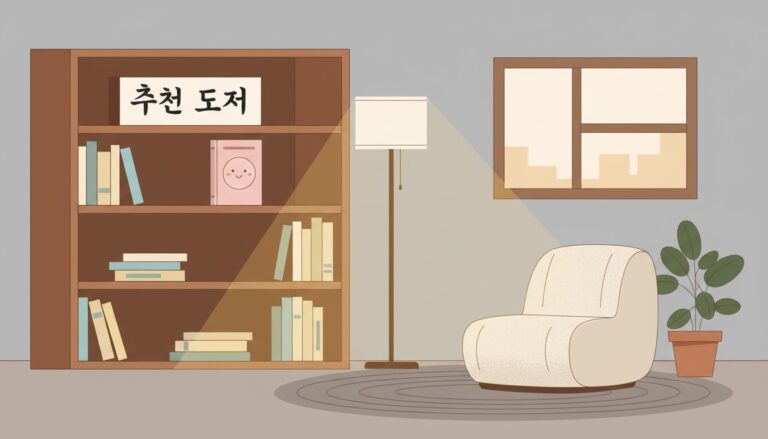
1. 추천 도서 (Chucheon doseo)
- Pronunciation: Choo-cheon do-seo [Think of ‘Choo’ like a train sound ➕ ‘cheon’ rhymes with ‘fun’ but with a ‘ch’]
- Meaning: Recommended Books
- Editor’s Insight: You will see this written on signs everywhere. 추천 means recommendation, and 도서 is a formal word for ‘books’ (used in libraries/bookstores).
- Situation: Written signs / Formal inquiries.
2. 요즘 인기 있는 책 (Yojeum ingi inneun chaek)
- Pronunciation: Yo-jeum in-gi it-neun chaek
- Meaning: Books popular these days
- Editor’s Insight: If you don’t know what to read, follow the crowd! Koreans love trends. asking for what is ‘ingi’ (popular) is a shortcut to finding interesting reads.
- Situation: Asking a librarian or friend (Polite).
3. 읽기 쉬운 책 (Ilgi swiun chaek)
- Pronunciation: Il-gi swi-oon chaek
- Meaning: Easy-to-read books
- Editor’s Insight: As an A2 learner, honesty is your best policy. Don’t try to read Shakespeare in Korean yet. Ask for something “easy to read.”
- Situation: Asking for personal advice.
Phase 3: Textbook vs. Real Life
Textbooks often teach you to sound like a robot. Let’s sound like a human.
| Textbook (Too Rigid) | Real Life (Natural) |
|---|---|
| 추천 도서는 무엇입니까? (What are the recommended books?) |
추천 도서 코너가 어디예요? (Where is the recommended book corner?) |
| 재미있는 책을 원합니다. (I want an interesting book.) |
재미있는 책 좀 추천해 주세요. (Please recommend an interesting book.) |
| 이것은 인기가 있습니까? (Is this popular?) |
요즘 이거 많이 읽어요? (Do people read this a lot these days?) |
Note: Notice how we use “좀 (jom)” in the real-life example? It literally means “a little,” but it acts as a magical softener to make your request sound polite and not demanding.
Phase 4: Cultural Context & Manners ᾒB
1. The Librarian is “Teacher”
In Korea, we often address professionals as 선생님 (Seonsaengnim – Teacher). Calling a librarian “Hey” or just “Excuse me” isn’t rude, but calling them Seonsaengnim shows high respect.
* Try this: “선생님, 질문 좀 해도 될까요?” (Teacher/Librarian, may I ask a question?)
2. The “Nunchi” of Noise
Korean libraries are extremely quiet. Even quieter than you expect. When you ask for a recommendation, do not use your full speaking voice.
* Tip: Lean in slightly and whisper. If you speak at a normal volume, everyone will look at you (and not in a good way!).
Phase 5: Roleplay Scenario
Setting: A local district library. Alex wants to find a book to study Korean.
Characters: Alex (Foreigner, A2 level), Librarian (Korean).
(Alex walks up to the information desk and lowers his voice)
Alex: 저기요, 선생님.
(Jeogiyo, seonsaengnim.)
Excuse me, sir.
Librarian: 네, 무엇을 도와드릴까요?
(Ne, mueoseul dowadeurilkkayo?)
Yes, how may I help you?
Alex: 한국어 공부하고 있어요. 읽기 쉬운 책 있어요?
(Hangugeo gongbuhago isseoyo. Ilgi swiun chaek isseoyo?)
I’m studying Korean. Do you have any easy-to-read books?
Librarian: 아, 그럼 어린이 추천 도서가 좋아요. 저쪽에 있어요.
(Ah, geureom eorini chucheon doseoga joayo. Jeojjoge isseoyo.)
Ah, then children’s recommended books would be good. They are over there.
Alex: 감사합니다!
(Gamsahamnida!)
Thank you!
Phase 6: 10-Second Shadowing
Let’s practice asking for a recommendation naturally. Pay attention to the pauses!
“요즘 / 어떤 책이 / 제일 / 인기 있어요?”
(Yojeum / eotteon chaeki / jeil / ingi-isseoyo?)Meaning: Which book is the most popular these days?
- Focus: Stress the word “제일 (jeil – most/best)” to emphasize you want the top choice.
Phase 7: FAQ & Troubleshooting
Q: Can I take photos of the recommended book list?
A: Generally, Yes. In Korea, taking photos of book covers or lists to remember them is common. Just make sure your camera shutter sound doesn’t disturb others (silent mode is best!).
Q: Is “Best Seller” the same as “Chucheon Doseo”?
A: Not exactly. 베스트셀러 (Best Seller) is based on sales/loans. 추천 도서 (Recommended Books) are curated by librarians. The recommended ones are often hidden gems!
Phase 8: Wrap-up
Today’s Summary:
Don’t wander aimlessly! Look for the sign “추천 도서” or ask a librarian “읽기 쉬운 책 좀 추천해 주세요” (Please recommend an easy book).
🚀 Your Mission:
Next time you pass a bookstore or library in Korea (or online!), find the section labeled 추천 or 베스트. Take a photo and try to read one title!
Which genre of Korean books are you most interested in? Tell me in the comments!
Phase 9: Pop Quiz 📝
1. How do you say “Recommended Books” in Korean?
a) 인기 도서 (Ingi doseo)
b) 추천 도서 (Chucheon doseo)
c) 만화책 (Manhwachaek)
2. What is a polite way to address a librarian?
a) 야! (Ya!)
b) 친구야 (Chingu-ya)
c) 선생님 (Seonsaengnim)
3. If you want a book that is not difficult, you ask for:
a) 읽기 쉬운 책 (Ilgi swiun chaek)
b) 무거운 책 (Mugeoun chaek)
c) 비싼 책 (Bissan chaek)
(Answers: 1-b, 2-c, 3-a)
Frequently Asked Questions (FAQ)
Q: What does "추천 도서 (Chucheon doseo)" mean in Korean and how do you pronounce it?
A: In Korean, "추천 도서 (Chucheon doseo)" is pronounced [Choo-cheon do-seo [Think of 'Choo' like a train sound ➕ 'cheon' rhymes with 'fun' but with a 'ch'] and means: Recommended Books
Q: What does "요즘 인기 있는 책 (Yojeum ingi inneun chaek)" mean in Korean and how do you pronounce it?
A: In Korean, "요즘 인기 있는 책 (Yojeum ingi inneun chaek)" is pronounced [Yo-jeum in-gi it-neun chaek] and means: Books popular these days
Q: What does "읽기 쉬운 책 (Ilgi swiun chaek)" mean in Korean and how do you pronounce it?
A: In Korean, "읽기 쉬운 책 (Ilgi swiun chaek)" is pronounced [Il-gi swi-oon chaek] and means: Easy-to-read books







