

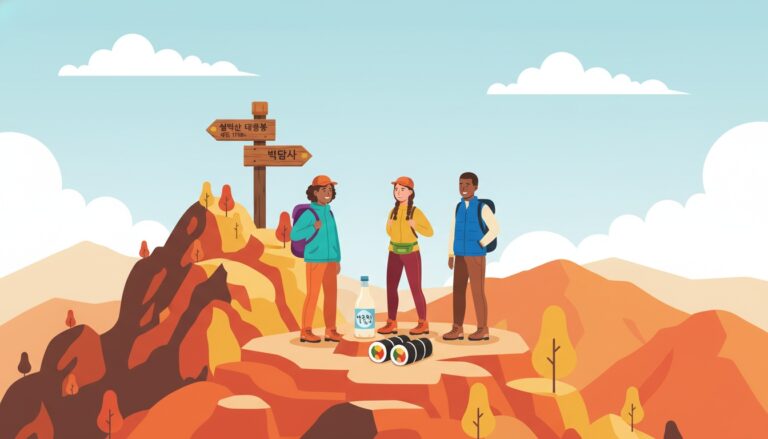
Surviving a Korean Hiking Club: Essential Phrases from the Peak to the After-Party
Introduction
Hello, this is Daily Hangul!
Are you living in Korea and looking for a way to make local friends? Or perhaps you just want to conquer the beautiful peaks of Bukhansan or Seoraksan? Joining a Deung-san Dong-ho-hoe (Hiking Club) is one of the best ways to immerse yourself in Korean culture. But be warned: Korean hiking is 50% walking and 50% socializing (and eating)!
Case Study (Synthetic Example):
This story combines experiences from several of my students. Let’s call our protagonist “Alex.” Alex joined a hiking club online. He thought he just needed strong legs. However, when he arrived, everyone was sharing food he didn’t bring, and he awkwardly refused the Dwipuri (after-party), not realizing that’s where the real bonding happens. The next week, the group chat was quiet towards him. Why? He missed the “Nunchi” (social sense).
Textbooks teach you how to say “The mountain is high.” But they don’t teach you how to ask for a break without sounding weak, or how to navigate the intense peer pressure of the post-hike dinner. Let’s fix that today.
At a Glance
- Today’s Expressions: Essential phrases for joining, resting, and socializing.
- Safety Level: Polite/Casual mix (Suitable for new club members).
- Difficulty: B2 (Intermediate) – Focuses on social nuance rather than just grammar.
Table of Contents
- Today’s Key Expressions Deep Dive
- Textbook vs. Real Korean
- Unique Analysis: The “After-Party” Pressure Gauge
- Real-Life Role Play
- Shadowing Challenge
- FAQ
- Wrap-up & Quiz
Today’s Key Expressions Deep Dive
1. 등린이예요 (I’m a hiking newbie)
- Expression: 등린이예요 / Deung-rin-i-ye-yo
- Meaning: I am a hiking beginner.
- Origin: 등산 (Hiking) + 어린이 (Child/Kid).
- Usage & Register:
- To whom: Club members, new friends.
- Tone:
해요체(Polite informal). It sounds humble and cute.
- Tutor’s Secret Note:
- Koreans love humility. Even if you are good at hiking, calling yourself a Deung-rin-i lowers expectations and makes people want to help you (give you snacks/water).
- Warning: Do not use this in a formal business meeting unless you are making a joke.
- Pronunciation Clinic:
- [등니니] (Deung-ni-ni): Because of nasalization, the ‘ㄹ’ often sounds softer, almost like an ‘n’ sound when flowing fast, or a soft ‘r/l’. Focus on Deung-Ri-Ni clearly first.
- Examples:
- (Self-intro) 안녕하세요, 저는 등린이예요. 잘 부탁드려요.
- Annyeonghaseyo, jeoneun deungriniyeyo. Jal butakdeuryeoyo. (Hello, I’m a hiking newbie. Please look after me.)
- (Struggling) 제가 등린이라서 조금 느려요.
- Jega deungriniraseo jogeum neuryeoyo. (I’m a bit slow because I’m a hiking beginner.)
- (Buying gear) 등린이한테 좋은 신발 추천해 주세요.
- Deungrinihante joeun sinbal chucheonhae juseyo. (Please recommend good shoes for a hiking beginner.)
- (Self-intro) 안녕하세요, 저는 등린이예요. 잘 부탁드려요.
- Alternatives:
- More Formal: 등산 초보입니다. (I am a hiking novice.)
- More Casual: 나 완전 산 알못이야. (I know nothing about mountains.)
- Mini Quiz:
- Q: If you want to say “I am a cooking beginner,” you can say “___린이예요.”
Click to see answer
요린이 (Yo-rin-i / Yorisa + Eorini)
- Q: If you want to say “I am a cooking beginner,” you can say “___린이예요.”
2. 정상까지 얼마나 남았어요? (How far to the peak?)
- Expression: 정상까지 얼마나 남았어요? / Jeongsang-kkaji eolmana namasseoyo?
- Meaning: How much is left until the summit?
- Usage & Register:
- To whom: Passing hikers, your group leader.
- Tone:
해요체(Polite informal).
- Tutor’s Secret Note:
- The Great Lie: If you ask a descending hiker this question, 99% will answer: “거의 다 왔어요!” (Almost there!). Do not trust this. It usually means “You have 30 more minutes of pain.”
- Pronunciation Clinic:
- [얼마나]: Stress the second syllable ‘ma’.
- [나마써요]: The final consonant ‘ㅆ’ carries over to the next vowel.
- Examples:
- (Exhausted) 정상까지 얼마나 남았어요?
- Jeongsang-kkaji eolmana namasseoyo? (How much further to the peak?)
- (Planning) 여기서 정상까지 얼마나 걸려요?
- Yeogiseo jeongsang-kkaji eolmana geollyeoyo? (How long does it take from here to the peak?)
- (Checking map) 아직 많이 남았나요?
- Ajik mani namannayo? (Is there still a lot left?)
- (Exhausted) 정상까지 얼마나 남았어요?
- Alternatives:
- Casual: 아직 멀었어? (Is it still far?)
- Context: 다 와 가요? (Are we almost there?)
- Mini Quiz:
- Q: Fill in the blank: “_______ (Summit) is beautiful!”
Click to see answer
정상 (Jeongsang)
- Q: Fill in the blank: “_______ (Summit) is beautiful!”
3. 뒷풀이 가실 거죠? (You’re going to the after-party, right?)
- Expression: 뒷풀이 가실 거죠? / Dwit-pu-ri gasil geojyo?
- Meaning: You are going to the after-party (social gathering), right?
- Usage & Register:
- To whom: Other members.
- Tone:
해요체with a persuasive nuance (-죠).
- Tutor’s Secret Note:
- Dwipuri is where the actual networking happens. It usually involves Pajeon (Green onion pancake) and Makgeolli (Rice wine). If you say no, people might think you didn’t enjoy the hike or don’t want to be friends. Try to go at least once!
- Pronunciation Clinic:
- [뒤푸리/Dwi-pu-ri]: The ‘ㅅ’ in 뒷 becomes a ‘t’ sound (stopping), but often blends into the next ‘p’ making it tense. Pronounce it crisply.
- Examples:
- (Asking) 오늘 뒷풀이 가실 거죠?
- Oneul dwitpuri gasil geojyo? (You’re going to the after-party today, right?)
- (Cheering) 뒷풀이 때 맛있는 거 먹어요!
- Dwitpuri ttae masinneun geo meogeoyo! (Let’s eat something delicious at the after-party!)
- (Declining) 저는 선약이 있어서 뒷풀이는 못 가요.
- Jeoneun seonyagi isseoseo dwitpurineun mot gayo. (I have a prior engagement, so I can’t go to the after-party.)
- (Asking) 오늘 뒷풀이 가실 거죠?
- Alternatives:
- Direct: 끝나고 술 한잔 해요? (Shall we have a drink after finishing?)
- Formal: 회식 참석하시나요? (Are you attending the team dinner? – usually for work)
- Mini Quiz:
- Q: Arrange the words: [거죠 / 가실 / 뒷풀이]
Click to see answer
뒷풀이 가실 거죠?
- Q: Arrange the words: [거죠 / 가실 / 뒷풀이]
Textbook vs. Real Korean
| Context | Textbook Korean (Book Korean) | Real Korean (Spoken/Slang) | Situation Checklist |
|---|---|---|---|
| Saying you are new | 등산은 처음입니다. (It is my first time hiking.) | 등린이라서 잘 못 타요. (I’m a hiking kid so I’m not good at it.) | Use Real Korean to sound friendly and modest. |
| Asking for a break | 잠시 휴식을 취합시다. (Let’s take a rest.) | 좀 쉬었다 가요! / 당 떨어졌어요. (Let’s rest a bit / My sugar dropped.) | “Sugar dropped” implies you need a snack break immediately. |
Unique Analysis: The “After-Party” Refusal Thermometer
In Korea, rejecting a Dwipuri can be tricky. Here is how to reject based on your relationship distance.
| Level | Expression (Korean/Romanized) | Tone/Nuance | When to use |
|---|---|---|---|
| 1 (Cold) | 안 가요. (An gayo.) | Direct, blunt. Might hurt feelings. | Only if you are angry or never want to see them again. |
| 2 (Polite) | 오늘은 좀 피곤해서요. (Oneureun jom pigonhaeseoyo.) | Soft excuse. | Standard rejection. Polite but creates distance. |
| 3 (Warm) | 너무 가고 싶은데, 선약이 있어요. (Neomu gago sipeunde, seonyagi isseoyo.) | “I really want to, but I have plans.” | Shows you like them but can’t go. Maintiains friendship. |
| 4 (Best) | 1차만 갔다가 가도 될까요? (Ilchaman gattaga gado doelkkayo?) | “Can I just go for the first round?” | Shows maximum effort. You will eat, then leave before heavy drinking. |
Real-Life Role Play
Scenario: Saturday morning, 9:00 AM at the entrance of Bukhansan National Park. The hiking club is meeting up.
Characters:
* Minji (Leader): Experienced hiker, energetic.
* Alex (You): Foreigner, first time joining.
Dialogue:
Minji: 안녕하세요! 혹시 ‘산타’ 동호회 회원님이세요?
(Annyeonghaseyo! Hoksi ‘Santa’ donghohoe hoewonnimiseyo?)
Hello! Are you perhaps a member of the ‘Santa’ club?Alex: 네, 맞아요! 저 오늘 처음 왔어요. 등린이예요.
(Ne, majayo! Jeo oneul cheoeum wasseoyo. Deungriniyeyo.)
Yes, that’s right! I came for the first time today. I’m a hiking newbie.Minji: 반가워요! 걱정 마세요. 오늘 코스 쉬워요. 정상까지 2시간이면 가요.
(Bangawoyo! Geokjeong maseyo. Oneul koseu swiwoyo. Jeongsang-kkaji dusiganimyeon gayo.)
Nice to meet you! Don’t worry. Today’s course is easy. It takes 2 hours to the peak.Alex: 아, 다행이네요. 열심히 따라갈게요!
(A, dahaengineyo. Yeolsimhi ttaragalgeyo!)
Ah, that’s a relief. I’ll follow diligently!Minji: 네, 그리고 이따가 뒷풀이 가실 거죠? 파전에 막걸리 예약해 뒀어요.
(Ne, geurigo ittaga dwitpuri gasil geojyo? Pajeone makgeolli yeyakae dwosseoyo.)
Yes, and you’re going to the after-party later, right? I reserved Pajeon and Makgeolli.Alex: 그럼요! 등산은 뒷풀이 때문에 하는 거죠.
(Geureomyo! Deungsaneun dwitpuri ttaemune haneun geojyo.)
Of course! Hiking is done for the sake of the after-party.
💡 Culture Tip:
Notice Alex’s last sentence? Saying “Hiking is for the after-party” is a classic Korean dad joke/social joke that instantly breaks the ice!
Shadowing & Speaking Challenge
Instructions: Listen to the script (imagine the rhythm) and repeat 3 times. Focus on the intonation.
Script:
“저 등린이라서 천천히 가야 해요. 정상에서 김밥 먹을까요?”
(Jeo deungrini-raseo cheoncheonhi gaya haeyo. Jeongsang-eseo gimbap meogeulkkayo?)
- [ ] First Try (Slowly check pronunciation)
- [ ] Second Try (Normal speed)
- [ ] Third Try (With emotion – pretend you are out of breath!)
Pronunciation Point:
* 김밥 (Gimbap): Make sure to pronounce the ‘m’ (ㅁ) and ‘p’ (ㅂ) distinctly. It’s not “Gim-bap” (English style), but tight lips. [Gim-ppap] is often how it sounds naturally due to tensification.
FAQ (Frequently Asked Questions)
Q1: Can I use “등린이” (Deungrini) with my boss?
A: Generally, no. Words ending in ~린이 (child) are slang. If your boss is very young and casual, maybe. But with a senior executive, stick to “등산 초보입니다” (I am a hiking novice).
Q2: What should I bring to a hiking club?
A: In Korea, sharing is caring. Bring small snacks like chocolates, cherry tomatoes, or cucumbers to share. Say “하나 드세요” (Please have one) to break the ice.
Q3: What if I really hate Makgeolli (Rice Wine)?
A: You can still go to the Dwipuri! Just say “저는 술을 못 마셔서 사이다 마실게요.” (I can’t drink alcohol, so I’ll drink cider/soda). Participation is more important than the alcohol itself.
Wrap-up & Action Item
Summary: Today we learned how to humblebrag as a 등린이, ask about the 정상 (peak), and navigate the 뒷풀이 (after-party) pressure.
Today’s Mission:
Next time you walk up a hill or stairs, take a selfie and post it on social media with the caption: “오늘도 열심히! 나는야 등린이.” (Working hard today too! I am a hiking newbie.)
Question for you:
What is your favorite snack to eat while hiking? Tell me in the comments!
Final Quiz
- Which word means “Hiking Beginner” using slang?
A) 등산가 (Deungsanga)
B) 등린이 (Deungrini)
C) 산신령 (Sansinryeong) -
When someone asks “뒷풀이 가실 거죠?” what is the most polite/warm way to decline?
A) 싫어요. (I hate it.)
B) 안 가요. (I’m not going.)
C) 가고 싶은데 선약이 있어요. (I want to go, but I have plans.) -
Fill in the blank:
“________까지 얼마나 남았어요?” (How far to the peak?)
Answer Key:
1. B
2. C
3. 정상 (Jeongsang)
Frequently Asked Questions (FAQ)
Q: What does "등린이예요 (I'm a hiking newbie)" mean in Korean and how do you pronounce it?
A: In Korean, "등린이예요 (I'm a hiking newbie)" is pronounced [see lesson guide] and means: I am a hiking beginner.
Q: What does "정상까지 얼마나 남았어요? (How far to the peak?)" mean in Korean and how do you pronounce it?
A: In Korean, "정상까지 얼마나 남았어요? (How far to the peak?)" is pronounced [see lesson guide] and means: How much is left until the summit?
Q: What does "뒷풀이 가실 거죠? (You're going to the after-party, right?)" mean in Korean and how do you pronounce it?
A: In Korean, "뒷풀이 가실 거죠? (You're going to the after-party, right?)" is pronounced [see lesson guide] and means: You are going to the after-party (social gathering), right?







