

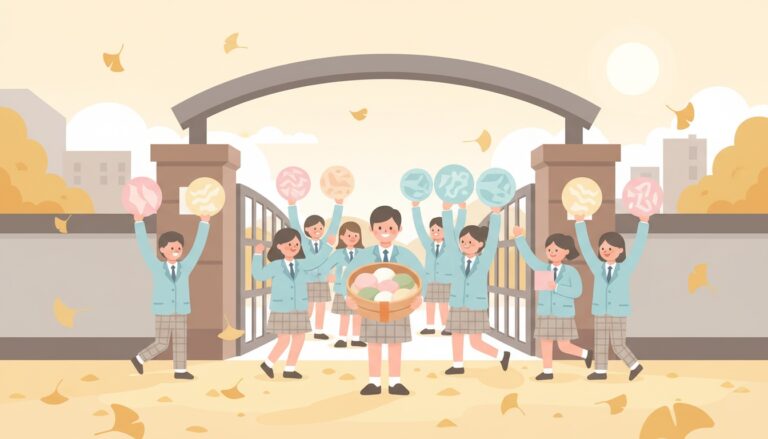
Survived the Suneung Fever? How to Cheer in Korean like a Local
Introduction
Hello, this is Daily Hangul!
Have you ever heard of a day in Korea when airplanes are grounded to keep the skies quiet? Or when police cars escort students to school? This is the day of Suneung (수능), the College Scholastic Ability Test (CSAT). It’s more than just an exam; it is a massive cultural event.
Episode: The Wall of Noise
(Note: This is a synthetic case study combining common experiences of foreigners in Korea during November.)
Mark, an English teacher in Seoul, was startled one cold November morning by loud drumming and chanting outside a high school. He thought it was a protest. In reality, it was junior students (hubae) cheering for their seniors (sunbae) entering the exam hall. He wanted to join in but only knew “Hello.” He felt awkward standing there silently while everyone shouted with passion.
Textbooks teach you “Good luck” is “Haeng-un-eul bim-ni-da” (행운을 빕니다). But if you say that at a high-energy cheering line, you might sound like a robot from the 1990s. Today, we will learn the real cheering squad energy.
At a Glance: Today’s Cheering Kit
- Target Audience: Friends, students, or anyone facing a big challenge.
- Difficulty: B1 (Intermediate) – Easy words, but context is key.
- Key Expressions:
- Hwaiting / Paiting (Universal energy booster)
- Daebak naseyo (Wishing for a miracle result)
- Jal jjigeuseyo (A witty, realistic wish)
Table of Contents
- Today’s Key Expressions Deep Dive
- Textbook vs. Real Korean
- Cultural Analysis: The “Sticky” Superstition
- Real-Life Role Play: The School Gate
- Shadowing Challenge
- FAQ & Wrap-up
Today’s Key Expressions Deep Dive
1. 파이팅 / 화이팅 (Paiting / Hwaiting)
- Meaning: Come on! / You can do it! / Let’s go!
- Context: Used everywhere. Sports, exams, tough workdays.
- Tutor’s Secret Note: Originally from the English word “Fighting,” but it has no aggressive meaning in Korea. It strictly means “Cheer up” or “Go for it.” Younger generations often write it as 화이팅 (Hwaiting), but standard orthography is 파이팅 (Paiting). Both are accepted in casual speech.
- Pronunciation Clinic: Don’t bite your lip for ‘F’. Pronounce it closer to a ‘P’ or a soft ‘H’.
- ❌ Fff-ighting
- ⭕ Pa-i-ting or Hwa-i-ting
Examples:
* Friends: 야, 긴장하지 말고 파이팅! (Ya, ginjanghaji malgo paiting!) – Hey, don’t be nervous, fighting!
* Self-talk: 오늘도 화이팅 하자. (Oneuldo hwaiting haja.) – Let’s do our best today too.
* Cheering Squad: 선배님, 파이팅! (Seonbaenim, paiting!) – Senior, you can do it!
2. 대박 나세요 (Daebak naseyo)
- Meaning: Hit the jackpot! / I hope you get an amazing result.
- Context: Originally for businesses opening, now used for exams to wish for a score higher than expected.
- Tutor’s Secret Note: “Daebak” (Great/Big success) is casual, but adding “-naseyo” makes it polite enough for seniors or acquaintances. It implies, “I hope your result is shockingly good.”
- Pronunciation Clinic: ‘D’ is soft (t), and ‘k’ at the end is an unreleased stop (don’t say Daeba-ku).
Examples:
* Exam: 이번 시험 대박 나세요! (Ibeon siheom daebak naseyo!) – Hit the jackpot on this exam!
* Business: 사장님, 대박 나세요. (Sajangnim, daebak naseyo.) – Boss (Shop owner), I hope your business booms.
* Casual: 너 이번에 진짜 대박이다. (Neo ibeone jinjja daebakida.) – You are seriously awesome/lucky this time.
3. 잘 찍으세요 (Jal jjigeuseyo)
- Meaning: Guess well! (Literally: Pick well)
- Context: A humorous and practical wish. Since exams are multiple-choice, if you don’t know the answer, you have to “guess” (jjikda).
- Tutor’s Secret Note: This is very Korean humor. Instead of vaguely saying “do well,” we realistically hope that even your random guesses turn into correct answers.
- Warning: Only use this with close friends or in a light-hearted cheering context. Don’t say this to a very strict professor!
Examples:
* To a Senior: 모르는 문제도 잘 찍으세요! (Moreuneun munjedo jal jjigeuseyo!) – Even for problems you don’t know, guess well!
* Casual: 정답만 콕콕 찍어! (Jeongdamman kokkok jjigeo!) – Pick only the correct answers!
* Role Play: 찍신이 강림하길… (Jjiksini gangnimhagil…) – May the God of Guessing descend upon you…
💡 Alternative Expressions
- More Formal: 좋은 결과 있으시길 바랍니다. (Joeun gyeolgwa isseusigil baramnida.) – I hope you have good results.
- More Casual: 시험 잘 봐! (Siheom jal bwa!) – Take the test well!
Mini Quiz: Click to reveal answer
Q. Which phrase is best to say humorously when someone doesn’t know the answer?
A) 화이팅 (Hwaiting)
B) 잘 찍으세요 (Jal jjigeuseyo)
C) 감사합니다 (Gamsahamnida)
Answer: B) 잘 찍으세요 (Jal jjigeuseyo)
Textbook vs. Real Korean
| Feature | Textbook / Formal | Real Korean / Survival |
|---|---|---|
| Context | Writing a formal card | Shouting at the school gate |
| Expression | 행운을 빕니다 (Haeng-un-eul bim-ni-da) Meaning: I wish you luck. |
딱 붙으세요! (Ttak buteuseyo!) Meaning: Stick (pass) tightly! |
| Feeling | Dry, polite, distant | Energetic, vivid, supportive |
| When to use | To a distant colleague or stranger | To friends, seniors (Sunbae), family |
Cultural Analysis: The “Sticky” Superstition
Why do Koreans give Sticky Rice Cakes (Chapsaltteok / 찹쌀떡) or Taffy (Yeot / 엿) before exams?
The “Stick” vs. “Slide” Theory
| Object | Korean Verb | Meaning | Exam Omen |
|---|---|---|---|
| Sticky Rice Cake | 붙다 (Butda) | To stick / To pass an exam | GOOD 🟢 (You will stick to the university) |
| Seaweed Soup | 미끄러지다 (Mikkeureojida) | To slide / To slip | BAD 🔴 (You will slip/fail the exam) |
- Tip: Never give seaweed soup (miyeok-guk) on exam day. Give chocolate, sticky rice cakes, or a fork (to “pick/stab” the right answers)!
Real-Life Role Play: The School Gate
Situation: Early morning at the school gate. Minji (Junior) is cheering for Hyun-woo (Senior) who is walking in to take the CSAT.
Minji: 선배님! 여기요! (Seonbaenim! Yeogiyo!)
Senior! Over here!
Hyun-woo: 오, 민지야. 여기까지 왔어? (O, Minji-ya. Yeogikkaji wasseo?)
Oh, Minji. You came all the way here?
Minji: 당연하죠. 이거 드세요. 찹쌀떡이에요. (Dangyeonhajyo. Igeo deuseyo. Chapsaltteogieyo.)
Of course. Please eat this. It’s sticky rice cake.
Hyun-woo: 고마워. 긴장되네. (Gomawo. Ginjangdoene.)
Thanks. I’m nervous.
Minji: 긴장하지 마세요! 그리고 모르면 잘 찍으세요! (Ginjanghaji maseyo! Geurigo moreumyeon jal jjigeuseyo!)
Don’t be nervous! And if you don’t know, guess well!
Hyun-woo: 하하, 알겠어. (Haha, algesseo.)
Haha, got it.
Minji: 수능 대박! 화이팅! (Suneung daebak! Hwaiting!)
Hit the jackpot on the Suneung! Fighting!
Shadowing Challenge 🎤
Imagine you are in the cheering crowd. Repeat this 3 times to get the rhythm.
“선배님, 긴장 풀고 대박 나세요! 화이팅!”
(Seonbaenim, ginjang pulgo daebak naseyo! Hwaiting!)
“Senior, relax and hit the jackpot! Fighting!”
- [ ] Attempt 1 (Slow)
- [ ] Attempt 2 (Normal speed)
- [ ] Attempt 3 (Cheering squad volume!)
👄 Pronunciation Point:
Link the sounds in 대박 나세요. It sounds like [대방나세요] (Daebang-naseyo) due to nasal assimilation. It flows smoother!
FAQ (Frequently Asked Questions)
Q1: Can I say “Fighting” to my boss before a big meeting?
Yes, but add “Sibsiyo” or “Haseyo” to be polite, or just say “Jal butak deurimnida” (Please take care of it). However, a simple “Hwaiting!” with a smile is often accepted in modern friendly offices. For a strict boss, use: “좋은 결과 있으시길 바랍니다” (I hope for good results).
Q2: What is the literal meaning of “Suneung”?
It is short for 수학 능력 시험 (College Scholastic Ability Test). It’s the most important test in a Korean student’s life.
Wrap-up & Mission
Today we learned how to cheer for someone taking a big exam in Korea. Remember, it’s not just about words; it’s about the energy you project!
📅 Today’s Mission:
If you have a friend who is stressed about a test or a job interview, send them a message: “긴장하지 말고 대박 나! 화이팅!” (Don’t be nervous and hit the jackpot! Fighting!)
Question for you:
Does your country have a specific food you eat (or avoid) before exams? Tell me in the comments!
Final Quiz
Click to start the quiz!
1. What does “Daebak” mean in this context?
A) Big failure
B) Awesome success / Jackpot
C) Spicy food
2. Why do Koreans give sticky rice cakes (Chapsaltteok) before exams?
A) They are delicious.
B) So the answers “stick” to you.
C) To make you thirsty.
3. Fill in the blank: If you don’t know the answer, ______ well!
(Korean: 잘 ______세요!)
A) 찍으 (jjigeu – guess)
B) 먹으 (meogeu – eat)
C) 자 (ja – sleep)
Answers: 1-(B), 2-(B), 3-(A)
Frequently Asked Questions (FAQ)
Q: What does "파이팅 / 화이팅 (Paiting / Hwaiting)" mean in Korean and how do you pronounce it?
A: In Korean, "파이팅 / 화이팅 (Paiting / Hwaiting)" is pronounced [Clinic: Don't bite your lip for 'F'. Pronounce it closer to a 'P' or a soft 'H'.] and means: Come on! / You can do it! / Let's go!
Q: What does "대박 나세요 (Daebak naseyo)" mean in Korean and how do you pronounce it?
A: In Korean, "대박 나세요 (Daebak naseyo)" is pronounced [Clinic: 'D' is soft (t] and means: Hit the jackpot! / I hope you get an amazing result.
Q: What does "잘 찍으세요 (Jal jjigeuseyo)" mean in Korean and how do you pronounce it?
A: In Korean, "잘 찍으세요 (Jal jjigeuseyo)" is pronounced [see lesson guide] and means: Guess well! (Literally: Pick well)







