

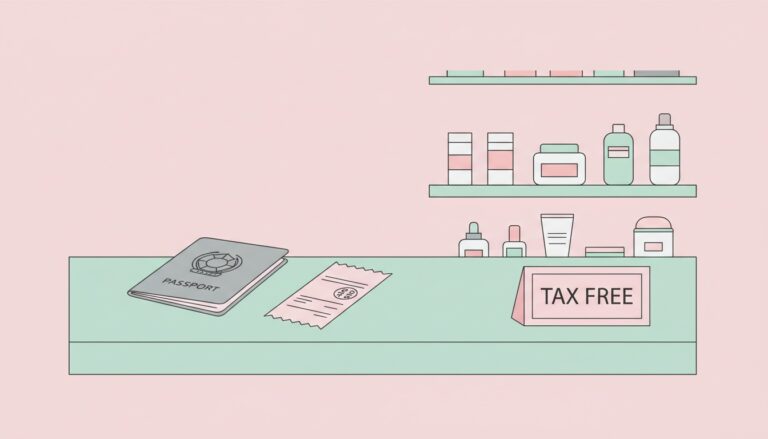
Shopping in Korea? Don’t Miss Your Refund! 🛍️ Essential Phrases for Tax-Free Shopping
Introduction
Hello, this is Daily Hangul!
Whether you are sweeping through Myeongdong for the latest skincare products or visiting a department store in Gangnam, there is one magic word that saves you money: Tax Refund.
Imagine you just bought a basket full of sheet masks and serums. You know you can get money back, but the clerk is moving fast, there’s a line behind you, and you panic. Do you just say “Tax?” or show your passport silently?
Note: This episode is based on a Synthetic Case compiled from frequently asked questions by students who traveled to Seoul. Many learners feel nervous about holding up the line and end up skipping their refund.
Textbooks often teach formal banking terms, but in a busy cosmetics shop, speed and clarity are key. Today, we will learn how to claim your rights confidently without slowing down the queue!
At a Glance: Today’s Menu
- Target Level: A2 (High Beginner) – Essential for saving money during travel.
- Safe Zone: Any retail store (Cosmetics, Clothing, Marts).
- Key Expressions:
- 면세 되나요? (Is tax-free available?)
- 여권 보여주세요. (Please show me your passport – Listening)
- 영수증 주세요. (Please give me the receipt.)
Table of Contents
- Today’s Core Expressions: Deep Dive
- Textbook vs. Real Korean
- Unique Analysis: The “Tax-Free” Process in Korea
- Real-Life Role Play: At the Counter
- Shadowing Challenge
- FAQ
- Final Quiz
Today’s Core Expressions: Deep Dive
1. 면세 되나요? (Myeon-se doe-na-yo?)
- Meaning (English): Is tax-free available? / Can I get a tax refund?
- Usage & Register:
- To whom: Store clerks.
- Style: Polite informal (Haeyo-che / 해요체).
- Tutor’s Secret Note:
- In Korea, “Tax Free” and “Tax Refund” are often grouped under the word 면세 (Myeon-se) in casual conversation. While myeon-se technically means “duty-free,” shops understand it as the tax refund service for tourists.
- Warning: Don’t just shout “Tax!” It can sound rude. Adding “-yo” at the end softens it instantly.
- Pronunciation Clinic:
- 면 (Myeon): Pronounce it like the ‘myon’ in ‘Myeongdong’.
- 세 (Se): Sharp ‘S’ sound, not ‘Z’.
- Examples:
- (Travel) 여기 면세 되나요? (Yeo-gi myeon-se doe-na-yo?) – Is tax-free available here?
- (Shopping) 이거 사면 면세 되나요? (I-geo sa-myeon myeon-se doe-na-yo?) – If I buy this, is it tax-free?
- (Clarification) 바로 면세 되나요? (Ba-ro myeon-se doe-na-yo?) – Is it an immediate tax refund? (Deducted right now?)
- Alternatives:
- Casual: 텍스 프리 돼요? (Tek-seu-peu-ri doe-yo?) – Is Tax Free okay? (Uses English loanword)
- Formal: 세금 환급 가능해요? (Se-geum hwan-geup ga-neung-hae-yo?) – Is tax refund possible?
- Mini Quiz:
- Q. Fill in the blank: ______ 되나요? (Is tax-free available?)
-
Click to see answer
면세 (Myeon-se)
2. 여권 있어요? (Yeo-gwon iss-eo-yo?)
- Meaning (English): Do you have your passport?
- Usage & Register:
- Context: This is usually a question the clerk asks you, or you stating you have it.
- Tutor’s Secret Note:
- You cannot get a tax refund without your physical passport (or sometimes a scanned QR code in specific apps, but physical is safest). If the clerk asks this, they are ready to process your refund.
- Pronunciation Clinic:
- 여권 (Yeo-gwon): The ‘gw’ sound is like ‘Guam’. It is often pronounced tightly as [여꿘 yeo-kkwon] by native speakers due to tensing rules.
- Examples:
- (Response) 네, 여권 있어요. (Ne, yeo-gwon iss-eo-yo.) – Yes, I have my passport.
- (Mistake) 아, 여권 없어요. (Ah, yeo-gwon eops-eo-yo.) – Ah, I don’t have my passport.
- (Question) 여권 필요해요? (Yeo-gwon pil-yo-hae-yo?) – Do I need a passport?
- Alternatives:
- Phrase: 여권 보여주세요. (Yeo-gwon bo-yeo-ju-se-yo.) – Please show me your passport. (Clerk’s phrase)
- Mini Quiz:
- Q. Meaning of ‘Yeo-gwon’ (여권)?
-
Click to see answer
Passport
3. 얼마 이상 사야 해요? (Eol-ma i-sang sa-ya hae-yo?)
- Meaning (English): How much do I need to buy (to get the refund)?
- Usage & Register:
- To whom: Clerk, when you are unsure of the minimum spending limit.
- Tutor’s Secret Note:
- Usually, the minimum is 30,000 KRW (approx $23 USD). Use this phrase if you are close to that amount and want to check.
- Pronunciation Clinic:
- 이 (I): Short ‘ee’.
- 상 (Sang): Soft ‘s’.
- Examples:
- (Checking limit) 면세 받으려면 얼마 이상 사야 해요? (Myeon-se bad-eu-ryeo-myeon eol-ma i-sang sa-ya hae-yo?) – To get tax-free, how much must I buy?
- (Simple) 삼만 원 이상이에요? (Sam-man won i-sang-i-e-yo?) – Is it over 30,000 won?
- Alternatives:
- Simple: 최소 금액이 얼마예요? (Choe-so geum-aek-i eol-ma-ye-yo?) – What is the minimum amount?
- Mini Quiz:
- Q. Fill in the blank: ______ 이상 (Over/More than how much?)
-
Click to see answer
얼마 (Eol-ma)
Textbook vs. Real Korean
| Feature | Textbook Korean (Book) | Real Korean (Street) |
|---|---|---|
| The Phrase | 세금 환급이 가능합니까? (Se-geum hwan-geup-i ga-neung-hap-ni-kka?) | 면세 돼요? (Myeon-se doe-yo?) |
| The Tone | Very formal, like a news anchor or bank teller. | Quick, efficient, friendly. |
| Asking Limit | 최소 구매 금액은 얼마입니까? (Choe-so gu-mae geum-aek-eun eol-ma-ip-ni-kka?) | 얼마부터 돼요? (Eol-ma bu-teo doe-yo?) |
Tutor’s Tip: In a busy Olive Young or convenience store, using the “Real Korean” phrases will make the interaction much faster. The clerks appreciate the brevity!
Unique Analysis: The “Refund” Types
In Korea, there are two types of Tax Refunds. Knowing the difference helps you understand the clerk’s response.
| Type | Korean Term | What Happens | Your Action |
|---|---|---|---|
| Immediate | 즉시 환급 (Jeuk-si Hwan-geup) | Tax is deducted before you pay. | Show passport at the counter. Pay less instantly. |
| Post-Refund | 사후 환급 (Sa-hu Hwan-geup) | You pay full price first. | Get a receipt (Global Tax Free slip) -> Scan it at the airport kiosk to get cash back. |
- Scenario: If the clerk says “Passport?” and types something, it’s likely Immediate. If they hand you a receipt and say “Airport,” it’s Post-Refund.
Real-Life Role Play
Situation: You are at a cosmetics store in Hongdae. You are buying creams totaling 35,000 KRW.
Clerk: 봉투 필요하세요? (Bong-tu pil-yo-ha-se-yo?)
Do you need a bag?
You: 네, 주세요. 아, 혹시 면세 되나요? (Ne, ju-se-yo. Ah, hok-si myeon-se doe-na-yo?)
Yes, please. Ah, by the way, is tax-free available?
Clerk: 네, 가능해요. 여권 보여주세요. (Ne, ga-neung-hae-yo. Yeo-gwon bo-yeo-ju-se-yo.)
Yes, it is. Please show me your passport.
You: 여기요. 바로 할인되나요? (Yeo-gi-yo. Ba-ro hal-in-doe-na-yo?)
Here you go. Is the discount immediate?
Clerk: 네, 즉시 환급 도와드릴게요. 3만 2천 원입니다. (Ne, jeuk-si hwan-geup do-wa-deu-ril-ge-yo. Sam-man i-cheon-won-ip-ni-da.)
Yes, I’ll help you with the immediate refund. It’s 32,000 won.
Shadowing & Speaking Challenge
Let’s practice! Read this aloud 3 times to get used to the speed.
“이거 면세 되나요? 여권 있어요!”
(I-geo myeon-se doe-na-yo? Yeo-gwon iss-eo-yo!)
- [ ] Attempt 1 (Slowly check pronunciation)
- [ ] Attempt 2 (Natural speed)
- [ ] Attempt 3 (Imagine you are in a busy line!)
Pronunciation Tip: Connect “iss-eo-yo” smoothly. It sounds like [이써요 i-sseo-yo], not it-eo-yo.
FAQ (Frequently Asked Questions)
Q1: Can I use a photo of my passport?
* Answer: Officially, no. Most shops require the physical passport to scan the chip. Always carry it if you plan to shop!
Q2: What is the minimum amount for a refund?
* Answer: Generally, you must spend over 30,000 KRW (approx $23) in one transaction at one store.
* Phrase: “3만 원 넘어야 해요.” (Sam-man won neom-eo-ya hae-yo.)
Q3: Can I combine receipts from different days?
* Answer: Usually no. It must be a single transaction over 30,000 KRW unless it is a department store customer service center that consolidates them.
Wrap-up & Action Item
Today we learned how to save money with the phrase “면세 되나요?” (Myeon-se doe-na-yo?).
Today’s Mission:
Next time you walk past a shop in Korea (or watch a Korea travel vlog), look for the “TAX FREE” logo on the window. If you spot it, whisper the phrase “여기 면세 되나요?” to yourself!
Tell me in the comments:
Have you ever forgotten to get a tax refund while traveling? 😭
Final Quiz
- Which phrase is the most natural way to ask for a tax refund at a shop?
a) 세금을 돌려주십시오. (Se-geum-eul dol-ryeo-ju-sip-si-o.)
b) 면세 되나요? (Myeon-se doe-na-yo?)
c) 돈 주세요. (Don ju-se-yo.) -
What does the clerk need to process your refund?
a) Your student ID
b) Your credit card only
c) Your passport (여권) -
Fill in the blank: “_______ 보여주세요.” (Please show me your passport.)
(Answer is a 2-syllable Korean word)
Answers:
1. b
2. c
3. 여권 (Yeo-gwon)
Frequently Asked Questions (FAQ)
Q: What does "면세" mean in Korean and how do you pronounce it?
A: In Korean, "면세" is pronounced [Myeon-se] and means: in casual conversation. While
Q: What does "면" mean in Korean and how do you pronounce it?
A: In Korean, "면" is pronounced [Myeon] and means: Pronounce it like the 'myon' in 'Myeongdong'.
Q: What does "세" mean in Korean and how do you pronounce it?
A: In Korean, "세" is pronounced [Se] and means: Sharp 'S' sound, not 'Z'.
Q: What does "여권" mean in Korean and how do you pronounce it?
A: In Korean, "여권" is pronounced [Yeo-gwon] and means: The 'gw' sound is like 'Guam'. It is often pronounced tightly as [여꿘 yeo-kkwon] by native speakers due to tensing rules.







