

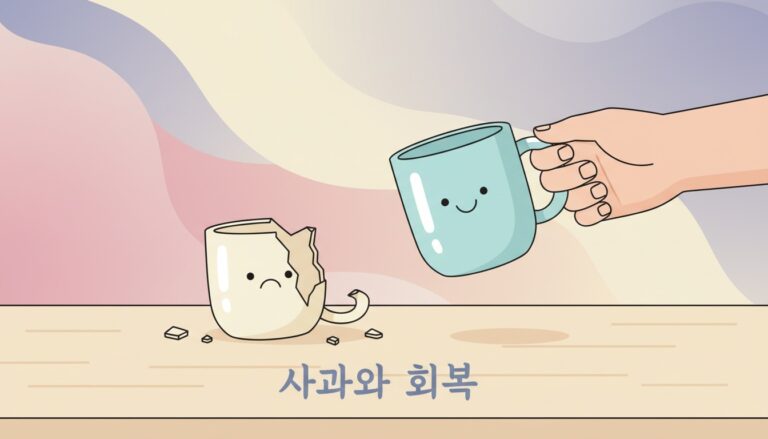
Help! I Broke a Friend’s Stuff 😱 How to Apologize & Offer Compensation in Korean
Introduction
Hello, this is Daily Hangul!
Have you ever borrowed a pen, an umbrella, or even a charger from a Korean friend or colleague, only to accidentally break it or lose it? It’s a moment of pure panic. Your heart drops, and you wonder, “Is a simple ‘Sorry’ (Mianhae) enough?”
Since no specific user story was submitted for this topic today, I will share a “Composite Case” based on common mistakes I’ve seen among my intermediate students over the years.
The Situation: You borrowed a co-worker’s humidifier or stapler. You dropped it, and it cracked. You said “Mianhamnida” (I’m sorry), but the atmosphere remained awkward. Why? Because in Korea, showing how you will take responsibility (action) is often more important than the apology itself.
Let’s learn how to navigate this crisis with natural Korean that restores trust immediately.
At a Glance: Today’s Summary
- Key Expressions: 4 Essential phrases for admitting fault and offering compensation.
- Safe Zone: Suitable for friends, co-workers, and acquaintances.
- Level: B1 (Intermediate). While beginner words work, these phrases add the necessary “social polish” to save relationships.
Table of Contents
- Today’s Key Expressions: Deep Dive
- Textbook vs. Real Korean
- Tone Thermometer: How Serious is it?
- Real-Life Role Play: The Broken Tumbler
- Shadowing Challenge
- FAQ
- Wrap-up & Quiz
Today’s Key Expressions: Deep Dive
1. 어떡하죠? (Eotteokhajo?)
- Meaning (English): What should I do? / Oh no! / I’m in trouble.
- Usage & Register:
- To whom: Co-workers, seniors, or people you are polite to.
- Style:
Haeyo-che(Polite informal).
- Tutor’s Secret Note:
- This isn’t really a question asking for a solution. It is an empathy marker showing that you are flustered and upset for them. If you just stand still and say “Sorry,” you seem cold. Saying this shows you share their pain.
- Warning: Do not say this while smiling nervously. It will look like you don’t care.
- Pronunciation Clinic:
- [어떠카죠] (Eotteokajo): The
ㄱandㅎcombine to make a strongㅋsound.
- [어떠카죠] (Eotteokajo): The
- Examples:
- 어떡하죠? 제가 실수로 깼어요. (Eotteokhajo? Jega silsuro kkaesseoyo.) – Oh no, I broke it by mistake.
- 큰일 났네요, 어떡하죠? (Keunil nanneyo, eotteokhajo?) – We have a big problem, what should I do?
- 어떡하죠? 작동이 안 돼요. (Eotteokhajo? Jakdong-i an dwaeyo.) – Oh no, it’s not working.
- Alternatives:
- Formal: 어쩌면 좋습니까? (Eojjeomyeon joseumnikka?)
- Casual: 어떡해? (Eotteokhae?)
Mini Quiz (Click to see answer)
Q. When you drop your boss’s phone, what is the first reaction sound?
A. 어떡하죠? (Eotteokhajo?)
2. 제가 실수로 ~했어요 (Jega silsuro ~haesseoyo)
- Meaning (English): I did ~ by mistake / It was my mistake that ~.
- Usage & Register:
- To whom: Anyone (Standard polite).
- Style: Essential for explaining the cause without making excuses.
- Tutor’s Secret Note:
- Adding 실수로 (silsuro) is crucial. Without it, “제가 깼어요” (I broke it) sounds like you did it on purpose. This adverb softens the blow significantly.
- Pronunciation Clinic:
- 실수로 [실쑤로] (Sil-ssu-ro): The
ㅅoften sounds tense/stronger.
- 실수로 [실쑤로] (Sil-ssu-ro): The
- Examples:
- 제가 실수로 떨어뜨렸어요. (Jega silsuro tteoreotteuryeosseoyo.) – I dropped it by mistake.
- 제가 실수로 물을 쏟았어요. (Jega silsuro mureul ssodasseoyo.) – I spilled water by mistake.
- 제가 실수로 다른 걸 가져왔어요. (Jega silsuro dareun geol gajyeowasseoyo.) – I brought the wrong one by mistake.
- Alternatives:
- More ownership: 제 불찰입니다. (Je bulcharimnida. – It is my negligence/fault. -> Very formal/Business)
- Casual: 내가 실수했어. (Naega silsuhaesseo.)
3. 똑같은 걸로 사 드릴게요 (Ttokgateun geollo sa deurilgeyo)
- Meaning (English): I will buy/get you the same one.
- Usage & Register:
- To whom: Friends, colleagues, acquaintances.
- Style: The golden standard of compensation in daily life.
- Tutor’s Secret Note:
- Koreans value 정 (Jeong) and restitution. Even if the item is cheap, offering to replace it (“sa deurilgeyo”) makes the other person feel respected. Usually, they will say “No, it’s okay,” but you must offer it first.
- Warning: Do not just offer cash (money) immediately for small personal items; it can feel cold. Offer the item first.
- Pronunciation Clinic:
- [똑까튼] (Ttok-ka-teun):
ㄱbecomes a double sound. - [드릴께요] (Deurilkkeyo): The ending is pronounced with a strong
ㄲ.
- [똑까튼] (Ttok-ka-teun):
- Examples:
- 죄송해요. 똑같은 걸로 사 드릴게요. (Joesonghaeyo. Ttokgateun geollo sa deurilgeyo.) – I’m sorry. I’ll buy you the same one.
- 망가졌네요. 제가 똑같은 걸로 구해 올게요. (Manggajyeonneyo. Jega ttokgateun geollo guhae olgeyo.) – It’s ruined. I’ll go get the same one.
- 지금 바로 가서 똑같은 걸로 사 드릴게요. (Jigeum baro gaseo ttokgateun geollo sa deurilgeyo.) – I’ll go buy the same one right now.
- Alternatives:
- Formal: 변상해 드리겠습니다. (Byeonsanghae deurigetseumnida. – I will compensate you.)
- Casual: 똑같은 거 사 줄게. (Ttokgateun geo sa julge.)
Textbook vs. Real Korean
| Feature | Textbook / Legal Style 📘 | Real Life / Natural ☕️ |
|---|---|---|
| Expression | 변상하겠습니다. (Byeonsanghagetseumnida.) | 제가 물어낼게요 / 다시 사 드릴게요. (Jega mureonaelgeyo / Dasi sa deurilgeyo.) |
| Context | Insurance claims, car accidents, serious business damages. | Breaking a cup, losing a borrowed pen, staining a shirt. |
| Vibe | “I am legally obligated to pay.” (Cold) | “I feel terrible and want to fix this.” (Warm) |
Checklist: When to use what?
* 🚗 Car Accident: 변상 (Byeonsang)
* ☕️ Spilled Coffee on Laptop: 변상 (Byeonsang) or 수리비 드릴게요 (Suribi deurilgeyo – I’ll pay for repairs)
* 🖊 Broken Pen: 다시 사 드릴게요 (Dasi sa deurilgeyo)
Unique Analysis: The Tone Thermometer 🌡️
How much responsibility are you taking? The ending verb changes the “Temperature” of your apology.
| Level | Expression | Temperature | Note |
|---|---|---|---|
| 1 (Cold) | 미안해요. (Mianhaeyo.) | ❄️ 10°C | Polite, but feels like just words. Might seem insincere if damage is done. |
| 2 (Warm) | 어떡하죠? 정말 죄송해요. (Eotteokhajo? Jeongmal joesonghaeyo.) | 🌡️ 36.5°C | Shows empathy and regret. Good for minor mistakes. |
| 3 (Hot) | 제가 책임질게요. (Jega chaegimjilgeyo.) | 🔥 80°C | “I will take responsibility.” Strong, masculine, or leader-like vibe. |
| 4 (Boiling) | 전액 보상하겠습니다. (Jeonaek bosanghagetseumnida.) | 🌋 100°C | “I will fully compensate the amount.” Very serious/business only. |
Real-Life Role Play 🎭
Situation: You borrowed a colleague’s (Min-ji) portable fan, but you dropped it, and a blade broke.
Speaker A (You): 헉… 민지 씨, 어떡하죠? 제가 이걸 떨어뜨려서 날개가 부러졌어요.
(Heok… Minji-ssi, eotteokhajo? Jega igeol tteoreotteuryeoseo nalgaega bureojyeosseoyo.)
(Gasp… Min-ji, oh no. I dropped this and the blade broke.)
Speaker B (Min-ji): 아, 진짜요? 어디 봐요. 어? 완전히 부러졌네요.
(A, jinjjayo? Eodi bwayo. Eo? Wanjeonhi bureojyeonneyo.)
(Ah, really? Let me see. Oh? It’s completely broken.)
Speaker A (You): 정말 죄송해요. 제가 실수로 쳤어요. 지금 바로 똑같은 걸로 주문해 드릴게요.
(Jeongmal joesonghaeyo. Jega silsuro chyeosseoyo. Jigeum baro ttokgateun geollo jumunhae deurilgeyo.)
(I’m really sorry. I hit it by mistake. I’ll order the same one for you right now.)
Speaker B (Min-ji): 에이, 괜찮아요. 싼 거예요. 그냥 쓰면 돼요.
(Ei, gwaenchanayo. Ssan geoyeyo. Geunyang sseumyeon dwaeyo.)
(Hey, it’s okay. It’s cheap. I can just use it.)
Speaker A (You): 아니에요, 제 마음이 불편해서 그래요. 커피라도 한 잔 살게요.
(Anieyo, je maeumi bulpyeonhaeseo geuraeyo. Keopirado han jan salgeyo.)
(No, I feel uncomfortable/bad about it. Let me at least buy you a coffee.)
💡 Cultural Tip: Even if Min-ji says “It’s okay,” offering a small treat (coffee/snack) acts as a “social glue” to ensure there are no hard feelings.
Shadowing Challenge 🗣️
Imagine you sat on a friend’s glasses. Speak clearly!
- 어떡하죠? 못 보고 깔고 앉았어요.
(Eotteokhajo? Mot bogo kkalgo anjasseoyo.)
(Oh no! I didn’t see it and sat on it.) -
정말 죄송해요. 수리비는 제가 낼게요.
(Jeongmal joesonghaeyo. Suribineun jega naelgeyo.)
(I’m really sorry. I will pay for the repair cost.)
Checklist:
* [ ] Did you emphasize the “J” sound in 죄송 (Joesong)?
* [ ] Did you sound worried, not robotic?
* [ ] Repeat 3 times!
FAQ: Frequently Asked Questions
Q1: Can I use “물어내다” (Mureonaeda) to my boss?
* Answer: Be careful. “물어내다” sounds a bit aggressive or raw, like “I’ll pay up.” To a boss, use “변상해 드리겠습니다” (Byeonsanghae deurigetseumnida) or “새로 사 오겠습니다” (Saero sa ogetseumnida – I will go buy a new one).
Q2: What if the item is old/used? Do I still buy a new one?
* Answer: In Korean culture, replacing a broken used item with a new one is considered good manners. You can say: “새것으로 바꿔 드릴게요” (Saegeoseuro bakkwo deurilgeyo – I’ll change it to a new one for you).
Wrap-up & Action Item
Accidents happen! The key to a “Korean apology” is showing that you want to restore the situation (buy a new one/pay for it), not just say sorry.
Today’s Mission:
Next time you make a small mistake (even stepping on someone’s foot), try adding “어떡하죠? 죄송해요” instead of just “Sorry.”
Tell me in the comments:
Have you ever broken something in Korea? How did you react?
Final Quiz 📝
- Which phrase is the most natural way to say “I’ll buy you the same one” to a friend?
A) 변상할게 (Byeonsanghalge)
B) 똑같은 걸로 사 줄게 (Ttokgateun geollo sa julge)
C) 돈 줄게 (Don julge) -
What does “어떡하죠?” (Eotteokhajo?) signal in an apology?
A) You are asking for directions.
B) You are angry.
C) You are sharing the panic/empathy. -
(Fill in the blank) To say “I did it by mistake,” you say: “제가 ___로 그랬어요.”
See Answers
1. B
2. C
3. 실수 (silsu)
Frequently Asked Questions (FAQ)
Q: What does "실수로" mean in Korean and how do you pronounce it?
A: In Korean, "실수로" is pronounced [silsuro] and means: is crucial. Without it, "제가 깼어요" (I broke it) sounds like you did it on purpose. This adverb softens the blow significantly.
Q: What does "정" mean in Korean and how do you pronounce it?
A: In Korean, "정" is pronounced [Jeong] and means: and restitution. Even if the item is cheap, offering to replace it ("sa deurilgeyo") makes the other person feel respected. Usually, they will say "No, it's okay," but you
Q: What does "[드릴께요]" mean in Korean and how do you pronounce it?
A: In Korean, "[드릴께요]" is pronounced [Deurilkkeyo] and means: The ending is pronounced with a strong
Q: What does "변상" mean in Korean and how do you pronounce it?
A: In Korean, "변상" is pronounced [Byeonsang] and means: * ☕️ Spilled Coffee on Laptop:







