

Hello, this is Daily Hangul!
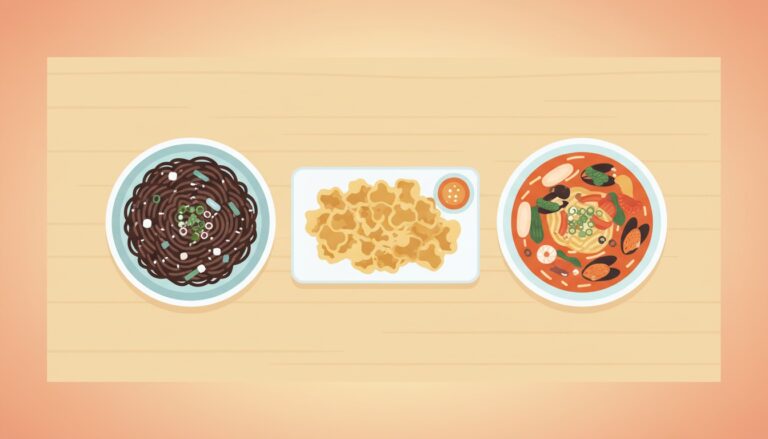
Have you ever sat down at a Korean-Chinese restaurant and felt your brain freeze? It’s not because you don’t know the words, but because you are facing the ultimate dilemma of Korean cuisine.
Composite Case Study:
Many of our intermediate learners (whom we’ll call ‘Alex’ for this example) report a specific moment of panic. The waiter is standing there with a notepad, waiting. Alex wants the savory black bean noodles (Jjajangmyeon), but the spicy seafood soup (Jjamppong) at the next table smells amazing. Alex hesitates, starts sweating, and eventually just points at a picture.
In Korea, choosing between these two is almost a personality test. Today, we will learn how to express this dilemma, how to solve it, and the cultural debate that divides the nation: the sauce pouring style.
Summary at a Glance
- Key Expressions: 고민하다 (To hesitate/debate), 반반 (Half and half), 찍먹 vs 부먹 (Dipping vs Pouring).
- Safe Usage: Casual dining, lunch with coworkers, or ordering delivery with friends.
- Level (B2): At this level, you move beyond just naming food to expressing preferences and debating cultural nuances.
Table of Contents
- Today’s Core Expressions Deep Dive
- Textbook vs. Real Korean
- Cultural Analysis: The Great Sauce Debate
- Real-Life Role Play: Lunch Time
- Shadowing Challenge
- FAQ
- Wrap-up & Quiz
Today’s Core Expressions Deep Dive
1. 고민하다 (Gomin-hada)
- Meaning:
- To worry / To hesitate / To be in a dilemma
- (고민하다 / 걱정하다)
- Usage & Register:
- Use with friends or coworkers when you can’t decide.
- Recommended: 해요-style (Haeyo-style) -> “고민해요.”
- Tutor’s Secret Note:
- While dictionaries say “worry,” in a food context, it means “I am happily struggling to choose.” It shows you care about the meal.
- Pronunciation Clinic:
- Pronounce the ‘n’ clearly. [Go-min-ha-da].
- Examples:
- Travel: 메뉴가 너무 많아서 고민해요.
(Menyuga neomu manaseo gominhaeyo.)
[There are so many items on the menu, I’m hesitating.] - Friends: 짜장면이랑 짬뽕 중에서 고민 중이야.
(Jjajangmyeonirang Jjamppong jungeseo gomin jungiya.)
[I’m debating between Jjajangmyeon and Jjamppong.] - Business: 점심 메뉴 때문에 고민하지 마세요.
(Jeomsim menyu ttaemune gomin-haji maseyo.)
[Don’t worry about the lunch menu.]
- Travel: 메뉴가 너무 많아서 고민해요.
- Substitutes:
- Formal: 결정하기 어렵습니다. (It is difficult to decide.)
- Casual: 못 고르겠어. (I can’t choose.)
- Mini Quiz:
- Q: I am ______ because I want to eat both. (둘 다 먹고 싶어서 ______.)
Click to see answer
고민해요 (gominhaeyo)
- Q: I am ______ because I want to eat both. (둘 다 먹고 싶어서 ______.)
2. 짬짜면 (Jjamjjamyeon)
- Meaning:
- A half-and-half dish of Jjajangmyeon and Jjamppong
- (짜장면 + 짬뽕 반반 메뉴)
- Usage & Register:
- Commonly used in casual restaurants or delivery apps.
- Tutor’s Secret Note:
- This is a “portmanteau” word. If you ask for this at a very high-end hotel restaurant, they might not have it, but 90% of local places will understand immediately.
- Pronunciation Clinic:
- Wait for the tense consonants (Double consonants). [Jjam-Jja-myeon]. Don’t make it soft like ‘Jam-ja’.
- Examples:
- Restaurant: 여기 짬짜면 하나 주세요.
(Yeogi Jjamjjamyeon hana juseyo.)
[Please give me one Jjamjjamyeon here.] - Friends: 너 짬짜면 먹어 본 적 있어?
(Neo Jjamjjamyeon meogeo bon jeok isseo?)
[Have you ever tried Jjamjjamyeon?] - Delivery: 배달 앱에 짬짜면이 없어요.
(Baedal aebe Jjamjjamyeoni eopseoyo.)
[There is no Jjamjjamyeon on the delivery app.]
- Restaurant: 여기 짬짜면 하나 주세요.
- Substitutes:
- Descriptive: 반반 메뉴 (Half-and-half menu)
- Specific: 볶짜면 (Fried rice + Jjajangmyeon)
- Mini Quiz:
- Q: Can I order ______? (______ 시켜도 돼요?)
Click to see answer
짬짜면 (Jjamjjamyeon)
- Q: Can I order ______? (______ 시켜도 돼요?)
3. 탕수육 (Tang-su-yuk)
- Meaning:
- Sweet and sour pork (Korean style)
- (한국식 돼지고기 튀김 요리)
- Usage & Register:
- Usually ordered as a shared dish (Side dish) for the table.
- Tutor’s Secret Note:
- Koreans rarely eat just Tangsuyuk. It is almost always a companion to noodles. If you order this alone, the waiter might ask, ” 식사는 안 하세요?” (Are you not having a meal?)
- Pronunciation Clinic:
- Beware of [Tang-su-yuk]. Often pronounced quickly as [Tang-su-yuk].
- Examples:
- Ordering: 탕수육 소(小)자 하나 추가해 주세요.
(Tangsuyuk so-jja hana chugahae juseyo.)
[Please add a small Tangsuyuk.] - Eating: 이 집 탕수육 진짜 바삭하다.
(I jip tangsuyuk jinjja basakhada.)
[This restaurant’s Tangsuyuk is really crispy.] - Sharing: 우리 탕수육 같이 시킬까요?
(Uri tangsuyuk gachi sikilkkayo?)
[Shall we order Tangsuyuk together?]
- Ordering: 탕수육 소(小)자 하나 추가해 주세요.
- Substitutes:
- Casual: 탕슉 (Slang/Shortened form)
- Similar Dish: 깐풍기 (Spicy garlic fried chicken)
- Mini Quiz:
- Q: Let’s share a ______. (______ 하나 나눠 먹자.)
Click to see answer
탕수육 (Tangsuyuk)
- Q: Let’s share a ______. (______ 하나 나눠 먹자.)
Textbook vs. Real Korean
| Context | Textbook Korean (Book) | Real Korean (Street/Restaurant) | Check |
|---|---|---|---|
| Ordering | 메뉴를 주세요. (Menyureul juseyo.) |
여기 메뉴판 좀요! (Yeogi menyupan jomyo!) |
Use “Jom-yo” to sound local. |
| Choosing | 저는 짜장면을 선택하겠습니다. (Jeoneun Jjajangmyeoneul seontaek-hagesseumnida.) |
전 짜장면으로 할게요. (Jeon Jjajangmyeoneuro halgeyo.) |
“~ro halgeyo” is the magic phrase. |
| Tasting | 맛이 맵습니까? (Masi maepseumnida?) |
이거 많이 매워요? (Igeo mani maewoyo?) |
Asking the staff before ordering. |
Cultural Analysis: The Great Sauce Debate
When eating Tangsuyuk, Koreans are divided into two warring factions. Knowing this will impress your Korean friends.
찍먹 (Jjik-meok) vs. 부먹 (Bu-meok)
| Type | Korean Meaning | English Meaning | Personality / Vibe |
|---|---|---|---|
| 찍먹 | 찍어 먹는 파 | Dipping the sauce | Likes crispy textures. Patient. Often says: “Don’t pour it!” |
| 부먹 | 부어 먹는 파 | Pouring the sauce over | Likes soft, flavor-soaked textures. Efficient. Often says: “Just eat it.” |
⚠️ Warning: Never pour the sauce over the meat without asking everyone at the table first! This can cause a silent “dinner war.”
Scenario Solution:
If you are unsure, just say: “소스 따로 주세요.” (Soseu ttaro juseyo – Please give me the sauce separately.) This is the safest diplomatic move.
Real-Life Role Play
Situation: Lunchtime at a Chinese restaurant near Hongdae. You are with a Korean friend, Min-ji.
Characters:
* You: Hungry foreign student.
* Min-ji: Korean friend.
(Scene Start)
Min-ji: 여기 짜장면 진짜 맛있어. 뭐 먹을래?
(Yeogi Jjajangmyeon jinjja masisseo. Mwo meogeullae?)
[The Jjajangmyeon here is really good. What do you want to eat?]
You: 음, 짬뽕도 먹고 싶고 짜장면도 먹고 싶어서 고민이야.
(Eum, Jjamppongdo meokgo sipgo Jjajangmyeondo meokgo sipeoseo gominiya.)
[Hmm, I want to eat Jjamppong and Jjajangmyeon, so I’m debating.]
Min-ji: 그럼 짬짜면 시켜! 그리고 우리 탕수육도 하나 나눠 먹을까?
(Geureom Jjamjjamyeon sikyeo! Geurigo uri Tangsuyukdo hana nanwo meogeulkka?)
[Then order Jjamjjamyeon! And shall we share a Tangsuyuk too?]
You: 좋아! 근데 너는 부먹이야, 찍먹이야?
(Joa! Geunde neoneun bumeogiya, jjikmeogiya?)
[Good! But are you a ‘pourer’ or a ‘dipper’?]
Min-ji: 오~ 그 단어도 알아? 난 무조건 찍먹이지!
(Oh~ geu daneodo ara? Nan mujogeon jjikmeogiji!)
[Oh~ You know that word? I am definitely a dipper!]
You: 다행이다. 나도 찍먹이거든. 소스 따로 달라고 하자.
(Dahaengida. Nado jjikmeogigeodeun. Soseu ttaro dallago haja.)
[That’s a relief. I’m a dipper too. Let’s ask for the sauce separately.]
(Scene End)
Shadowing & Speaking Challenge
Repeat this sentence 3 times to sound like a native when ordering.
Script:
“사장님, 여기 짬짜면 하나랑 탕수육 소(小)자 하나 주세요. 소스는 따로 주시고요!”
(Sajangnim, yeogi Jjamjjamyeon hanarang Tangsuyuk so-jja hana juseyo. Soseuneun ttaro jusigoyo!)
Meaning: Boss (Owner), please give me one Jjamjjamyeon and one small Tangsuyuk. And please give the sauce separately!
Checklist:
* [ ] 1st Try (Slowly checking pronunciation)
* [ ] 2nd Try (Focus on intonation)
* [ ] 3rd Try (Speed of a hungry person)
Pronunciation Tip: When saying 따로 (Tta-ro), pronounce the Double ‘Dd’ strong and sharp to ensure they don’t pour the sauce!
FAQ (Frequently Asked Questions)
Q1: Can I ask for Jjamjjamyeon at a high-end restaurant?
A: Probably not. Fancy restaurants usually stick to traditional single servings. It’s best to ask: “반반 메뉴 되나요?” (Banban menyu doenayo? – Is a half-half menu available?)
Q2: Is Jjamppong always very spicy?
A: Yes, usually. If you can’t eat spicy food well, ask for 백짬뽕 (Baek-jjamppong). It is a white broth seafood noodle soup that is savory and not spicy (or very mild).
* Example: “백짬뽕으로 주세요.” (Baek-jjamppong-euro juseyo.)
Wrap-up & Action Item
Today we tackled the biggest dilemma in Korean food culture: Jjajangmyeon vs. Jjamppong and the Sauce War.
Today’s Mission:
Next time you watch a K-Drama or Mukbang, identify if they are eating Jjajang or Jjamppong, and check if they pour the sauce (Bu-meok) or dip it (Jjik-meok). Leave a comment below with your preference!
Question for you:
Are you Team Jjajang (Black Bean) or Team Jjamppong (Spicy Soup)? Tell me in the comments!
Final Quiz
1. What do you say when you can’t decide what to eat?
A) 행복해요 (Haengbokhaeyo)
B) 고민해요 (Gominhaeyo)
C) 주문해요 (Jumunhaeyo)
2. How do you describe a person who pours the sauce over the meat?
A) 찍먹 (Jjikmeok)
B) 부먹 (Bumeok)
C) 처먹 (Cheomeok – Do not use this!)
3. Fill in the blank: If you want sauce separately, say “소스 _____ 주세요.”
(Answer is in the Deep Dive section!)
See Answers
1. B) 고민해요
2. B) 부먹
3. 따로 (ttaro)
Frequently Asked Questions (FAQ)
Q: What does "고민하다 (Gomin-hada)" mean in Korean and how do you pronounce it?
A: In Korean, "고민하다 (Gomin-hada)" is pronounced [see lesson guide] and means: To worry / To hesitate / To be in a dilemma
Q: What does "짬짜면 (Jjamjjamyeon)" mean in Korean and how do you pronounce it?
A: In Korean, "짬짜면 (Jjamjjamyeon)" is pronounced [see lesson guide] and means: A half-and-half dish of Jjajangmyeon and Jjamppong
Q: What does "탕수육 (Tang-su-yuk)" mean in Korean and how do you pronounce it?
A: In Korean, "탕수육 (Tang-su-yuk)" is pronounced [see lesson guide] and means: Sweet and sour pork (Korean style)







