

Introduction
Annyeonghaseyo! (안녕하세요!) It’s your Korean language booster, Daily Hangul (DailyHangul.com)! 🌟
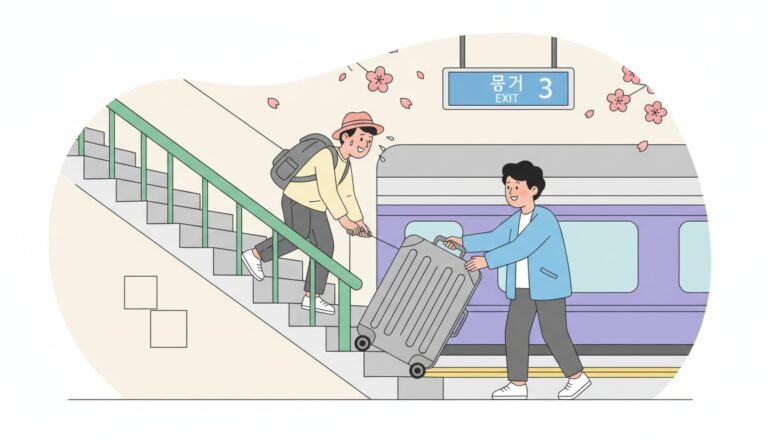
Have you ever been on a trip to Korea, bought way too many souvenirs (K-beauty products, snacks, albums!), and suddenly realized… your suitcase is too heavy to carry up the subway stairs? 😱 Or maybe you’re moving into a new dorm and can’t lift a heavy box alone?
Don’t worry! In K-Dramas, this is usually the moment a charming main character appears to help. But in real life, you need to know how to ask! Today, we will learn how to ask for help with heavy items politely and naturally. Let’s get those muscles ready! 💪
Core Expressions
Here are 3 essential phrases to save your back and make new friends!
1. 도와주세요 (Dowajuseyo)
- Pronunciation: [Do-wa-ju-se-yo]
- English Meaning: Please help me.
- Detail: This is the most standard and polite way to ask for help. You can use this in an emergency or simply when you need a hand. It comes from the verb ‘돕다’ (to help).
- 💡 Pronunciation Tip: Connect the sounds smoothly! It sounds like “Do-wa-ju-se-yo.” Make sure to say it with an earnest tone!
2. 너무 무거워요 (Neomu mugeowoyo)
- Pronunciation: [Neo-mu mu-geo-wo-yo]
- English Meaning: It is too heavy.
- Detail: Before asking for help, it’s natural to explain why you need it. ‘Neomu’ means ‘too’ or ‘very,’ and ‘mugeowoyo’ means ‘heavy.’ You’ll hear ‘Neomu’ all the time in K-Dramas to emphasize feelings!
- 💡 Pronunciation Tip: The ‘eo’ in ‘geo’ and ‘wo’ sounds like the ‘u’ in ‘cup’ or ‘o’ in ‘love’. Don’t pronounce it like ‘go’! It is [Mu-geo-wo-yo].
3. 이것 좀 들어 주세요 (Igeot jom deureo juseyo)
- Pronunciation: [I-geot jom deu-reo ju-se-yo]
- English Meaning: Please hold/lift this for me.
- Detail: This is a specific request. ‘Igeot’ means ‘this thing.’ ‘Deureo juseyo’ means ‘please lift/hold.’ We add ‘Jom’ (a little) to make the request sound softer and more polite, not demanding.
- 💡 Pronunciation Tip: When saying ‘Deureo’ (들어), the ‘R’ sound carries over. It sounds like [Deu-reo], not [Deul-eo].
Real Conversation
Imagine you are at a subway station in Seoul with no escalator. You see a passerby.
A (You): 저기요! 실례합니다. (Jeogiyo! Sillyehamnida.)
[Excuse me! Pardon me.]
B (Passerby): 네? (Ne?)
[Yes?]
A: 가방이 너무 무거워요. (Gabang-i neomu mugeowoyo.)
[The bag is too heavy.]
A: 좀 도와주세요. (Jom dowajuseyo.)
[Please help me a little.]
B: 아, 제가 들어 드릴게요. (Ah, jega deureo deurilkkeyo.)
[Ah, I will carry it for you.]
A: 정말 감사합니다! (Jeongmal gamsahamnida!)
[Thank you so much!]
Culture Tip: The Magic Word “Jom (좀)” 🧙♂️
In the conversation above, did you notice the word ‘좀 (Jom)’? Literally, it means “a little” or “some.” However, in Korean culture, it is used as a magic word to soften requests.
If you just say “도와주세요” (Help me), it is grammatically correct but can sound a bit urgent or direct. Adding “좀” (Jom dowajuseyo) implies, “Could you please help me just a little bit?” It makes you sound humble and polite. Use ‘Jom’ whenever you ask for a favor, and you’ll sound like a local! 👍
Conclusion & Practice
Great job! Now you don’t have to struggle with heavy luggage alone in Korea. Remember, Koreans are generally very helpful if you ask politely!
📝 Mini Quiz
- How do you say “It is too heavy” in Korean? (______ _______)
- True or False: Adding ‘Jom’ (좀) makes your request sound rude. (O / X)
- Fill in the blank: “Please help me” = ________-yo.
⬇️ Scroll down for answers!
.
.
.
.
Answers:
1. 너무 무거워요 (Neomu mugeowoyo)
2. X (False! It makes it polite!)
3. 도와주세 (Dowajuse)
Frequently Asked Questions (FAQ)
Q: What does "도와주세요 (Dowajuseyo)" mean in Korean and how do you pronounce it?
A: In Korean, "도와주세요 (Dowajuseyo)" is pronounced [Do-wa-ju-se-yo] and means: Please help me.
Q: What does "너무 무거워요 (Neomu mugeowoyo)" mean in Korean and how do you pronounce it?
A: In Korean, "너무 무거워요 (Neomu mugeowoyo)" is pronounced [Neo-mu mu-geo-wo-yo] and means: It is too heavy.
Q: What does "이것 좀 들어 주세요 (Igeot jom deureo juseyo)" mean in Korean and how do you pronounce it?
A: In Korean, "이것 좀 들어 주세요 (Igeot jom deureo juseyo)" is pronounced [I-geot jom deu-reo ju-se-yo] and means: Please hold/lift this for me.







