

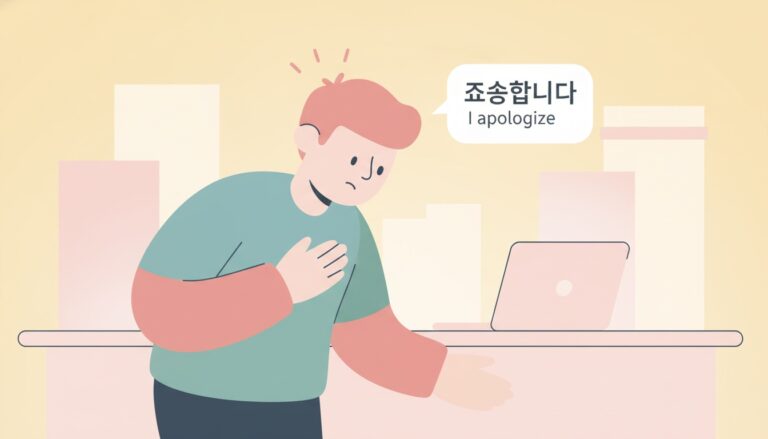
Introduction
Hello! It’s Daily Hangul (DailyHangul.com), here to upgrade your Korean skills! 🚀
Have you ever needed to ask a stranger for directions or interrupt a busy colleague at work? In these situations, you don’t want to seem rude! 😱 Just like in English we say “Excuse me” or “Sorry to bother you,” Korean has specific phrases to soften the blow before asking for a favor.
If you watch K-dramas, you’ve definitely seen a polite employee approaching their boss with these phrases. Today, let’s learn how to be a polite and sophisticated Korean speaker! Let’s dive in! 🏊♂️
Core Expressions
Here are 3 essential ways to apologize when interrupting or bothering someone.
1. 실례합니다 (Excuse me)
- Pronunciation: [Sillyehamnida]
- English Meaning: Excuse me.
- Detail: This is the standard formal way to say “Excuse me.” You use this when entering a room, passing by someone in a crowded place, or approaching a stranger to ask a question.
- 💡 Pronunciation Tip: Notice the double ‘l’ sound! Even though it is written as ‘sil-rye’, the ‘l’ and ‘r’ combine to make a smooth ‘L’ sound like in the English word ‘Lily’. So it sounds like [Sil-lye-ham-ni-da].
2. 죄송하지만… (I am sorry, but…)
- Pronunciation: [Joesonghajiman…]
- English Meaning: I am sorry, but…
- Detail: This is a “magic cushion” phrase! 🛡️ Before asking a question or a favor, put this at the beginning. It shows you know you are interrupting and feel sorry about it.
- 💡 Pronunciation Tip: The ‘j’ in ‘ji-man’ is soft. Also, Koreans often trail off at the end (…), waiting for the other person to respond!
3. 바쁘신데 죄송해요 (Sorry to bother you while you are busy)
- Pronunciation: [Bappeusinde joesonghaeyo]
- English Meaning: I’m sorry (to interrupt) since you are busy.
- Detail: This is a very considerate phrase often used in business settings or with seniors. Acknowledging that the other person is busy makes you look very professional and polite! 👔
- 💡 Pronunciation Tip: ‘Bappeu’ (Busy) has the double consonant ‘Pp’ (ㅃ). Make sure to tense your lips and make a strong /p/ sound without letting air escape!
Real-life Conversation
Let’s see how these are used in an office situation! 🏢
Situation: Minji (A) needs to ask her senior (B) a question.
A: (Knock knock) 실례합니다.
(Excuse me.)
B: 네, 들어오세요.
(Yes, come in.)
A: 선배님, 바쁘신데 죄송해요. 지금 시간 괜찮으세요?
(Senior, I’m sorry to bother you while you’re busy. Is now a good time?)
B: 네, 괜찮아요. 무슨 일이에요?
(Yes, it’s okay. What’s going on?)
A: 죄송하지만, 이것 좀 도와주실 수 있나요?
(I’m sorry, but could you help me with this?)
Culture Tip 🇰🇷
The Art of “Cushion Language”
In Korea, being direct can sometimes be considered rude, especially when asking for favors. We use what we call “Cushion Language” (쿠션어). Just like a cushion makes sitting comfortable, these phrases make your request softer for the listener!
If you just say “Help me” (도와주세요), it sounds like a demand. But if you add “Joesonghajiman” (I’m sorry, but…) in front, you sound like a well-mannered local! Next time you order food or ask for directions, try using a cushion phrase! 😉
Conclusion & Quiz
Great job today! Now you can interrupt people without worrying about being rude. Being polite is the first step to making Korean friends! 🤝
Let’s practice! (Answers below)
- Fill in the blank: When you enter a superior’s office, you knock and say “_______hamnida!”
- True or False: “Bappeusinde joesonghaeyo” means “I am not busy.”
- Quiz: Which phrase is the best “Cushion” before asking a favor?
A) 사랑해 (Saranghae)
B) 죄송하지만 (Joesonghajiman)
See you next time! Annyeong! 👋
Answers:
1. Sillye (실례)
2. False (It means “Sorry to bother you while you are busy”)
3. B
Frequently Asked Questions (FAQ)
Q: What does "실례합니다 (Excuse me)" mean in Korean and how do you pronounce it?
A: In Korean, "실례합니다 (Excuse me)" is pronounced [Sillyehamnida] and means: Excuse me.
Q: What does "죄송하지만... (I am sorry, but...)" mean in Korean and how do you pronounce it?
A: In Korean, "죄송하지만... (I am sorry, but...)" is pronounced [Joesonghajiman...] and means: I am sorry, but...
Q: What does "바쁘신데 죄송해요 (Sorry to bother you while you are busy)" mean in Korean and how do you pronounce it?
A: In Korean, "바쁘신데 죄송해요 (Sorry to bother you while you are busy)" is pronounced [Bappeusinde joesonghaeyo] and means: I'm sorry (to interrupt) since you are busy.







