

Introduction
Hello! It’s Daily Hangul (DailyHangul.com), here to upgrade your Korean skills! 😊
Have you watched the movie Parasite or the series Squid Game? 🎬 These famous K-contents show a side of Korea that isn’t just bright lights and K-Pop—they talk about the gap between the rich and the poor.
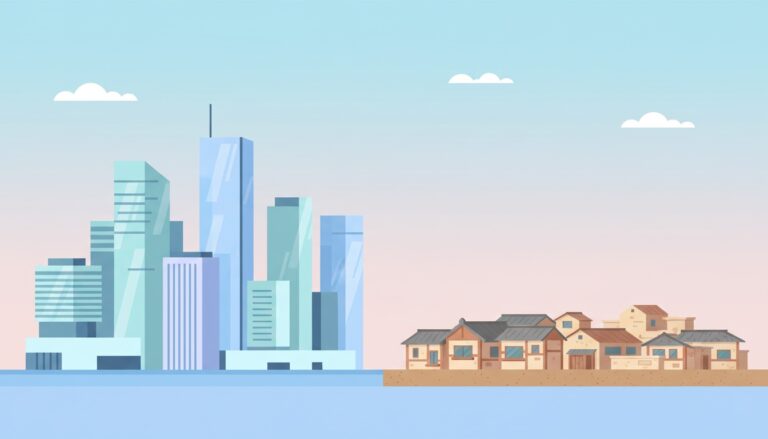
Today, we are going to learn how to talk about a slightly more serious but very important topic: Urbanization and Inequality. If you watch Korean news or talk to Korean friends about life in Seoul, these expressions will make you sound very fluent and aware of social issues! Let’s dive in! 🏙️
Key Expressions
Here are 4 useful expressions to discuss social issues in the city.
1. 빈부 격차 (Binbu gyeokcha)
- Pronunciation: [Binbu gyeokcha]
- English Meaning: The gap between rich and poor
- Detail: ‘빈(Bin)’ means poverty, and ‘부(Bu)’ means wealth. ‘격차(Gyeokcha)’ means a gap or difference. This is the standard word used in news and serious conversations to describe income inequality.
- 💡 Pronunciation Tip: In 격차, the ‘ㄱ’ meets ‘ㅊ’, making the ‘ㅊ’ sound stronger. Pronounce it like [Binbu gyeok-cha].
2. 집값이 너무 비싸요 (Jipgapsi neomu bissayo)
- Pronunciation: [Jipgapsi neomu bissayo]
- English Meaning: Housing prices are too expensive.
- Detail: This is the most common complaint in big cities like Seoul. ‘집값(Jipgap)’ means house price. You will hear this in almost every Korean drama about family or marriage!
- 💡 Pronunciation Tip: When saying 집값, the ‘ㅂ’ and ‘ㄱ’ combine to make a tense sound. It sounds like [Jip-kkap].
3. 살기 힘들어요 (Salgi himdeureoyo)
- Pronunciation: [Salgi himdeureoyo]
- English Meaning: It is hard to make a living / It is hard to live.
- Detail: You use this when the cost of living is high or life feels competitive. It’s a very common phrase used by young people in Korea (the ‘Sampo Generation’) when talking about the future.
4. 문제가 심각해요 (Munjega simgakhaeyo)
- Pronunciation: [Munjega simgakhaeyo]
- English Meaning: The problem is serious.
- Detail: Use this to agree with someone who is talking about social issues like pollution, traffic, or inequality.
- 💡 Pronunciation Tip: Because of the ‘ㅎ’ in 해, the ‘ㄱ’ sound in ‘각’ flows into it. It sounds softer, like [Sim-ga-kae-yo].
Real Conversation
Let’s see how two friends, Minji and Jason, talk about life in Seoul at a café.
Minji: 요즘 서울 집값이 너무 비싸요. 이사 가기 무서워요.
(Yojeum Seoul jipgapsi neomu bissayo. Isa gagi museowoyo.)
(Housing prices in Seoul are too expensive these days. I’m scared to move.)
Jason: 맞아요. 뉴스에서 봤는데, 빈부 격차가 더 커지고 있대요.
(Majayo. Nyuseu-eseo bwanneunde, binbu gyeokcha-ga deo keojigo itdaeyo.)
(That’s right. I saw on the news that the gap between rich and poor is getting bigger.)
Minji: 휴, 평범한 사람들은 점점 살기 힘들어요.
(Hyu, pyeongbeomhan saramdeureun jeomjeom salgi himdeureoyo.)
(Sigh, it’s becoming harder for ordinary people to make a living.)
Jason: 도시 문제가 심각해요. 정부가 빨리 해결하면 좋겠어요.
(Dosi munjega simgakhaeyo. Jeongbuga ppalli haegyeolhamyeon jokesseoyo.)
(The city problems are serious. I hope the government solves it quickly.)
Culture Tip: The “Banjiha” (Semi-basement) 🏠
Did you see the semi-basement home in the movie Parasite? In Korean, this is called 반지하 (Banjiha).
As urbanization in Seoul happened very quickly, there wasn’t enough space for everyone. These semi-basement apartments became a symbol of the urban poor who struggle with high housing costs (집값). While they are affordable options for students or young workers, they also represent the inequality (빈부 격차) in the city. Knowing this word helps you understand the background of many Korean stories!
Conclusion & Quiz
Today we talked about a deep topic! Being able to express concern about social issues shows that your Korean is reaching a higher level. Great job today! 👏
Let’s check what you learned!
- How do you say “The gap between rich and poor” in Korean?
( Hint: ㅂㅂ ㄱㅊ ) -
True or False: “살기 힘들어요” means “Living is very easy and fun.”
( True / False )
Answers:
1. 빈부 격차 (Binbu gyeokcha)
2. False (It means “It is hard to make a living”)
Frequently Asked Questions (FAQ)
Q: What does "빈부 격차 (Binbu gyeokcha)" mean in Korean and how do you pronounce it?
A: In Korean, "빈부 격차 (Binbu gyeokcha)" is pronounced [Binbu gyeokcha] and means: The gap between rich and poor
Q: What does "집값이 너무 비싸요 (Jipgapsi neomu bissayo)" mean in Korean and how do you pronounce it?
A: In Korean, "집값이 너무 비싸요 (Jipgapsi neomu bissayo)" is pronounced [Jipgapsi neomu bissayo] and means: Housing prices are too expensive.
Q: What does "살기 힘들어요 (Salgi himdeureoyo)" mean in Korean and how do you pronounce it?
A: In Korean, "살기 힘들어요 (Salgi himdeureoyo)" is pronounced [Salgi himdeureoyo] and means: It is hard to make a living / It is hard to live.
Q: What does "문제가 심각해요 (Munjega simgakhaeyo)" mean in Korean and how do you pronounce it?
A: In Korean, "문제가 심각해요 (Munjega simgakhaeyo)" is pronounced [Munjega simgakhaeyo] and means: The problem is serious.






