

📉 Smart Travel: Mastering Won & Exchange Rates! 🇰🇷
👋 Introduction
Hello, K-culture fans! This is Daily Hangul, your best friend for learning Korean! 😊
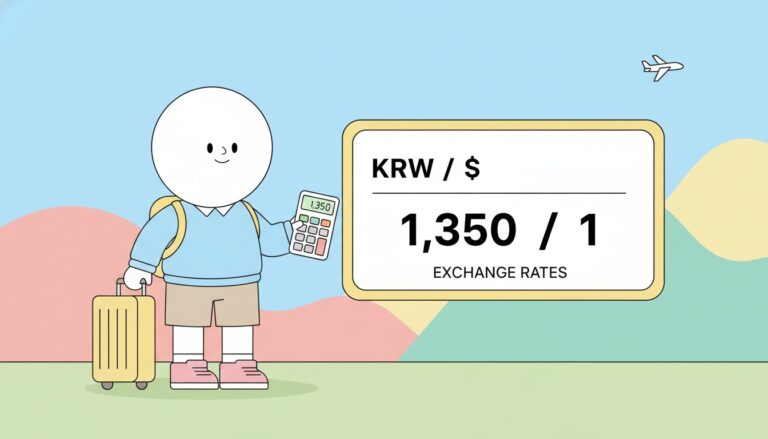
Are you planning a trip to Korea? ✈️ One thing every traveler worries about is money! Exchange rates (Currency values) change every day. Sometimes, the Korean Won gets stronger, and your trip might cost a little more than you planned. 😱
In K-dramas, you often see characters checking their bank accounts and sighing, right? Today, let’s learn how to talk about exchange rates and budgets so you can travel smart and handle money like a local!
📚 Key Expressions
1. 환율이 올랐어요
- Pronunciation: [Hwann-yul-i ol-la-sseo-yo]
- English Meaning: The exchange rate went up.
- Detail: 환율 (Hwanyul) means “exchange rate.” 올랐어요 (Ollasseoyo) is the past tense of “to go up.” If the rate goes down, you can say “내렸어요 (Naeryeosseoyo).”
- 💡 Pronunciation Tip: When pronouncing 환율, it sounds like [환뉼 (Hwann-yul)] because of the ‘ㄴ’ sound addition rule in Korean. It flows smoother!
2. 비싸졌어요
- Pronunciation: [Bi-ssa-jyeo-sseo-yo]
- English Meaning: It became expensive.
- Detail: You know 비싸요 (Bissayo) means “It’s expensive,” right? By adding -아/어 졌어요, it means “It became expensive” (a change in state). Use this when hotel prices or flight tickets go up!
3. 예산이 부족해요
- Pronunciation: [Ye-san-i bu-jo-kae-yo]
- English Meaning: The budget is insufficient / I’m short on budget.
- Detail: 예산 (Yesan) means “budget.” 부족해요 (Bujokaeyo) means “not enough.” This is a very useful phrase when you are calculating travel expenses.
🗣️ Real Conversation
Let’s see how two friends, Mina and Paul, talk about their upcoming Korea trip expenses.
Mina: 큰일 났어요. 오늘 환율이 올랐어요!
(Keunil nasseoyo. Oneul hwanyuli ollasseoyo!)
[Oh no. The exchange rate went up today!]
Paul: 정말요? 그럼 호텔비가 더 비싸졌어요?
(Jeongmalyo? Geureom hotel-bi-ga deo bissajyeosseoyo?)
[Really? Then, did the hotel cost become more expensive?]
Mina: 네. 여행 예산이 부족해요.
(Ne. Yeohaeng yesani bujokaeyo.)
[Yes. The travel budget is tight/insufficient.]
Paul: 걱정 마세요. 쇼핑을 조금만 합시다! 😂
(Geokjeong maseyo. Shopping-eul jogeum-man hapsida!)
[Don’t worry. Let’s just shop a little bit!]
🇰🇷 Culture Tip: “Money Exchange in Korea”
Did you know? In Korea, you don’t always have to go to a bank to exchange money! 🏦
- Myeongdong Exchange Booths: If you go to Myeongdong (명동), a famous shopping district in Seoul, there are many private exchange booths. They often offer much better rates than airports or hotels!
- Cash vs. Card: While cash is useful for street food (Tteokbokki! 🍢), Korea is a “card-loving” country. Most places accept credit cards or prepaid travel cards (like WOWPASS), so you don’t need to carry too much cash.
📝 Wrap-up & Quiz
Today we learned how to react when the exchange rate changes! Don’t panic, just adjust your budget smartly. 😉
Let’s check what you learned!
- How do you say “The exchange rate went up” in Korean?
( Hint: Hwan______ Ol______ ) -
True or False: “비싸졌어요” means “It became cheaper.”
( True / False ) -
Fill in the blank: “My budget is not enough.” = 예산이 ______해요.
[Answers]
1. 환율이 올랐어요 (Hwanyuli ollasseoyo)
2. False (It means “It became expensive.” Cheaper is “싸졌어요”!)
3. 부족 (Bujok)
See you next time! 안녕! 👋
Frequently Asked Questions (FAQ)
Q: What does "환율이 올랐어요" mean in Korean and how do you pronounce it?
A: In Korean, "환율이 올랐어요" is pronounced [Hwann-yul-i ol-la-sseo-yo] and means: The exchange rate went up.
Q: What does "비싸졌어요" mean in Korean and how do you pronounce it?
A: In Korean, "비싸졌어요" is pronounced [Bi-ssa-jyeo-sseo-yo] and means: It became expensive.
Q: What does "예산이 부족해요" mean in Korean and how do you pronounce it?
A: In Korean, "예산이 부족해요" is pronounced [Ye-san-i bu-jo-kae-yo] and means: The budget is insufficient / I'm short on budget.







