

Introduction
Hello! It’s Daily Hangul, here to upgrade your Korean skills! 👋✨
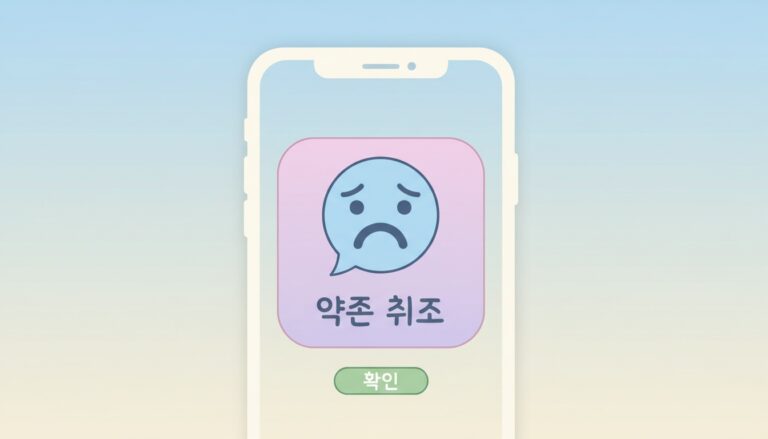
Have you ever made a promise to meet a friend, but suddenly got sick or had urgent work to do? It happens to everyone! In K-Dramas, this is the moment when the protagonist looks at their phone with a sad face and types a message… 📱💔
Today, we will learn how to cancel an appointment politely in Korean. It is very important to say this nicely so you don’t hurt the other person’s feelings. Let’s master these expressions so you can handle unexpected situations like a pro! Let’s go! 🚀
Core Expressions
Here are the 3 most essential phrases you need when canceling plans.
1. 정말 미안해요 (I’m really sorry)
- Pronunciation: [Jeongmal mianhaeyo]
- Meaning: I’m really sorry.
- Detail: This is the most standard way to apologize. You can drop ‘yo’ (요) to say “정말 미안해” if you are talking to a close friend. Start your message with this to show your sincerity! 🙏
- 💡 Pronunciation Tip: In 미안해요 (Mianhaeyo), the ‘H’ sound is very soft. It often sounds more like ‘Mian-a-yo’ when spoken quickly by native speakers!
2. 급한 일이 생겼어요 (Something urgent came up)
- Pronunciation: [Geupan iri saenggyeosseoyo]
- Meaning: Something urgent came up.
- Detail: You don’t need to explain every detail (like “my stomach hurts” or “my boss is angry”). Just using this phrase is a polite way to say, “I have a situation.”
- 💡 Pronunciation Tip: When 급한 (Geupan) is pronounced, the ‘p’ (ㅂ) and ‘h’ (ㅎ) combine to make a strong ‘P’ sound. So it sounds like [Geu-pan]!
3. 오늘 못 갈 것 같아요 (I don’t think I can go today)
- Pronunciation: [Oneul mot gal geot gatayo]
- Meaning: I don’t think I can go/make it today.
- Detail: Instead of saying a direct “No” (which can be rude), Koreans prefer to say “I don’t think I can go.” It sounds much softer and more considerate.
- 💡 Pronunciation Tip: The word 못 (mot) means ‘cannot’. But when followed by 갈 (gal), the ‘t’ sound changes to a ‘k’ sound due to nasalization rules. So, say it like [Mok-kal]!
Real-life Dialogue
Let’s see how Minji cancels her dinner plan with Jason. (Situation: Polite/Standard polite level)
Jason: 민지 씨, 우리 오늘 저녁 7시에 만나요? 🕖
(Minji, are we meeting at 7 PM tonight?)
Minji: 제이슨 씨, 정말 미안해요. 😥
(Jason, I am really sorry.)
Minji: 갑자기 급한 일이 생겼어요.
(Something urgent suddenly came up.)
Jason: 아, 정말요? 괜찮아요!
(Ah, really? It’s okay!)
Minji: 그래서 오늘 못 갈 것 같아요. 다음에 꼭 봐요! 😭
(So I don’t think I can go today. Let’s meet next time for sure!)
Culture Tip 🇰🇷
“Next time!” (다음에 봐요)
In Korea, if you just cancel and say “bye,” it might feel a bit cold. To show that you still like the person and want to see them, we almost always add “다음에 봐요” (Let’s meet next time) or “다음에 밥 먹어요” (Let’s eat together next time).
Even if you don’t have a specific date in mind, saying this is considered good manners and “Social Sense” (Nunchi/눈치)! It keeps the relationship warm. 🍜💖
Conclusion & Quiz
Today we learned how to say sorry when you can’t keep a promise. Remember, being polite is key in Korean culture!
Let’s check if you remember the expressions! 👇
Quiz 1. Fill in the blank.
“I cannot go today.”
= 오늘 (_____) 갈 것 같아요.
Quiz 2. True or False?
In Korea, it is better to give a direct “No” than to give a vague reason like “Something came up.”
( O / X )
[Answers]
1. 못 (Mot)
2. X (It is better to be soft and indirect!)
See you in the next lesson! 안녕! 👋
Frequently Asked Questions (FAQ)
Q: What does "정말 미안해요 (I'm really sorry)" mean in Korean and how do you pronounce it?
A: In Korean, "정말 미안해요 (I'm really sorry)" is pronounced [Jeongmal mianhaeyo] and means: I'm really sorry.
Q: What does "급한 일이 생겼어요 (Something urgent came up)" mean in Korean and how do you pronounce it?
A: In Korean, "급한 일이 생겼어요 (Something urgent came up)" is pronounced [Geupan iri saenggyeosseoyo] and means: Something urgent came up.
Q: What does "오늘 못 갈 것 같아요 (I don't think I can go today)" mean in Korean and how do you pronounce it?
A: In Korean, "오늘 못 갈 것 같아요 (I don't think I can go today)" is pronounced [Oneul mot gal geot gatayo] and means: I don't think I can go/make it today.






