

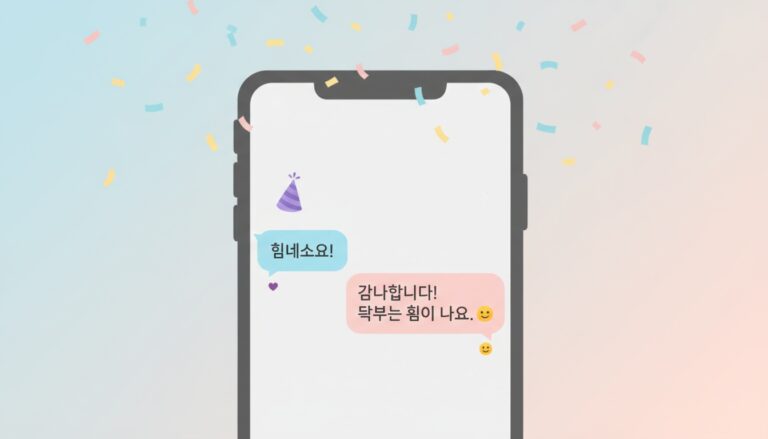
Texting After a Party: Korean Essentials 🥂
Annyeonghaseyo! It’s your Korean bestie, Daily Hangul! 👋✨
Did you have a blast at a party or a dinner gathering last night? In Korea, the fun isn’t truly over until you send a caring message the next day! You’ve probably seen this scene in K-Dramas a million times: the main character wakes up, grabs their phone, and texts their crush or friends to make sure they are okay. 😍📱
Today, we will learn how to send that sweet “morning after” message. It’s a great way to show you care and keep the friendship going! Let’s dive in! 🚀
📝 Key Expressions
Here are the top 3 phrases you need to know to text your friends after a party!
1. 잘 들어갔어?
- Pronunciation: [Jal deureogasseo?]
- English Meaning: Did you get home safe? (Lit. Did you enter well?)
- Explanation: This is the #1 most common text sent after parting ways. Even if you send it the next morning, it implies “Did you get home safely last night?” Use this with close friends (Banmal/Casual).
- 💡 Pronunciation Tip:
- Linking Sound: When you say
들어(deureo), theㄹ(l/r) sound moves over to the empty circleㅇ. So it sounds more like [Deu-reo], not [Deul-eo]. Smooth like butter! 🧈
- Linking Sound: When you say
2. 어제 재미있었어!
- Pronunciation: [Eoje jaemiisseosseo!]
- English Meaning: Yesterday was fun!
- Explanation: A simple and perfect way to compliment the host or your friends.
어제(Eoje) means yesterday, and재미있었어(jaemiisseosseo) is the past tense of “fun.” - 💡 Pronunciation Tip:
- Double ‘SS’: The
ㅆ(ss) at the bottom of있and었creates a strong, hissing ‘S’ sound. It gives the word energy! Think of a snake saying “Yesss!” 🐍
- Double ‘SS’: The
3. 속 괜찮아?
- Pronunciation: [Sok gwaenchana?]
- English Meaning: Is your stomach okay? (Are you okay?)
- Explanation: If there was alcohol involved at the party 🍻, this is the ultimate caring phrase.
속(Sok) refers to your stomach/insides. You are asking if they have a hangover. K-Drama fans, memorize this one! - 💡 Pronunciation Tip:
- Nasalization: In
괜찮아(gwaenchana), theㅎ(h) is weak and often silent, and theㄴ(n) sound carries over. It sounds like [Gwaen-cha-na]. Don’t stress the ‘h’!
- Nasalization: In
💬 Real-life Conversation
Let’s see how Minji and Jason text each other the morning after a birthday party.
(Text Message)
Jason: 민지야, 잘 들어갔어?
(Minji-ya, jal deureogasseo?)
[Minji, did you get home safe?]
Minji: 응, 제이슨! 어제 재미있었어.
(Eung, Jason! Eoje jaemiisseosseo.)
[Yeah, Jason! Yesterday was fun.]
Jason: 다행이다. 속 괜찮아?
(Dahaengida. Sok gwaenchana?)
[That’s a relief. Is your stomach okay?]
Minji: 조금 피곤해. 우리 다음에 또 봐!
(Jogeum pigonhae. Uri daeume tto bwa!)
[I’m a little tired. Let’s meet again next time!]
🇰🇷 Culture Tip: The “Haejang” Culture
Did you notice Jason asked “Sok gwaenchana?”
In Korea, drinking culture is social, but caring for each other afterwards is just as important! If someone drank a lot, friends often go eat Haejang-guk (해장국) together the next day. “Haejang” means to chase a hangover.
Asking about someone’s condition the next day isn’t just polite; it shows deep “Jeong” (정 – affection/bonding). If you send this text, your Korean friends will be touched! ❤️
🎓 Wrap-up & Quiz
Today we learned how to be a considerate friend after a party! Try sending these messages next time you hang out.
Let’s check what you remember! (Answers below)
- How do you ask “Did you get home safe?”
👉 ___ 들어갔어? (Hint: Well/Good) -
How do you say “Yesterday was fun”?
👉 ___ 재미있었어. (Hint: Yesterday) -
(True/False) Asking “Sok gwaenchana?” is rude to close friends.
👉 (___)
Good luck, and see you next time! Annyeong! 👋
Answers: 1. 잘 (Jal) / 2. 어제 (Eoje) / 3. False (It shows you care!)
Frequently Asked Questions (FAQ)
Q: What does "잘 들어갔어?" mean in Korean and how do you pronounce it?
A: In Korean, "잘 들어갔어?" is pronounced [Jal deureogasseo?] and means: Did you get home safe? (Lit. Did you enter well?)
Q: What does "어제 재미있었어!" mean in Korean and how do you pronounce it?
A: In Korean, "어제 재미있었어!" is pronounced [Eoje jaemiisseosseo!] and means: Yesterday was fun!
Q: What does "속 괜찮아?" mean in Korean and how do you pronounce it?
A: In Korean, "속 괜찮아?" is pronounced [Sok gwaenchana?] and means: Is your stomach okay? (Are you okay?)






