

Introduction
Annyeonghaseyo! Hello, everyone! 👋 It’s your favorite Korean tutor, Daily Hangul!
Today, we are going to dive into a very special topic: Happiness (행복, Haengbok). You might have heard of the Danish concept “Hygge” (coziness) or the Swedish “Lagom” (just right). Did you know Koreans also have beautiful words to describe these feelings of small happiness and balance?
If you watch healing K-dramas like “Hometown Cha-Cha-Cha” or the movie “Little Forest,” you will see characters searching for peace away from the busy city life. Today, let’s learn how to express that cozy, balanced happiness in Korean! Let’s get started! 🚀
Core Expressions
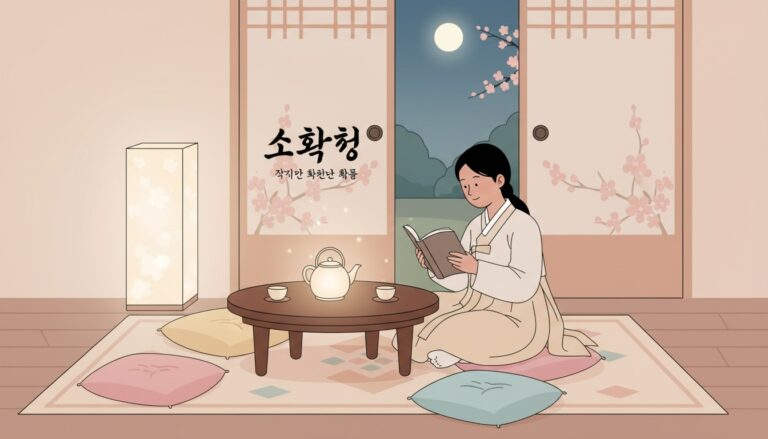
1. 소확행 (So-hwak-haeng)
- Pronunciation: [So-hwak-haeng]
- English Meaning: Small but certain happiness
- Detailed Explanation: This is a trendy word formed by shortening a longer phrase. It refers to the happiness you feel from small, everyday things—like drinking a warm coffee ☕, petting a cat 🐈, or eating delicious Ramyeon 🍜. It is the Korean equivalent of Hygge.
- 💡 Pronunciation Tip: The ‘ㅎ’ (h) in ‘확’ (hwak) and ‘행’ (haeng) should be pronounced clearly but softly. Try to say each syllable with a little bounce!
2. 여유 (Yeo-yu)
- Pronunciation: [Yeo-yu]
- English Meaning: Relaxed state of mind / Leisure / Room to breathe
- Detailed Explanation: This is a beautiful word that doesn’t have a direct translation in English. It means having “space” in your mind or time. When you are not rushing and feeling peaceful, you have “Yeo-yu.”
- 💡 Pronunciation Tip: Connect the sounds smoothly. It sounds like “Yuh-you.” There is no hard stop between the two syllables.
3. 적당히 (Jeok-dang-hi)
- Pronunciation: [Jeok-dang-hi]
- English Meaning: Moderately / In moderation / Just enough
- Detailed Explanation: This fits the Lagom philosophy perfectly (not too much, not too little). You can use this when talking about working, eating, or drinking. It emphasizes balance.
- 💡 Pronunciation Tip: Even though it is written as ‘히’ (hi) at the end, in natural speed, the ‘h’ sound often becomes very weak, sounding almost like [Jeok-dang-i].
Real-life Conversation
Situation: Two friends, Minji and Jason, are sitting in a quiet park on a Sunday afternoon. 🌳
Minji: 날씨가 진짜 좋다. 이게 바로 소확행이지!
(Nalssiga jinjja jota. Ige baro so-hwak-haeng-iji!)
The weather is really good. This is exactly “small but certain happiness”!
Jason: 맞아. 요즘 너무 바빴어. 여유가 필요했어.
(Maja. Yojeum neomu bappasseo. Yeo-yu-ga piryohaesseo.)
Right. I was too busy lately. I needed some “relaxation/space”.
Minji: 일도 적당히 해야 해. 건강이 최고야.
(Ildo jeok-dang-hi haeya hae. Geongangi choegoya.)
You should work “in moderation” too. Health is the best.
Jason: 고마워. 우리 자주 이렇게 쉬자.
(Gomawo. Uri jaju ireoke swija.)
Thanks. Let’s rest like this often.
Culture Tip: “Mung-hit” (멍 때리기)
Have you heard of “Mung ddaerigi” (멍 때리기)? It means “spacing out” or staring blankly into space. In Korea, this is considered a way to heal your brain!
There are even specific terms for it:
* Bul-mung (불멍): Staring at a fire (camping fire) 🔥
* Mul-mung (물멍): Staring at water (ocean or river) 🌊
Doing this helps you find your Yeo-yu (peace of mind). Next time you visit the Han River in Seoul, try “Mul-mung” like a local!
Conclusion & Quiz
Great job today! 🎉 We learned how to find happiness in small things (So-hwak-haeng), the importance of mental space (Yeo-yu), and balance (Jeok-dang-hi). I hope you find your own happiness today!
📝 Mini Quiz
- Which word means “Small but certain happiness”? (Hint: S_ _ _ _ _ _ _ _)
- True or False: “Jeok-dang-hi” means working extremely hard without rest.
- Fill in the blank: “I need some mental space and relaxation.” -> “나는 _____가 필요해.”
⬇️ Answers
1. 소확행 (So-hwak-haeng)
2. False (It means “moderately” or “just enough”)
3. 여유 (Yeo-yu)
Frequently Asked Questions (FAQ)
Q: What does "소확행 (So-hwak-haeng)" mean in Korean and how do you pronounce it?
A: In Korean, "소확행 (So-hwak-haeng)" is pronounced [So-hwak-haeng] and means: Small but certain happiness
Q: What does "여유 (Yeo-yu)" mean in Korean and how do you pronounce it?
A: In Korean, "여유 (Yeo-yu)" is pronounced [Yeo-yu] and means: Relaxed state of mind / Leisure / Room to breathe
Q: What does "적당히 (Jeok-dang-hi)" mean in Korean and how do you pronounce it?
A: In Korean, "적당히 (Jeok-dang-hi)" is pronounced [Jeok-dang-hi] and means: Moderately / In moderation / Just enough







