

Hello! It’s Daily Hangul (DailyHangul.com), here to upgrade your Korean skills! 🚀
Have you ever needed to ask a stranger for directions or interrupt a busy coworker, but felt frozen because you didn’t want to be rude? 😅
In Korea, manners are everything! Knowing how to politely interrupt or apologize for bothering someone is the key to sounding like a local. You’ve probably seen this in K-dramas: the main character approaches a scary boss and says something softly before speaking. That is what we are learning today!
Let’s master the art of the “Polite Interruption” so you can speak with confidence! 💪
🔑 Key Expressions: 3 Ways to Say “Excuse Me”
1. 실례합니다 (Excuse me)
- Pronunciation: [Sil-lye-ham-ni-da]
- English Meaning: Excuse me / I am committing a discourtesy.
- Explanation: This is the most standard and formal way to say “Excuse me.” You use this when entering a room, approaching a stranger on the street, or interrupting someone you don’t know well. It literally means “I am doing something rude (by interrupting).”
- 💡 Pronunciation Tip: Notice the ‘ll’ sound in the middle? When ‘ㄹ’ (l/r) meets another ‘ㄹ’, it creates a strong, rolling ‘L’ sound. Say it like “Sil-lye,” not “Sil-rye.”
2. 죄송한데… (I’m sorry, but…)
- Pronunciation: [Joe-song-han-de…]
- English Meaning: I am sorry, but…
- Explanation: This is a magic phrase! ✨ Instead of just saying “Sorry,” adding “-undae/ndae” (-는데/ㄴ데) at the end softens the sentence. It signals, “I’m sorry to interrupt, but I have something to say/ask.” It sounds much more natural than ending the sentence abruptly.
- 💡 Pronunciation Tip: The ‘oe’ in ‘Joe’ sounds similar to the ‘we’ in ‘wet’. So it sounds like “Jwe-song.”
3. 바쁘신데 죄송해요 (Sorry to bother you while you’re busy)
- Pronunciation: [Ba-ppeu-sin-de joe-song-hae-yo]
- English Meaning: I apologize for bothering you when you are busy.
- Explanation: If you work in a Korean office or need to talk to a busy store clerk, use this! It shows you respect their time. Koreans love this phrase because it shows you have high “Nunchi” (social awareness).
🗣️ Real-life Conversation: At the Office
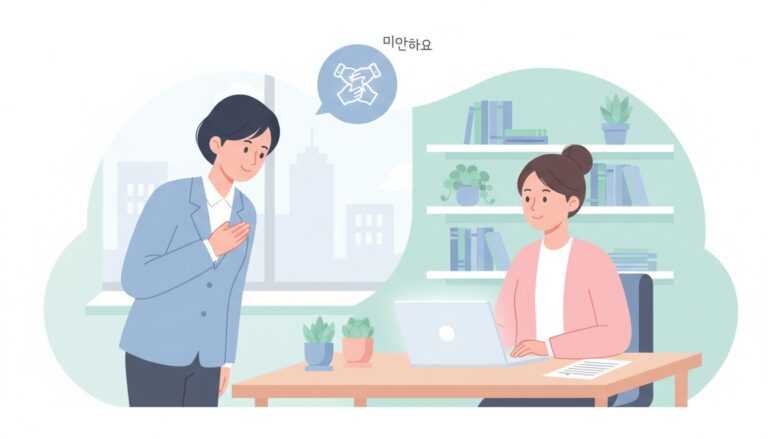
Situation: You need to ask a coworker (Minji) a quick question.
A (You): 저기요, 민지 씨. 바쁘신데 죄송해요.
(Jeogiyo, Minji-ssi. Ba-ppeu-sin-de joe-song-hae-yo.)
Excuse me, Minji. Sorry to bother you while you’re busy.
B (Minji): 아, 아니에요. 무슨 일이에요?
(Ah, anieyo. Museun irieyo?)
Ah, no problem. What’s up?
A (You): 실례가 안 된다면, 이것 좀 물어봐도 될까요?
(Sil-lye-ga an doendamyeon, igeot jom mureobwado doelkkayo?)
If it’s not rude, may I ask about this?
B (Minji): 그럼요! 언제든지 물어보세요.
(Geureomyo! Eonjedeunji mureoboseyo.)
Of course! Ask me anytime.
🇰🇷 Culture Tip: The Art of Trailing Off…
Did you notice in Expression #2, I wrote “죄송한데…” with dots?
In English, clear and direct sentences are good. But in Korean culture, being too direct can sometimes feel cold or aggressive. When you are asking a favor or apologizing, trailing off slightly (leaving the sentence a bit open) allows the listener to step in and help you. It creates a softer, more polite vibe. So, don’t be afraid to drag the ending sound a little bit! “Joe-song-han-de…”
📝 Wrap-up & Quiz
Today we learned how to be a polite pro! Being able to apologize before asking a favor will make Koreans very happy to help you. Try using these expressions next time you need help!
Let’s test your knowledge!
- Fill in the blank: When you approach a stranger to ask for directions, the standard formal phrase is “______-ham-ni-da.”
(Hint: Sil-___) -
True or False: Saying “Joe-song-han-de…” (trailing off) is considered rude in Korea.
-
Scenario: Your boss is typing furiously on their computer. Which phrase is best?
A) 안녕 (An-nyeong)
B) 바쁘신데 죄송해요 (Ba-ppeu-sin-de joe-song-hae-yo)
Answers:
1. Sil-lye (실례합니다)
2. False (It makes you sound softer and more polite!)
3. B
Frequently Asked Questions (FAQ)
Q: What does "실례합니다 (Excuse me)" mean in Korean and how do you pronounce it?
A: In Korean, "실례합니다 (Excuse me)" is pronounced [Sil-lye-ham-ni-da] and means: Excuse me / I am committing a discourtesy.
Q: What does "죄송한데... (I'm sorry, but...)" mean in Korean and how do you pronounce it?
A: In Korean, "죄송한데... (I'm sorry, but...)" is pronounced [Joe-song-han-de...] and means: I am sorry, but...
Q: What does "바쁘신데 죄송해요 (Sorry to bother you while you're busy)" mean in Korean and how do you pronounce it?
A: In Korean, "바쁘신데 죄송해요 (Sorry to bother you while you're busy)" is pronounced [Ba-ppeu-sin-de joe-song-hae-yo] and means: I apologize for bothering you when you are busy.







