

Introduction
Hello! This is Daily Hangul (DailyHangul.com), here to upgrade your Korean skills! 😊
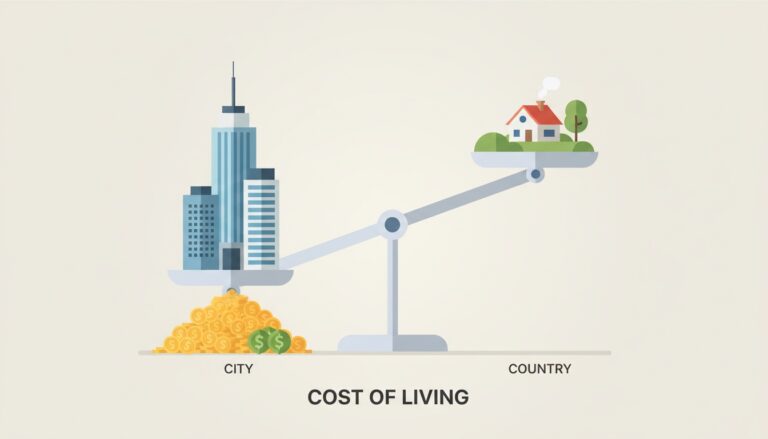
Have you ever watched K-dramas like Hometown Cha-Cha-Cha or Welcome to Samdal-ri? You often see characters moving from the busy, expensive city of Seoul to a peaceful, affordable seaside village.
Today, we are going to learn how to talk about house prices in Korea. Whether you are planning to live in Korea or just want to understand why your favorite K-drama character is struggling with rent, these expressions are super useful! Let’s compare the City (Dosi) and the Countryside (Sigol)! 🏙️ vs 🌳
Core Expressions
Here are 3 essential expressions to discuss cost and housing.
1. 비싸요 (It’s expensive)
- Pronunciation: [Bi-ssa-yo]
- English Meaning: It’s expensive.
- Detail: You can use this for anything that costs a lot of money, from house rent to a fancy dinner. In K-dramas, you’ll often hear characters sighing and saying this when looking for an apartment in Seoul.
- 💡 Pronunciation Tip: The ‘ss’ (ㅆ) is a tense sound. Imagine you are hissing like a snake! Don’t say it soft like ‘s’, say it strong and sharp: SSayo.
2. 싸요 (It’s cheap)
- Pronunciation: [Ssa-yo]
- English Meaning: It’s cheap.
- Detail: This is the opposite of “Bissayo.” You might use this when you find a bargain or when talking about living costs in the countryside compared to the city.
- 💡 Pronunciation Tip: Just like above, emphasize the ‘Ss’ sound strongly. It sounds very different from ‘Sayo’ (which means “I buy” or “It accumulates”).
3. 월세 (Monthly rent)
- Pronunciation: [Wol-se]
- English Meaning: Monthly rent.
- Detail: Most young people or foreigners in Korea pay Wolse. You pay a deposit first, and then pay this rent every month.
- 💡 Pronunciation Tip: ‘Wol’ (월) means Moon/Month. Make sure to curl your tongue for the ‘l’ sound at the end of ‘Wol’.
Real-life Dialogue
Let’s see how friends talk about moving houses. Minji wants to move to Seoul, and Jason is asking about the price.
Minji: 나 서울로 이사 가.
(Na Seoul-lo isa ga.)
I am moving to Seoul.
Jason: 우와! 서울 집값 어때? 비싸요?
(Uwa! Seoul jip-gap eottae? Bissayo?)
Wow! How are Seoul house prices? Is it expensive?
Minji: 응, 월세가 진짜 비싸요.
(Eung, wolse-ga jinjja bissayo.)
Yes, the monthly rent is really expensive.
Jason: 시골은 더 싸요.
(Sigol-eun deo ssayo.)
The countryside is cheaper.
Culture Tip: The “Jeonse” System 🇰🇷
Did you know Korea has a unique rental system called Jeonse (전세)?
Instead of paying monthly rent (Wolse), you pay a huge lump sum deposit (usually 50-80% of the house value) to the landlord for 2 years. You get all of that money back when you move out! 😲
However, because Jeonse requires a lot of money upfront, many young people and K-drama characters start with Wolse (Monthly rent) in Seoul because the city is so popular and crowded!
Conclusion & Quiz
Today we learned how to compare costs between the city and the countryside! Remember, Seoul is exciting but usually Bissayo, and the countryside is peaceful and Ssayo.
📝 Pop Quiz!
Fill in the blanks with the correct Korean word (in Romanization).
- Seoul apartments are very expensive. -> Seoul apateu-neun neomu ______.
- I pay monthly rent. -> Jeon-eun ______-reul naeyo.
Answers:
1. Bissayo (비싸요)
2. Wolse (월세)
Keep practicing, and see you next time! Annyeong! 👋
Frequently Asked Questions (FAQ)
Q: What does "비싸요 (It's expensive)" mean in Korean and how do you pronounce it?
A: In Korean, "비싸요 (It's expensive)" is pronounced [Bi-ssa-yo] and means: It's expensive.
Q: What does "싸요 (It's cheap)" mean in Korean and how do you pronounce it?
A: In Korean, "싸요 (It's cheap)" is pronounced [Ssa-yo] and means: It's cheap.
Q: What does "월세 (Monthly rent)" mean in Korean and how do you pronounce it?
A: In Korean, "월세 (Monthly rent)" is pronounced [Wol-se] and means: Monthly rent.







