

Returning Items in Korea? Easy Packing Guide! 📦
Hello! It’s your Korean upgrade buddy, Daily Hangul (매일한글)! 😊
Have you ever ordered clothes online like your favorite K-Drama stars (maybe looking for that Business Proposal style?), but when they arrived… they didn’t fit? 😱
Don’t worry! Online shopping in Korea is famous for being fast, and returning items is just as easy. Today, we will learn how to talk about packing items for a return. This is super useful if you live in Korea or want to understand daily life scenes in K-Dramas!
Let’s get started! 🚀
3 Core Expressions for Returns
1. 반품하다 (Banpumhada)
- Pronunciation: [Ban-pum-ha-da]
- English Meaning: To return (a product)
- Detail: This is the most important word for today! When you want to send a product back and get a refund, you use 반품. If you just want to exchange the size or color, you say 교환 (Gyohwan).
2. 포장하다 (Pojanghada)
- Pronunciation: [Po-jang-ha-da]
- English Meaning: To pack / To wrap
- Detail: You need to put the item back in the box to return it. This action is called 포장하다. You might hear this in restaurants too, when asking for “take-out” (포장해 주세요)!
3. 문 앞에 (Mun ape)
- Pronunciation: [Mu-na-pe]
- English Meaning: In front of the door
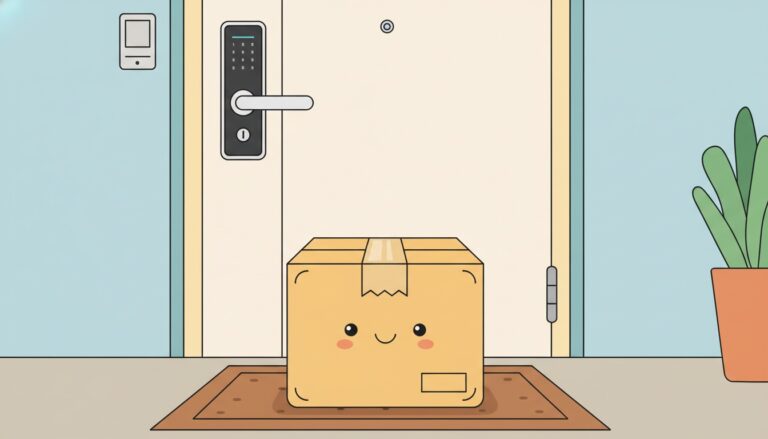
- Detail: In Korea, you don’t always meet the delivery person. You often leave the return package “in front of the door.”
- 💡 Pronunciation Tip: When you say 문 앞에, the ‘ㄴ’ sound in 문 (Mun) moves over to fill the empty ‘ㅇ’ spot in 앞 (ap). So it sounds like [무나페 / Mu-na-pe]! Try saying it smoothly!
Real-life Conversation 🗣️
Imagine you are talking to your Korean roommate or friend about a package.
A: 이거 반품할 거야?
(Igeo banpumhal geoya?)
Is this for a return?
B: 응, 사이즈가 너무 작아.
(Eung, saijeuga neomu jaga.)
Yeah, the size is too small.
A: 박스 포장은 다 했어?
(Bakseu pojang-eun da haesseo?)
Did you finish packing the box?
B: 응! 이제 문 앞에 둘 거야.
(Eung! Ije mun ape dul geoya.)
Yes! Now I’m going to put it in front of the door.
Culture Tip & K-Drama Vibes 🇰🇷
“The Magic of the Doorstep”
Have you noticed in K-Dramas like Crash Landing on You or typical web dramas, packages are always just sitting outside the apartment door? 🏠
Korea has a unique “Doorstep Delivery Culture.” Because it’s generally very safe, delivery drivers leave packages in front of your door, and you leave return items there too! You don’t need to wait at home for the driver. Just pack it, leave it 문 앞에 (in front of the door), and they will pick it up silently like a ninja! 🥷✨
Review & Quiz 📝
Let’s check what we learned today! Fill in the blanks.
- I need to return this clothes. -> 이 옷을 ______하고 싶어요.
- Please leave it in front of the door. -> ______ 두세요.
[Answers]
1. 반품 (Banpum)
2. 문 앞에 (Mun ape)
Great job today! Now you can shop online in Korea without fear! See you next time! 안녕! 👋
Frequently Asked Questions (FAQ)
Q: What does "반품하다 (Banpumhada)" mean in Korean and how do you pronounce it?
A: In Korean, "반품하다 (Banpumhada)" is pronounced [Ban-pum-ha-da] and means: To return (a product)
Q: What does "포장하다 (Pojanghada)" mean in Korean and how do you pronounce it?
A: In Korean, "포장하다 (Pojanghada)" is pronounced [Po-jang-ha-da] and means: To pack / To wrap
Q: What does "문 앞에 (Mun ape)" mean in Korean and how do you pronounce it?
A: In Korean, "문 앞에 (Mun ape)" is pronounced [Mu-na-pe] and means: In front of the door







