

Pandemic vs. Epidemic: Sound Like a Pro in Korean
Hello! Welcome back to [Maeil Hangeul], your secret weapon for leveling up your Korean fluency!
Today, we’re diving into a topic that has become a part of our global conversation: public health. Specifically, we’ll untangle the precise meanings of pandemics and epidemics in Korean. Why is this important? In Korea these days, understanding news reports, public announcements, and high-level discussions about health requires knowing the exact terminology. Getting these words right will not only boost your vocabulary but also allow you to understand and discuss complex social issues like a native speaker. Let’s get started!
Core Expressions You Need to Know
Here are the key terms that distinguish different levels of disease outbreaks.
1. 풍토병 (Endemic Disease)
- Pronunciation [Romanization]: Pungtopyeong
- English Meaning: Endemic disease
- Detailed Explanation: This is a compound word derived from Hanja (Chinese characters): 풍토 (風土) meaning ‘natural features’ or ‘climate’ of a region, and 병 (病) meaning ‘disease’. A 풍토병 is a disease that is constantly present to a greater or lesser degree in a particular region. Think of malaria in certain tropical areas. It’s a baseline, expected presence, unlike a sudden outbreak. This is a more technical, academic term you’d see in reports or documentaries.
- 💡 Pronunciation Tip: The first syllable ‘풍’ [pung] has an aspirated ‘ㅍ’ (p) sound, so release a strong puff of air. The final ‘ㅂ’ in ‘병’ [byeong] is unreleased, meaning you close your lips for the ‘p’ sound but don’t burst it open. It’s a soft stop.
2. 유행병 (Epidemic)
- Pronunciation [Romanization]: Yuhaengbyeong
- English Meaning: Epidemic
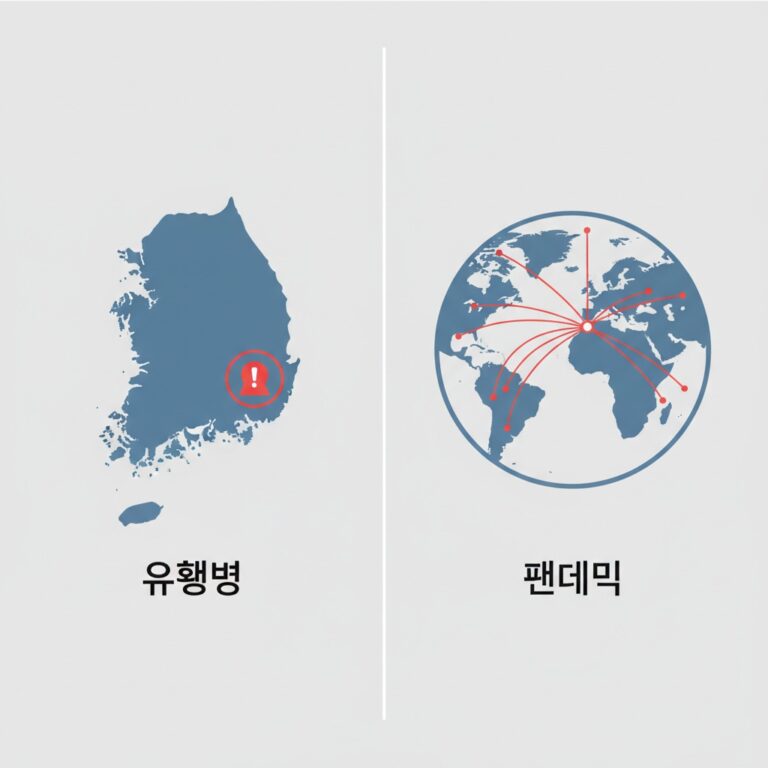
- Detailed Explanation: You might already know the word 유행 (流行), which means ‘trend’ or ‘fashion’. The Hanja literally means ‘to flow and go’. When combined with 병 (病), it means a disease that is “trending”—spreading rapidly and widely among a population within a specific area or community. This is a step up from an endemic disease; it’s an active, large-scale outbreak.
- 💡 Pronunciation Tip: The ‘ㅎ’ (h) in ‘행’ [haeng] is a very light, breathy sound. In Korean, ‘h’ is often subtle, especially between vowels. Make sure to pronounce it, but don’t make it too harsh.
3. 범유행 (Pandemic) / 팬데믹 (Pandemic)
- Pronunciation [Romanization]: Beomyuhaeng / Paendemik
- English Meaning: Pandemic
- Detailed Explanation: This is the big one. The Hanja character 범 (汎) means ‘all’ or ‘pan’. So, 범유행 literally means an “all-encompassing epidemic”—one that has spread across countries and continents. However, in modern Korean, especially since COVID-19, the English loanword 팬데믹 [paendemik] is far more common in everyday news and conversation. 범유행 is now considered a more formal, academic, or legalistic term. Using 팬데믹 will make you sound more current.
- 💡 Pronunciation Tip: For 범유행 [beomyuhaeng], the pronunciation is straightforward. For 팬데믹 [paendemik], Koreans pronounce it very close to the English, but with Korean vowel sounds. The ‘a’ in ‘pan’ is like the ‘ㅐ’ [ae] vowel, which is bright and open.
4. 감염병의 예방 및 관리에 관한 법률 (Infectious Disease Control and Prevention Act)
- Pronunciation [Romanization]: Gamyeombyeong-ui yebang mit gwanni-e gwanhan beomnyul
- English Meaning: Infectious Disease Control and Prevention Act
- Detailed Explanation: This is an advanced, C1-level term, but it’s the key to understanding Korea’s official response to public health crises. Let’s break it down:
- 감염병 (감염: infection, 병: disease): Infectious disease
- 예방 (prevention) 및 (and) 관리 (management): Prevention and management
- 에 관한 (regarding/concerning): regarding
- 법률 (law): Act/Law
This is the official name of the legal framework that the government, including the Korea Disease Control and Prevention Agency (질병관리청), operates under during a public health emergency.
- 💡 Pronunciation Tip: This is a long phrase, so focus on the linking sounds (liaison or 연음). For example, 관리에 [gwanni-e] is pronounced [gwallie]. The ‘ㄴ’ sound at the end of ‘관’ influences the pronunciation of the next syllable. This is a key feature of fluent Korean pronunciation.
Example Dialogue
Let’s see how these terms are used in a natural conversation.
A: 뉴스 봤어? 아프리카 일부 지역에서 새로운 감염병이 유행병 단계라고 하네.
(A: Did you see the news? They’re saying a new infectious disease is at the epidemic stage in some parts of Africa.)
B: 아, 정말? 그게 혹시 그 지역의 풍토병은 아니고?
(B: Oh, really? Are you sure it’s not just a disease that’s endemic to that region?)
A: 아니, 확산 속도가 빨라서 세계보건기구(WHO)가 팬데믹으로 번질 가능성을 주시하고 있대.
(A: No, the spread is so fast that the WHO is monitoring its potential to become a pandemic.)
B: 심각하구나. 우리나라 감염병 예방 및 관리에 관한 법률에 따른 대응 체계도 다시 점검해야겠네.
(B: That’s serious. We’ll probably have to re-check our response system under the Infectious Disease Control and Prevention Act.)
Culture Tip & Trend Deep Dive
The COVID-19 팬데믹 fundamentally changed public discourse in Korea. Suddenly, highly technical terms became part of daily life. The head of the 질병관리청 (KDCA) became a nationally recognized figure, and their daily briefings were watched by millions.
When you watch Korean news, you’ll notice that journalists and officials use these terms with great precision. They will clearly distinguish between a localized 유행병 and a global 팬데믹. Knowing this distinction allows you to grasp the perceived severity and scale of the situation immediately. Furthermore, any official government action, like mask mandates or travel restrictions, is legally grounded in the 감염병의 예방 및 관리에 관한 법률. Understanding this helps you see the “why” behind public policy, moving you from a passive language learner to an informed observer of Korean society.
Let’s Review & Practice!
To wrap up, we learned the crucial differences between:
* 풍토병: A local, baseline disease.
* 유행병: A regional outbreak or epidemic.
* 팬데믹 / 범유행: A global outbreak or pandemic.
Now, let’s test your knowledge!
- Fill in the blank: If a new flu strain starts in one country and spreads worldwide, the WHO would declare it a ______.
(Hint: Use the more common, modern term!) -
Short Answer: In one or two sentences, explain the difference between a 유행병 and a 팬데믹 in Korean.
You’ve mastered some very advanced and relevant vocabulary today. Great job! Try to create your own sentence using one of these new terms and leave it in the comments below! We’d love to see what you come up with.
Frequently Asked Questions (FAQ)
Q: What does "풍토" mean in Korean and how do you pronounce it?
A: In Korean, "풍토" is pronounced [風土] and means: meaning 'natural features' or 'climate' of a region, and
Q: What does "병" mean in Korean and how do you pronounce it?
A: In Korean, "병" is pronounced [病] and means: meaning 'disease'. A
Q: What does "'풍'" mean in Korean and how do you pronounce it?
A: In Korean, "'풍'" is pronounced [pung] and means: has an aspirated 'ㅍ' (p) sound, so release a strong puff of air. The final 'ㅂ' in
Q: What does "'병'" mean in Korean and how do you pronounce it?
A: In Korean, "'병'" is pronounced [byeong] and means: is unreleased, meaning you close your lips for the 'p' sound but don't burst it open. It's a soft stop.







