

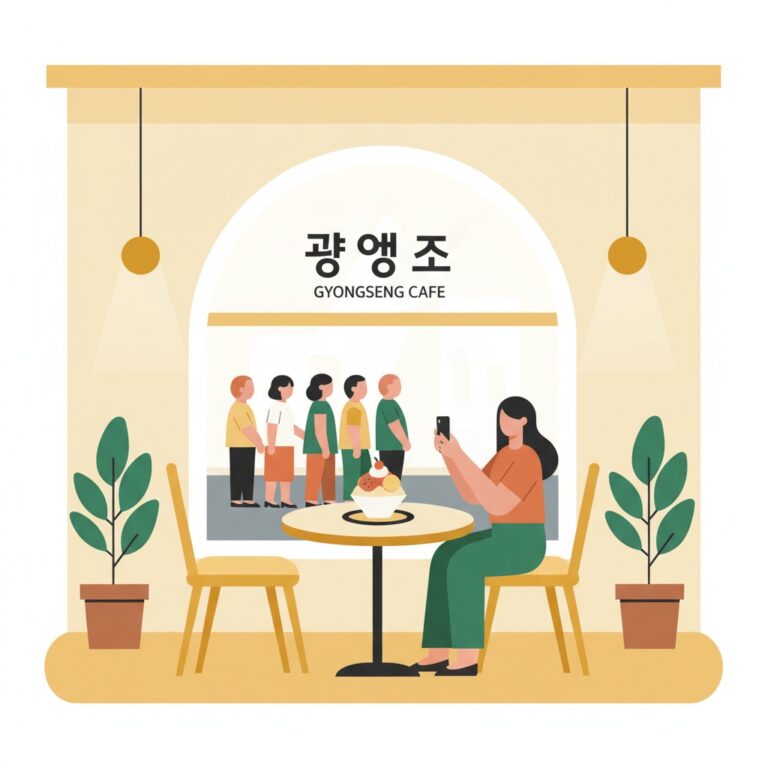
Beyond ‘Delicious!’: Level Up Your Korean Food Reviews
Hello! Welcome to [Daily Hangul], here to upgrade your Korean skills!
Have you ever had a meal in Korea so good you wanted to tell the world about it? Or maybe you’ve scrolled through Naver blogs and delivery apps, trying to figure out if a restaurant is really worth visiting. Today, we’re diving into the exciting world of Korean food reviews!
Lately in Korea, writing and reading detailed online reviews is a huge part of the dining culture. It’s not just about saying something was tasty; it’s about capturing the whole experience. We’ll teach you four essential, trendy phrases that will make your reviews sound natural, authentic, and totally convincing. Let’s get started!
Core Expressions for Your Next Review
Here are some key phrases you’ll see all over Korean blogs, social media, and review apps.
1. 존맛탱 (JMT)
- Pronunciation [Romanization]: Jonmattaeng
- English Meaning: Super delicious / Freaking delicious
- Detailed Explanation: This is popular slang, an abbreviation of 존나 맛있는 탱구리 (Jonna Masinneun Taengguri). While the first word, ‘존나,’ is a strong swear word for ‘f*ing’ or ‘very,’ **JMT has become a more mainstream and softened slang term, especially online. It’s the ultimate compliment for food. Use it in informal settings like social media captions, texts with friends, or casual online reviews.
- 💡 Pronunciation Tip: The key here is the ‘탱’ (taeng) sound. It starts with ‘ㄸ’ (tt), which is a “tense” or “doubled” consonant. It’s not ‘t’ but a harder, unaspirated [tt] sound. Make the sound at the front of your mouth with a burst of air held back, like the ‘t’ in the English word “stop.”
2. 분위기 깡패 (Bunwigi Kkangpae)
- Pronunciation [Romanization]: Bunwigi kkangpae
- English Meaning: “Atmosphere gangster” (i.e., a place with a killer vibe/ambiance)
- Detailed Explanation: This phrase literally translates to “atmosphere gangster,” which sounds a bit strange! But it’s a high compliment used to describe a restaurant, cafe, or bar with an incredible atmosphere. Think beautiful interior design, great lighting, and a perfect mood. If a place is highly “Instagrammable,” it’s definitely a 분위기 깡패.
- 💡 Pronunciation Tip: Notice the ‘깡’ (kkang). Like ‘ㄸ’ above, ‘ㄲ’ (kk) is a tense consonant. It’s a harder, sharper sound than the regular ‘ㄱ’ (g/k). To make the [kk] sound, tighten the back of your throat as you say it, without releasing a puff of air. It’s the difference between ‘gang’ and ‘kkang.’
3. 웨이팅 필수 (Waiting Pilsu)
- Pronunciation [Romanization]: Weiting pilsu
- English Meaning: “Waiting is a must” / Expect a line
- Detailed Explanation: This is a combination of the English word ‘waiting’ (웨이팅) and the Korean word ‘필수’ (pilsu), which means ‘required’ or ‘essential.’ When you see this in a review, it’s a sign that the restaurant is extremely popular—so popular that you’ll almost certainly have to wait for a table. It’s a good problem to have and a strong indicator of a 맛집 (matjip – a famous, delicious restaurant).
- 💡 Pronunciation Tip: Korean pronunciation often links sounds together. Here, it sounds very smooth: [we-i-ting pil-su]. Practice saying it as one fluid phrase rather than two separate words.
4. 재방문 의사 100% (Jaebangmun Uisa Baek-peosenteu)
- Pronunciation [Romanization]: Jaebangmun uisa baek-peosenteu
- English Meaning: 100% intention to revisit
- Detailed Explanation: This is a classic review phrase that clearly expresses your satisfaction. 재방문 (jaebangmun) means ‘revisit,’ 의사 (uisa) means ‘intention,’ and 100% (baek-peosenteu) is ‘100 percent.’ Putting it all together gives you a powerful and common way to say, “I will definitely be back!” It’s a fantastic concluding sentence for a positive review.
- 💡 Pronunciation Tip: The vowel ‘의’ (ui) can be tricky! When it’s at the beginning of a word like in ‘의사’, it’s pronounced as a glide from ‘ㅡ’ (eu) to ‘ㅣ’ (i), sounding like [ui]. However, you’ll often hear it simplified to [의/eui] or even [이/i]. For ‘의사’, sticking to the clear [ui-sa] pronunciation is best.
Example Dialogue
Here’s how you might see these phrases used in a conversation between two friends planning to visit a new cafe.
A: Hey, have you seen the reviews for that new dessert cafe in Hongdae? The one famous for its crème brûlée cheesecake?
B: Oh, the one all over Instagram? I saw a blog post about it! The reviewer said the place is a total 분위기 깡패 (bunwigi kkangpae). The photos looked amazing.
A: Exactly! But they also warned that it’s 웨이팅 필수 (waiting pilsu) on weekends, so we should probably go early.
B: Sounds like a plan. Was the cake good?
A: The reviewer said it was absolute JMT (존맛탱) and ended the post with “재방문 의사 100% (jaebangmun uisa baek-peosenteu)“!
B: Wow, okay, I’m sold. Let’s go this Saturday!
Culture Tip: The Power of the Online Review
In Korea, online word-of-mouth is incredibly powerful. Before visiting a new place, most people will search for reviews on platforms like Naver Blog, MangoPlate (a review app), or check the reviews on delivery apps like Baemin (배민).
- The “Proof Shot” (인증샷): The concept of 분위기 깡패 is tied to the culture of taking an 인증샷 (injeungshot), or a “proof shot,” to post on social media. A beautiful interior is just as important as delicious food for many younger Koreans.
- Authenticity is Key: Using slang like JMT makes a review feel more genuine and relatable to other users. It shows that you’re not just writing a formal assessment but sharing a real, enthusiastic experience.
- Be the Influencer: When you use phrases like 웨이팅 필수 or 재방문 의사 100%, you’re not just sharing an opinion; you’re providing valuable information that helps others make a decision. This is the core of Korean review culture!
Let’s Wrap It Up & Practice!
Today, we learned four amazing phrases to make your Korean food reviews shine:
* JMT (존맛탱): For when something is incredibly delicious.
* 분위기 깡패: To describe a place with a fantastic atmosphere.
* 웨이팅 필수: To show a place is so popular there’s always a line.
* 재방문 의사 100%: The perfect way to say you’ll definitely be back.
Now, it’s your turn to practice!
Quiz Time!
- You went to a cafe with beautiful decorations, great music, and cozy lighting. You would describe it as a _______________.
- Imagine you just had the best tteokbokki of your life. How would you write “I’ll definitely come back!” in a review using one of today’s phrases?
Leave your answers and your own review sentences in the comments below using the expressions we learned today. We can’t wait to read them
Frequently Asked Questions (FAQ)
Q: What does "재방문" mean in Korean and how do you pronounce it?
A: In Korean, "재방문" is pronounced [jaebangmun] and means: means 'revisit,'
Q: What does "의사" mean in Korean and how do you pronounce it?
A: In Korean, "의사" is pronounced [uisa] and means: means 'intention,' and
Q: What does "분위기 깡패" mean in Korean and how do you pronounce it?
A: In Korean, "분위기 깡패" is pronounced [bunwigi kkangpae] and means: . The photos looked amazing.
Q: What does "웨이팅 필수" mean in Korean and how do you pronounce it?
A: In Korean, "웨이팅 필수" is pronounced [waiting pilsu] and means: on weekends, so we should probably go early.







