

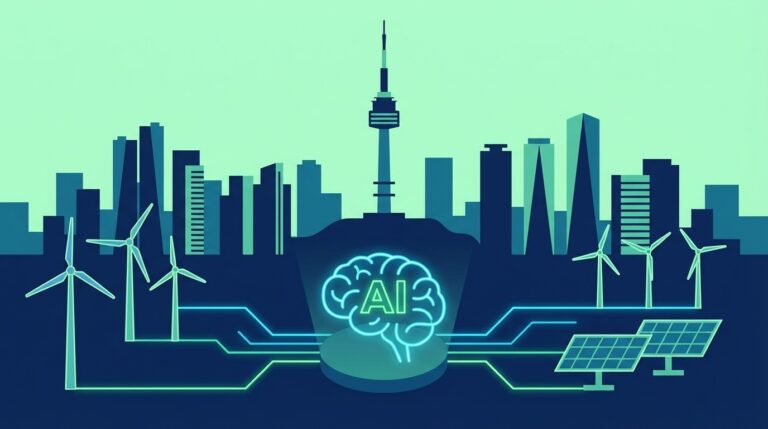
Korean Tech Talk: Is AI Accurately Predicting Our Energy Future?
Hello! Welcome back to Maeil Hangul, where we upgrade your Korean skills to the next level!
Today, we’re diving into a sophisticated topic perfect for advanced learners: discussing the accuracy of AI in energy forecasting. This is an incredibly relevant conversation in Korea right now. As a global leader in technology and green energy initiatives, Korea is heavily investing in AI to create ‘smart grids’ and manage power more efficiently. Using the phrases we learn today will not only make you sound fluent but also incredibly knowledgeable about current affairs in Korea. Let’s get started!
Key Expressions for Your Tech Toolkit
Here are some essential phrases you’ll need to discuss technology and data like a pro.
1. 정확도를 제고하다 (Jeonghwakdoreul jegohada)
* English Meaning: To enhance/improve accuracy.
* Detailed Explanation: This is a formal, technical phrase perfect for reports, presentations, or professional discussions. 정확도 (jeonghwakdo) means ‘accuracy,’ and 제고하다 (jegohada) is a Sino-Korean verb meaning ‘to enhance’ or ‘raise.’ Using this will make you sound highly proficient in a business or academic setting.
* 💡 Pronunciation Tip: In 정확도, the ‘ㅎ’ (h) sound is subtle but present, almost like a soft puff of air after the ‘ㄱ’ (g/k). It’s pronounced [jeong-hwak-tto], with the ‘도’ becoming a tensed sound [tto] due to the preceding consonant.
2. 변수를 고려하다 (Byeonsureul goryeohada)
* English Meaning: To consider variables.
* Detailed Explanation: This is a crucial phrase for any conversation about forecasting or analysis. 변수 (byeonsu) means ‘variable,’ and 고려하다 (goryeohada) means ‘to consider.’ You’d use this when talking about the different factors an AI model needs to account for, like weather, holidays, or economic events.
* 💡 Pronunciation Tip: The ‘ㄹ’ (r/l) in 고려 [goryeo] is pronounced as a soft ‘r,’ similar to the Spanish ‘r’ sound. It’s a gentle flap of the tongue, not a hard American ‘r’.
3. 오차 범위를 줄이다 (Ocha beomwireul jurida)
* English Meaning: To reduce the margin of error.
* Detailed Explanation: This is another key technical term. 오차 (ocha) means ‘error,’ 범위 (beomwi) means ‘range’ or ‘scope,’ and 줄이다 (jurida) means ‘to reduce.’ It’s the perfect way to talk about making predictions more precise.
* 💡 Pronunciation Tip: When the syllable ‘오’ is followed by ‘차’, they flow together smoothly as [o-cha]. For 범위 [beom-wi], make sure to pronounce both the ‘ㅁ’ (m) ending of the first syllable and the ‘위’ (wi) of the second clearly.
4. 신뢰도가 높다/낮다 (Silloedoga nopda/natda)
* English Meaning: The reliability is high/low.
* Detailed Explanation: 신뢰도 (silloedo) means ‘reliability’ or ‘credibility.’ This phrase is fundamental for evaluating any system, data set, or prediction. You can pair it with 높다 (nopda) for ‘high’ or 낮다 (natda) for ‘low’.
* 💡 Pronunciation Tip: The combination of two ‘ㄹ’s (from 신뢰 and 도) creates a distinct ‘l’ sound. So, it’s pronounced [sillwedo], not [sin-roe-do]. This is a common pronunciation rule called ‘liquidization.’
Example Dialogue
Let’s see these phrases in action. Here’s a conversation between two researchers, Min-jun and Ji-hye, at a Korean energy tech company.
A (민준): 새로 도입한 AI 에너지 수요 예측 모델은 어떤가요? 신뢰도가 높은 편인가요?
(A (Min-jun): How is the new AI energy demand forecasting model we introduced? Is the reliability high?)
B (지혜): 아직은 개선할 점이 많아요. 특히 기상 이변 같은 예상치 못한 변수를 고려해서 오차 범위를 줄여야 해요.
(B (Ji-hye): There’s still a lot to improve. We especially need to reduce the margin of error by considering unexpected variables like extreme weather events.)
A (민준): 맞아요. 지속적인 데이터 학습을 통해 예측 정확도를 제고하는 것이 핵심 과제겠네요.
(A (Min-jun): Right. I guess our key task is to enhance the prediction accuracy through continuous data learning.)
Culture Tip & Trend Deep Dive
In Korea, discussions about AI and energy aren’t just for experts. They are part of a major national initiative called the ‘Korean New Deal’ (한국판 뉴딜), which has a strong focus on the ‘Green New Deal.’ This policy aims to build a smart, eco-friendly infrastructure, and AI-powered energy grids are at its core. Major corporations like KEPCO (한국전력공사 – Korea Electric Power Corporation) are actively developing and implementing these technologies. Therefore, using these advanced, Hanja-based terms (정확도, 변수, 오차, 신뢰도) shows that you’re not just speaking Korean, but you’re also in tune with the country’s technological and economic trajectory. It signals a high level of professional and cultural fluency.
Let’s Practice!
Time to put your knowledge to the test! Fill in the blanks with the phrases we learned today.
- For the project to succeed, we must _______________ by analyzing more data. (enhance the accuracy)
- The current forecast is unreliable because it fails to _______________ holiday power consumption. (consider the variables)
Ready to sound like a tech expert? Try creating your own sentence using one of today’s expressions in the comments below. We’d love to see it!
Frequently Asked Questions (FAQ)
Q: What does "정확도" mean in Korean and how do you pronounce it?
A: In Korean, "정확도" is pronounced [jeonghwakdo] and means: means 'accuracy,' and
Q: What does "제고하다" mean in Korean and how do you pronounce it?
A: In Korean, "제고하다" is pronounced [jegohada] and means: is a Sino-Korean verb meaning 'to enhance' or 'raise.' Using this will make you sound highly proficient in a business or academic setting.
Q: What does "변수" mean in Korean and how do you pronounce it?
A: In Korean, "변수" is pronounced [byeonsu] and means: means 'variable,' and
Q: What does "고려하다" mean in Korean and how do you pronounce it?
A: In Korean, "고려하다" is pronounced [goryeohada] and means: means 'to consider.' You'd use this when talking about the different factors an AI model needs to account for, like weather, holidays, or economic events.






