

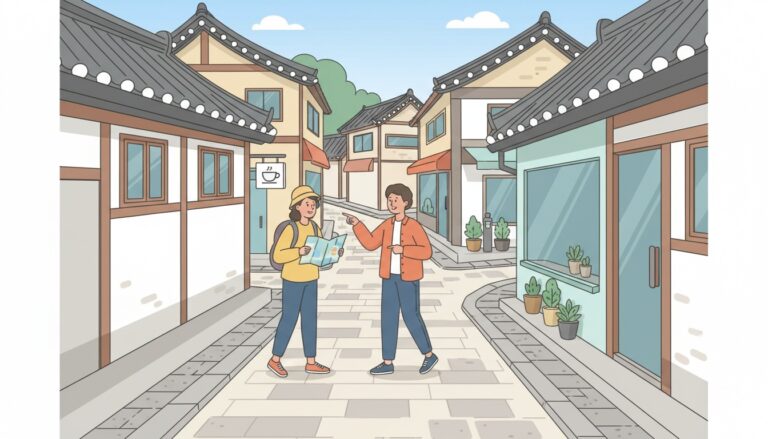
Lost in Seoul? Ask ‘이 길이 맞아요?’ Like a Pro!
Hello! It’s your favorite Korean guide, [매일한글] (Maeil Hangeul), here to upgrade your Korean skills!
Have you ever been wandering through a new city, map in hand, and felt completely lost? Today, we’re going to learn the essential phrases to ask for directions, especially the golden question: “Is this the right way?” Lately in Korea, exploring charming, hidden alleyways, known as ‘골목길 (golmok-gil),’ has become a huge trend on social media. These spots are beautiful but can be tricky to find! With today’s lesson, you’ll be navigating them with confidence.
Key Expressions You Need to Know
Here are three must-know phrases for your Korean adventure.
1. 저기요 (Jeogiyo)
- Romanization: Jeogiyo
- English Meaning: Excuse me.
- Detailed Description: This is the most common and polite way to get someone’s attention on the street. Before you ask a question, always start with a friendly “저기요!”
- 💡 Pronunciation Tip: The pronunciation is quite straightforward. Just say it with a rising intonation at the end, like you’re asking a question: [Jeo-gi-yo?]. This makes you sound polite and approachable.
2. 이 길이 맞아요? (I gir-i maj-ayo?)
- Romanization: I gir-i maj-ayo?
- English Meaning: Is this the right way?
- Detailed Description: This is the core phrase of our lesson!
이 (i)means ‘this,’길 (gil)means ‘road’ or ‘way,’ and맞아요? (maj-ayo?)means ‘is it correct?’. It’s a polite and natural way to confirm your path. - 💡 Pronunciation Tip: Pay attention to ‘길이’. It’s not pronounced ‘gil-i’ but [giri]. This is a pronunciation rule called ‘연음 (yeoneum)’ or ‘linking’. When a syllable ending in a consonant (like ‘길’) is followed by a syllable starting with a vowel (like ‘이’), the consonant sound moves over to the next syllable. So, ‘gil-i’ smoothly becomes ‘[gi-ri]’.
3. 쭉 가세요 (Jjuk gaseyo)
- Romanization: Jjuk gaseyo
- English Meaning: Go straight.
- Detailed Description: This is a very common answer you will hear.
쭉 (jjuk)is an adverb that means ‘straight’ or ‘continuously,’ and가세요 (gaseyo)is the polite form of ‘to go.’ - 💡 Pronunciation Tip: The first sound, ‘쭉’, uses the letter ‘ㅉ’ (ssang-jieut). This is a ‘tense’ consonant. To make this sound, make a ‘j’ sound but with more tension in your tongue and without a puff of air. It should sound short and sharp: [jjuk].
Example Conversation
Imagine you’re searching for a famous cafe in Seoul’s trendy Ikseon-dong alleyways.
- A (You): 저기요, 실례합니다. 혹시 한글 카페 가려면 이 길이 맞아요?
- (Jeogiyo, sillyehamnida. Hoksi Hangeul kape garyeomyeon i gir-i maj-ayo?)
- Excuse me. To get to Hangeul Cafe, is this the right way?
- B (A friendly Korean): 아, 아니요. 반대쪽이에요. 저쪽으로 쭉 가세요.
- (A, aniyo. Bandae-jjog-ieyo. Jeo-jjog-euro jjuk gaseyo.)
- Oh, no. It’s the opposite direction. Please go straight that way.
- A (You): 아, 감사합니다!
- (A, gamsahamnida!)
- Ah, thank you!
Culture Tip: The ‘Golmok-gil’ (골목길) Vibe
As we mentioned, exploring ‘골목길 (golmok-gil)’ is a huge trend, especially among the younger generation in Korea. It’s called ‘골목길 감성 (golmok-gil gamseong)’, which means the ‘alleyway vibe/aesthetic.’ People love discovering unique, retro-style cafes and photo spots hidden away from the main streets. When you’re on your own ‘golmok-gil’ adventure, you’ll definitely need to ask for directions. Using phrases like “이 길이 맞아요?” shows you’re not just a tourist, but someone who’s genuinely exploring Korean culture!
Let’s Review & Practice!
Great job today! You’ve learned how to get someone’s attention with ‘저기요’, confirm your path with ‘이 길이 맞아요?’, and understand the answer ‘쭉 가세요’.
Now, time for a quick quiz!
Practice Question: You are looking for Gyeongbok Palace. You see a big gate in front of you. How would you ask a person nearby, “Excuse me, is this the right way to Gyeongbok Palace?”
Write your answer in the comments below using the phrases we learned today! We can’t wait to see your sentences!
Frequently Asked Questions (FAQ)
Q: What does "저기요 (Jeogiyo)" mean in Korean and how do you pronounce it?
A: In Korean, "저기요 (Jeogiyo)" is pronounced [Tip: The pronunciation is quite straightforward. Just say it with a rising intonation at the end, like you're asking a question: [Jeo-gi-yo?] and means: Excuse me.
Q: What does "이 길이 맞아요? (I gir-i maj-ayo?)" mean in Korean and how do you pronounce it?
A: In Korean, "이 길이 맞아요? (I gir-i maj-ayo?)" is pronounced [Tip: Pay attention to '길이'. It's not pronounced 'gil-i' but [giri] and means: Is this the right way?
Q: What does "쭉 가세요 (Jjuk gaseyo)" mean in Korean and how do you pronounce it?
A: In Korean, "쭉 가세요 (Jjuk gaseyo)" is pronounced [Tip: The first sound, '쭉', uses the letter 'ㅉ' (ssang-jieut] and means: Go straight.







