

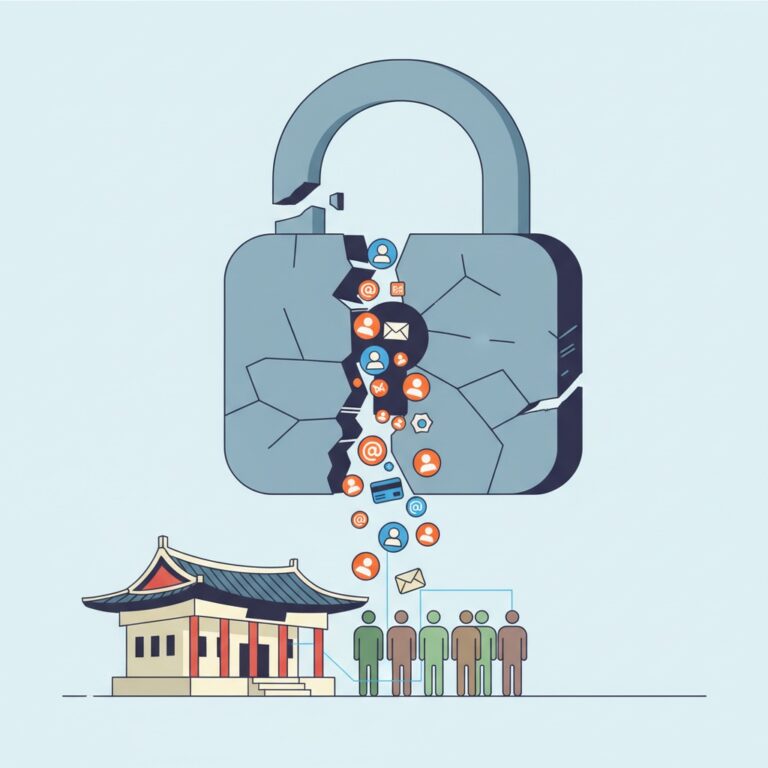
Korean Data Breach? Here’s Your Legal Action Plan!
Hello! Welcome back to [Maeil Hangeul], your trusted guide to upgrading your Korean skills to a native-like level!
Today, we’re tackling a topic that’s incredibly relevant in our digital age: cybersecurity and privacy. Specifically, we’ll simulate the legal response process after a personal data breach. In today’s hyper-connected Korea, where nearly every aspect of life is online, a data breach can be a serious concern. But don’t worry! After this lesson, you’ll be equipped with the advanced vocabulary needed to understand the news, discuss your rights, and navigate the legal landscape like a pro.
Let’s dive into the essential legal terminology you need to know!
Core Legal Expressions for a Data Breach Scenario
Here are the key phrases you’ll encounter when discussing legal action following a data breach in Korea.
1. 개인정보 유출 (Gaeinjeongbo yuchul)
- Pronunciation [Romanization]: [Gae-in-jeong-bo yu-chul]
- English Meaning: Personal Information Leak / Data Breach
- Detailed Explanation: This is the standard, formal term for a data breach. It’s a compound noun: 개인 (gaein) meaning ‘individual’ or ‘personal’, 정보 (jeongbo) meaning ‘information’, and 유출 (yuchul) meaning ‘leak’ or ‘outflow’. You will see this exact phrase in news headlines, official company apologies, and legal documents. It specifically refers to the unauthorized release of private data.
- 💡 Pronunciation Tip:
The pronunciation is quite straightforward. However, focus on giving each syllable equal stress, which is typical in Korean. Avoid the English tendency to stress one syllable more than others. Say it smoothly: Gae-in-jeong-bo-yu-chul.
2. 손해배상 청구 소송 (Sonhaebaesang cheonggu sosong)
- Pronunciation [Romanization]: [Son-hae-bae-sang cheong-gu so-song]
- English Meaning: A lawsuit to claim compensation for damages.
- Detailed Explanation: This long but crucial term breaks down the entire legal action.
- 손해 (sonhae): damage, loss, harm
- 배상 (baesang): compensation, reparation
- 청구 (cheonggu): a claim, a demand
- 소송 (sosong): a lawsuit, litigation
Putting it all together, it’s a “lawsuit to demand compensation for damages.” This is the formal name for the legal action you would take against a company that has leaked your data.
- 💡 Pronunciation Tip:
The key here is the tense consonant ‘ㅆ’ in 소송 (sosong). It’s not a soft ‘s’ but a strong, tensed [ss] sound, produced with more pressure at the front of your mouth. Practice by breaking the phrase in half: 손해배상 [son-hae-bae-sang] and 청구 소송 [cheong-gu so-song].
3. 집단소송 (Jipdansosong)
- Pronunciation [Romanization]: [Jip-dan-so-song]
- English Meaning: Class-action lawsuit
- Detailed Explanation: This refers to a lawsuit where a large group of people collectively brings a case to court. 집단 (jipdan) means ‘group’ or ‘collective’. In the context of a large-scale data breach affecting thousands or even millions of users, a 집단소송 is the most common form of legal response. It allows victims to pool their resources and file a single, powerful lawsuit.
- 💡 Pronunciation Tip:
Notice the sound change with the first two syllables: 집단. The final ‘ㅂ’ (p/b) sound in 집 (jip) meets the initial ‘ㄷ’ (d) sound in 단 (dan). In this position, the ‘ㄷ’ becomes a tensed sound, similar to ‘ㄸ’ (tt). So, the pronunciation is closer to [jip-ttan] than [jip-dan]. This phenomenon, called ‘tensing’ or gyeong-eumhwa (경음화), is very common in Korean.
4. 입증 책임 (Ipjeung chaegim)
- Pronunciation [Romanization]: [Ip-jjeung chae-gim]
- English Meaning: Burden of proof
- Detailed Explanation: This is a critical legal concept. 입증 (ipjeung) means ‘proof’ or ‘substantiation’, and 책임 (chaegim) means ‘responsibility’. The 입증 책임 determines who must prove their case in court. In many Korean data breach lawsuits, the law places the burden of proof on the company. This means the company has the responsibility to prove it took adequate security measures, rather than the victims having to prove the company was negligent.
- 💡 Pronunciation Tip:
This term also features a fascinating sound change. The final ‘ㅂ’ (p) in 입 (ip) influences the following ‘ㅈ’ (j), causing it to become the tensed consonant ‘ㅉ’ (jj). Therefore, you don’t pronounce it as ‘ip-jeung’, but rather as the more natural, connected [입쯩 / ip-jjeung].
Example Dialogue
Let’s see how these terms are used in a real conversation. Imagine two friends, Min-jun (A) and Sora (B), discussing a recent news story.
A: 민준: 뉴스 봤어? 유명 쇼핑몰에서 또 대규모 개인정보 유출 사고가 터졌대. 내 정보도 포함됐는지 확인해 봐야겠어.
(Min-jun: Did you see the news? There was another massive personal information leak at a famous shopping mall. I need to check if my data was included.)
B: 소라: 정말? 피해자들이 모여서 집단소송을 준비하고 있다는 기사를 본 것 같아. 당연히 손해배상 청구 소송으로 가야지.
(Sora: Really? I think I saw an article saying the victims are gathering to prepare a class-action lawsuit. Of course, they should proceed with a lawsuit for damages.)
A: 민준: 맞아. 이런 사건에서는 보통 기업에게 입증 책임이 있잖아. 자신들이 보안 조치를 충분히 했다는 걸 증명하지 못하면 배상해야 할 거야.
(Min-jun: That’s right. In cases like this, the company usually has the burden of proof, right? If they can’t prove they took sufficient security measures, they’ll have to pay compensation.)
B: 소라: 법적 절차가 어떻게 진행되는지 계속 지켜보자. 우리도 언제든 피해자가 될 수 있으니까.
(Sora: Let’s keep an eye on how the legal process unfolds. We could become victims at any time.)
Culture Tip & Trend Analysis
In Korea, a country with one of the highest internet penetration rates in the world, data breaches are a significant social issue.
- From Apathy to Action: In the past, consumers might have simply changed their passwords and moved on. However, public awareness has grown immensely. Today’s Korean consumers, particularly the digitally native MZ generation, are highly proactive.
- The Power of Online Communities: When a breach occurs, the first step for many victims is to join an online community, often a “집단소송 카페” (class-action lawsuit café) on platforms like Naver. These communities become hubs for sharing information, finding legal representation, and organizing collective action.
- Corporate Accountability: Due to strong public pressure and stricter laws like the Personal Information Protection Act (개인정보 보호법), companies face severe consequences, including hefty fines and significant damage to their brand reputation. The public apology from a CEO has become a standard, almost ritualistic, part of the post-breach process. Knowing these legal terms is not just about language; it’s about understanding the evolving landscape of consumer rights and corporate responsibility in modern Korea.
Wrap-up & Practice!
Great job today! We’ve covered some very advanced but essential legal vocabulary: 개인정보 유출, 손해배상 청구 소송, 집단소송, and 입증 책임. Understanding these terms will give you a much deeper insight into news reports and discussions about digital rights in Korea.
Now, let’s test your knowledge!
- Fill in the blank:
After a major data breach at a financial company, thousands of victims joined a _______________ to demand compensation.
(피해자들은 _______________을/를 통해 회사를 상대로 손해배상을 청구했다.) -
Short Answer:
In a Korean court, who usually has the 입증 책임 to prove that proper security measures were in place during a data breach?
Leave your answers in the comments below using the new vocabulary we learned today! We’d love to see you put your skills into practice. See you in the next lesson
Frequently Asked Questions (FAQ)
Q: What does "개인" mean in Korean and how do you pronounce it?
A: In Korean, "개인" is pronounced [gaein] and means: meaning 'individual' or 'personal',
Q: What does "정보" mean in Korean and how do you pronounce it?
A: In Korean, "정보" is pronounced [jeongbo] and means: meaning 'information', and
Q: What does "유출" mean in Korean and how do you pronounce it?
A: In Korean, "유출" is pronounced [yuchul] and means: meaning 'leak' or 'outflow'. You will see this exact phrase in news headlines, official company apologies, and legal documents. It specifically refers to the unauthorized release of private data.
Q: What does "손해" mean in Korean and how do you pronounce it?
A: In Korean, "손해" is pronounced [sonhae] and means: damage, loss, harm







