

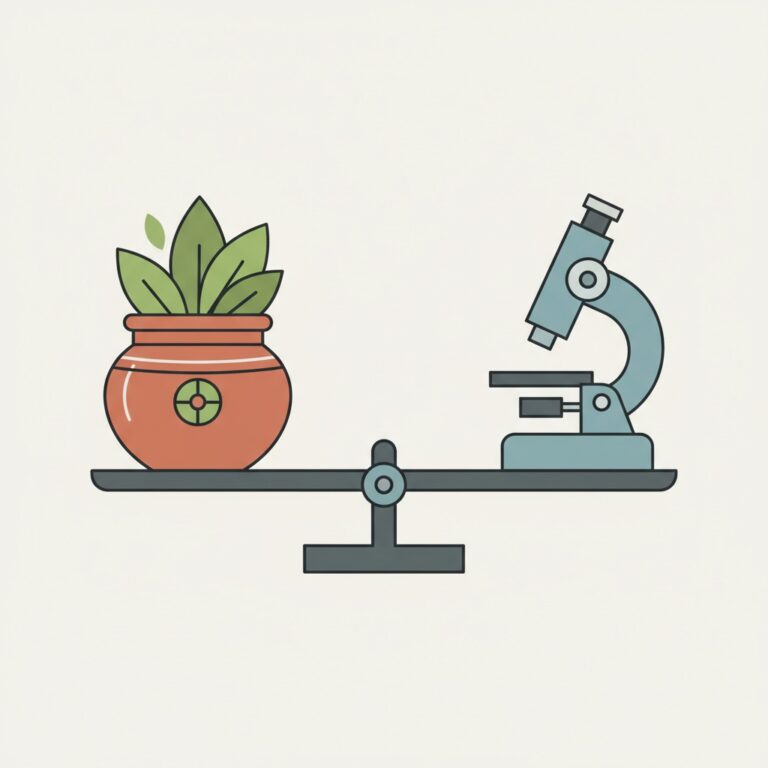
Korean for Critics: Debating Alternative Medicine Like a Pro
Hello! This is Maeil Hangul (매일한글), here to upgrade your Korean skills to the next level!
Today, we’re diving into a sophisticated topic: how to critically discuss and write about alternative and integrative medicine in Korean. This is perfect for when you want to share your nuanced opinions on a documentary, participate in a debate, or write a thoughtful critique. Lately in Korea, wellness documentaries exploring everything from traditional Hanbang (한방) to new-age therapies are trending on streaming services, sparking lively discussions online. With the expressions you learn today, you’ll be able to jump right into those conversations with confidence and precision!
Core Expressions for Your Critical Toolkit
Here are four key expressions that will help you analyze and critique with the nuance of a native speaker.
1. 일리가 있다 (illiga itda)
- Pronunciation [Romanization]: [il-li-ga it-da]
- English Meaning: To have a point; to be reasonable or plausible.
- Detailed Explanation: This is an essential phrase for creating a balanced argument. You use it to acknowledge the validity of a point before you introduce your own counterargument. It shows that you’re not dismissing the other side outright, which makes your critique more persuasive. It’s suitable for both formal writing and educated conversation.
- 💡 Pronunciation Tip: The magic here happens between ‘일(il)’ and ‘리(li)’. The ‘ㄹ(l)’ at the end of the first syllable links directly to the ‘ㄹ(l)’ at the beginning of the second, creating a smooth, elongated ‘L’ sound: [illi]. It’s not “il-liga,” but rather “il-li-ga.” This sound-linking (연음, yeoneum) is key to sounding natural.
2. 맹신하다 (maengsinhada)
- Pronunciation [Romanization]: [maeng-sin-ha-da]
- English Meaning: To blindly believe; to have blind faith in something.
- Detailed Explanation: This powerful verb carries a negative connotation and is used to criticize an uncritical or fanatical belief in something—be it a person, an ideology, or a medical claim. The character ‘맹'(maeng) means ‘blind’. It’s the perfect word to use when arguing that someone is accepting information without proper skepticism or evidence.
- 💡 Pronunciation Tip: The pronunciation is straightforward, but focus on the clear distinction between the syllables. The ‘ㅇ(ng)’ in ‘맹(maeng)’ is a soft nasal sound, similar to the ‘-ng’ in “singing.”
3. 검증되지 않았다 (geomjeungdoeji anatda)
- Pronunciation [Romanization]: [geom-jeung-dwe-ji a-nat-da]
- English Meaning: To be unverified; to be unproven.
- Detailed Explanation: This is a crucial phrase for any discussion involving scientific or factual claims. It formally states that something has not been scientifically proven or verified. Using this phrase instantly elevates your argument, grounding it in a need for evidence. It’s frequently used in academic papers, news reports, and formal debates.
- 💡 Pronunciation Tip: The part to watch is ‘되지’ (doe-ji). While written as ‘doe-ji’, it’s often pronounced more smoothly as [dwe-ji]. Also, in the final part ‘않았다’ (anatda), the ‘ㅎ(h)’ sound is silent when followed by a vowel, and the ‘ㄴ(n)’ links to the next syllable, making the sound [a-nat-da].
4. ~는 점을 간과해서는 안 된다 (~neun jeom-eul gan-gwahaeseoneun an doenda)
- Pronunciation [Romanization]: [~neun jeo-meul gan-gwa-hae-seo-neun an dwen-da]
- English Meaning: We must not overlook the fact that…
- Detailed Explanation: This is a sophisticated grammatical structure used to introduce a critical point that others might have missed. It’s a very strong and formal way to guide the listener’s attention to a potential flaw or an important consideration. It adds a serious, analytical tone to your writing or speech.
- 💡 Pronunciation Tip: The key is the smooth flow. In ‘점을’ (jeom-eul), the final ‘ㅁ(m)’ sound links to the next syllable, making it sound like [jeo-meul]. The most complex part is ‘해서는 안 된다’ (haeseoneun an doenda), which flows together naturally in conversation. Practice saying it as a single, connected phrase.
Example Dialogue
Let’s see how two friends, Sora and Ji-hoon, might use these expressions while discussing a new documentary about “miracle herbs.”
Sora: 지훈아, 어제 그 ‘자연의 치유력’이라는 다큐멘터리 봤어? 좀 흥미롭던데.
(Ji-hoon, did you see that documentary yesterday called ‘The Healing Power of Nature’? It was pretty interesting.)
Ji-hoon: 응, 봤어. 스트레스 관리에 대한 부분은 일리가 있더라. 확실히 명상이 도움은 되지.
(Yeah, I saw it. The part about stress management had a point. Meditation is definitely helpful.)
Sora: 맞아. 하지만 그 약초가 모든 병을 고친다는 주장은 좀…
(Right. But the claim that this one herb cures all diseases is a bit…)
Ji-hoon: 정확해. 과학적으로 검증되지 않았는데 그걸 맹신하는 건 위험하다고 생각해. 그리고 제작사가 그 약초를 직접 판매한다는 점을 간과해서는 안 돼.
(Exactly. I think it’s dangerous to blindly believe in it when it’s unverified by science. And we must not overlook the fact that the production company itself sells that herb.)
Culture Tip: The Unique Position of Hanbang (한방)
When discussing alternative medicine in Korea, you can’t ignore Hanbang (한방, traditional Korean medicine). Unlike in many Western countries where traditional medicine is purely “alternative,” Hanbang is an institutionalized part of the national healthcare system.
There are licensed Hanui-sa (한의사, traditional medicine doctors), university hospitals for Hanbang, and many treatments are even covered by national health insurance. Because of this, the debate in Korea isn’t just about “science vs. pseudoscience.” It’s a more complex conversation about integrating two different medical paradigms. When you use today’s critical expressions, remember this context. You can critique a specific unverified claim without dismissing the entire field of Hanbang, which many Koreans trust and use regularly. Knowing this will make your opinion sound much more informed and culturally aware!
Let’s Wrap It Up & Practice!
Today, we learned four excellent expressions to help you articulate a balanced and critical viewpoint in Korean:
- 일리가 있다 (To have a point)
- 맹신하다 (To blindly believe)
- 검증되지 않았다 (To be unverified)
- ~는 점을 간과해서는 안 된다 (We must not overlook the fact that…)
Now it’s your turn to be the critic!
Practice Quiz:
1. Fill in the blank: 그 치료법의 효과는 아직 과학적으로 __________. (The effectiveness of that treatment method has not yet been scientifically __________.)
2. Using ~는 점을 간과해서는 안 된다, write a short sentence critiquing a movie you’ve seen recently. (e.g., “The visuals were amazing, but we must not overlook the fact that the plot was weak.”)
Leave your answers in the comments below! I’d love to see you put these powerful expressions to use. Happy learning







