

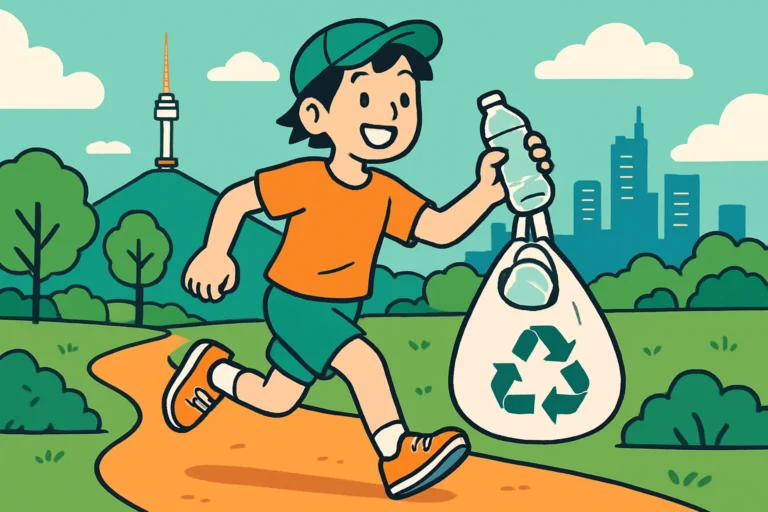
지구를 지켜라! Creative Korean Phrases for Eco-Warriors
Hello! It’s your favorite Korean booster, [Maeil Hangeul], here to upgrade your language skills!
Have you ever wanted to talk about protecting the environment in Korean, but felt like you only knew the basic words like “recycling”? Today, we’re going to level up! We’ll learn some creative and trendy expressions that will help you discuss eco-friendly ideas like a native speaker.
Lately in Korea, there’s a huge wave of interest in environmentalism, especially among younger generations. You’ll see things like “plogging” (플로깅), upcycling art, and “zero-waste” challenges all over social media. These phrases will not only help you understand these trends but also inspire you to think of your own creative solutions!
Core Expressions for Eco-Innovators
Here are some key phrases to get you started on your journey to becoming a Korean-speaking eco-warrior!
1. 일석이조 (Ilseogijo)
- Romanization: [il-seo-gi-jo]
- English Meaning: Killing two birds with one stone.
- Detailed Explanation: This is a very common four-character idiom (사자성어) derived from Chinese characters: 一 (one) 石 (stone) 二 (two) 鳥 (bird). It describes achieving two things with a single action. It’s the perfect way to talk about activities like “plogging” (줍깅 or 플로깅), where you get exercise and clean up your neighborhood simultaneously.
- 💡 Pronunciation Tip:
The final consonant ‘ㄱ’ in ‘석’ links with the ‘이’ that follows, so it’s not pronounced “il-seok-i-jo” but smoothly as [il-seo-gi-jo]. Think of it flowing together like one word!
2. 분리수거를 철저히 하다 (Bullisugeoreul cheoljeohi hada)
- Romanization: [bul-li-su-geo-reul cheol-jjeo-hi ha-da]
- English Meaning: To separate trash for recycling thoroughly.
- Detailed Explanation: You probably know
분리수거(recycling separation), but the key word here is 철저히 (cheoljeohi), which means “thoroughly” or “meticulously.” In Korea, recycling isn’t just a suggestion; it’s a detailed system. Using this phrase shows you understand the cultural importance of doing it perfectly—washing out containers, removing labels, and sorting everything correctly. - 💡 Pronunciation Tip:
The letters ‘ㅌ’ and ‘ㅎ’ in ‘철저히’ combine to create a stronger, aspirated sound. The ‘ㅎ’ (h) sound in ‘히’ is very soft, almost silent, after the ‘ㅓ’ vowel. Focus on making the [cheol-jjeo] part strong and clear.
3. 텀블러를 생활화하다 (Teombeulleoreul saenghwalhwahada)
- Romanization: [teom-beul-leo-reul saeng-hwal-hwa-ha-da]
- English Meaning: To make using a tumbler a part of daily life (a habit).
- Detailed Explanation: This is a fantastic pattern! The grammar
~을/를 생활화하다means “to make [noun] a lifestyle/habit.” It’s much more natural than saying “I use a tumbler every day.” You can apply it to other eco-friendly actions too, like장바구니를 생활화하다(to make using a reusable shopping bag a habit). - 💡 Pronunciation Tip:
In생활화[saenghwalhwa], the ‘ㄱ’ 받침 (final consonant) meets ‘ㅎ’, and they combine to create a stronger ‘ㅋ’ [k] sound. So, you’ll hear something closer to [생콸화 – saeng-kwal-hwa]. This is a common pronunciation rule in Korean!
4. 용기내 챌린지 (Yonggi-nae chaellinji)
- Romanization: [yong-gi-nae chael-lin-ji]
- English Meaning: The “Take Courage / Bring Your Container” Challenge.
- Detailed Explanation: This is a brilliant and trendy phrase that involves a clever pun! The word 용기 (yonggi) means two things:
- Courage (勇氣)
- Container (容器)
So, the “용기내 챌린지” is a social media movement that encourages people to have the courage to bring their own reusable containers to restaurants or markets to get takeout food, reducing single-use plastic.
- 💡 Pronunciation Tip:
The pronunciation here is straightforward. Just remember that “챌린지” is the Korean way of writing the English word “challenge.” Pronounce it with clear, distinct syllables: [chael-lin-ji].
Example Dialogue
Let’s see how these expressions work in a real conversation!
A: Wow, look at those people jogging with trash bags. What are they doing?
(우와, 저 사람들 쓰레기봉투를 들고 조깅하네. 뭐 하는 거지?)
B: Ah, they’re plogging! It’s super trendy these days. It’s a perfect example of 일석이조, isn’t it? You get to exercise and clean up the environment.
(아, 플로깅하는 거야! 요즘 완전 유행이잖아. 운동도 하고 환경도 지키고, 완전 일석이조지.)
A: That’s such a great idea! I’ve been trying to 텀블러를 생활화하고 있는데, that’s next-level. I also saw my favorite K-pop idol doing the 용기내 챌린지 on Instagram!
(정말 좋은 생각이다! 나도 텀블러를 생활화하려고 노력 중인데, 저건 차원이 다르네. 나도 내가 제일 좋아하는 아이돌이 인스타그램에서 용기내 챌린지 하는 거 봤어!)
B: Exactly! It’s all part of the fun. But of course, the most basic and important thing is to always 분리수거를 철저히 하는 것 at home.
(맞아! 다 그런 재미지. 그래도 물론 집에서 분리수거를 철저히 하는 게 제일 기본이고 중요해.)
Culture Tip & Trend Deep Dive: The #용기내챌린지
As we learned, the “Yonggi-nae Challenge” (#용기내챌린지) is more than just a phrase; it’s a powerful social movement in Korea.
Korean Z-generation (Z세대) is very active in this. They post photos on Instagram showing themselves proudly handing over their glass or stainless steel containers at bakeries, side-dish shops (반찬가게), and even coffee shops. It’s a visual way to prove their commitment to reducing waste.
So, if you want to sound like a true insider, you can say: “저도 용기내 챌린지에 동참하고 싶어요!” (I want to participate in the Yonggi-nae Challenge, too!). It shows you’re not just learning the language, but also the culture and modern trends that shape it.
Let’s Review and Practice!
Great job today! We learned that protecting the environment in Korean is about more than just vocabulary; it’s about creative, action-oriented phrases like 일석이조, ~을/를 생활화하다, and the trendy 용기내 챌린지. And don’t forget the cultural importance of doing things 철저히!
Now, it’s your turn to practice!
- Fill in the blank:
Biking to work instead of driving is a great example of _______________ because you save money on gas and get a workout. -
Create a sentence:
Using what you learned, how would you say, “I am trying to make using a reusable shopping bag a daily habit”?
Leave your answers in the comments below using the new expressions you learned today! We can’t wait to see your creative sentences
Frequently Asked Questions (FAQ)
Q: What does "철저히" mean in Korean and how do you pronounce it?
A: In Korean, "철저히" is pronounced [cheoljeohi] and means: , which means "thoroughly" or "meticulously." In Korea, recycling isn't just a suggestion; it's a detailed system. Using this phrase shows you understand the cultural importance of doing it
Q: What does "용기" mean in Korean and how do you pronounce it?
A: In Korean, "용기" is pronounced [yonggi] and means: means two things:







