

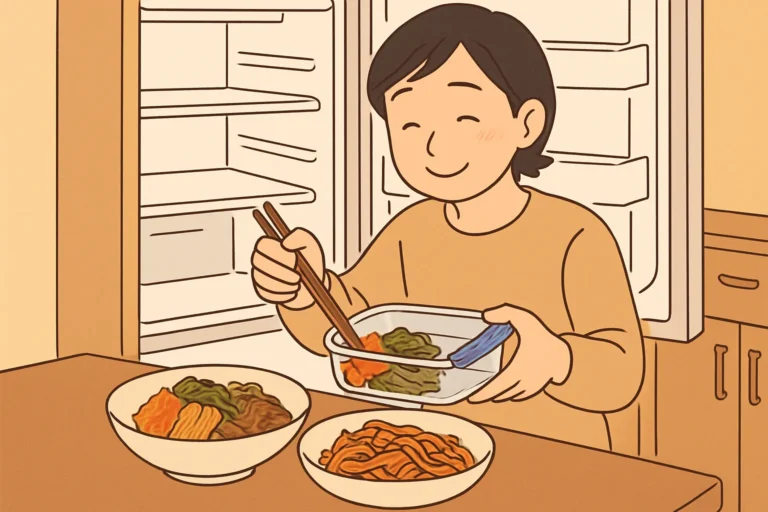
Unlock Your Fridge’s Magic: Korean for Leftovers!
Hello! This is [Daily Korean], here to upgrade your Korean skills!
Have you ever cooked a delicious Korean meal, like Japchae or Dakgalbi, and had some amazing food left over? What do you do with it? Today, we’re going to learn how to talk about storing leftovers in Korean. This is super useful for everyday life! Lately in Korea, with the “집밥 (Jib-bap / home-cooked meal)” trend and “Zero Waste” challenges on social media, knowing how to save your food properly is more popular than ever. Let’s learn how to tell your friends how to save that delicious food for later!
Core Expressions You Need to Know
Here are the essential phrases to become a master of Korean leftovers!
1. 남은 음식 (Nam-eun eum-sik)
- Pronunciation [Romanization]: [Na-meun eum-sik]
- English Meaning: Leftover food
- Detailed Explanation: This is the most common and direct way to say “leftovers.” It’s a combination of the verb 남다 (namda), meaning “to remain” or “to be left over,” and 음식 (eumsik), meaning “food.” The -은 (-eun) attached to the verb stem
남turns it into an adjective that describes the food. So, it literally means “food that is left over.” -
💡 Pronunciation Tip:
Notice how 남은 (nam-eun) is pronounced [나믄/na-meun]? This is a super important pronunciation rule called 연음 (yeon-eum), or liaison. When a syllable ends in a consonant (like남) and the next syllable starts with a vowel (like은), the consonant sound “moves over” to the next syllable. So, instead of a choppynam-eun, it flows smoothly asna-meun. You’ll see this everywhere!
2. 밀폐 용기 (Mil-pye yong-gi)
- Pronunciation [Romanization]: [Mil-pye yong-gi]
- English Meaning: Airtight container
-
Detailed Explanation: This is a must-know word for anyone serious about storing food in Korea, especially for pungent foods like kimchi! 밀폐 (milpye) means “airtight” or “sealed,” and 용기 (yonggi) means “container.” If you want to keep your food fresh and your fridge smelling clean, you need a mil-pye yong-gi.
-
💡 Pronunciation Tip:
The first syllable 밀 (mil) is straightforward. For 폐 (pye), make sure to produce a strong, airy ‘p’ sound, almost like there’s a puff of air. This is because ㅍ (p) is an aspirated consonant. It’s stronger than the ‘p’ in “spy” but similar to the ‘p’ in “pie.”
3. 냉장고에 넣다 (Naeng-jang-go-e neo-ta)
- Pronunciation [Romanization]: [Naeng-jang-go-e neo-ta]
- English Meaning: To put in the refrigerator
-
Detailed Explanation: This is your go-to phrase for the action of refrigerating something. 냉장고 (naengjanggo) is “refrigerator,” -에 (-e) is a location particle meaning “in” or “to,” and 넣다 (neota) is the verb “to put in.” You can replace “refrigerator” with 냉동실 (naengdongsil) for “freezer.”
-
💡 Pronunciation Tip:
The letter ㅎ (h) in 넣다 (neota) is very shy! When it’s at the end of a syllable, its sound is very weak or silent. So when you conjugate the verb to 넣어요 (neo-eo-yo) in the polite form, the ‘ㅎ’ sound basically disappears, and it’s pronounced [너어요/neo-eo-yo], notneo-heo-yo.
4. -(으)면 돼요 (-(eu)myeon dwae-yo)
- Pronunciation [Romanization]: [-(eu)myeon dwae-yo]
- English Meaning: You just have to… / It’s fine if you…
-
Detailed Explanation: This is an incredibly useful grammar pattern for giving simple instructions or advice. You attach it to a verb stem. If the stem ends in a vowel, you use -면 돼요. If it ends in a consonant, you use -으면 돼요. It’s a soft, friendly way to say “All you need to do is…”
- 가다 (gada) → 가면 돼요. (You just have to go.)
- 먹다 (meokda) → 먹으면 돼요. (You just have to eat it.)
Example Dialogue
Let’s see how these expressions are used in a real conversation. Imagine your friend, B, is leaving your house after you cooked them some amazing Kimchi-jjigae.
A: 이 김치찌개 남은 음식 많은데, 가져갈래?
[I Kimchi-jjigae nam-eun eum-sik man-eun-de, ga-jyeo-gal-lae?]
There’s a lot of leftover Kimchi-jjigae, do you want to take it?
B: 정말? 고마워! 이거 어떻게 보관해야 돼?
[Jeong-mal? Go-ma-wo! I-geo eo-tteo-ke bo-gwan-hae-ya dwae?]
Really? Thanks! How should I store this?
A: 이 밀폐 용기에 담아서 냉장고에 넣으면 돼요.
[I mil-pye yong-gi-e dam-a-seo naeng-jang-go-e neo-eu-myeon dwae-yo.]
You just have to put it in this airtight container and put it in the fridge.
B: 알겠어! 오늘 정말 맛있게 먹었어.
[Al-ge-sseo! O-neul jeong-mal ma-sit-ge meo-geo-sseo.]
Got it! I really enjoyed the meal today.
Culture Tip: The Art of Korean Leftovers!
You’ve learned the phrases, now let’s dive into the culture.
In Korea, the concept of leftovers is built into the food culture itself, thanks to 반찬 (banchan), or side dishes. Families often make a large batch of a few side dishes and store them in 밀폐 용기 (mil-pye yong-gi) to eat over several days. This is the original Korean meal prep!
Pro Tip: When you use these phrases, you’ll sound even more like a local if you remember this: Koreans are very particular about separating foods, especially kimchi, to prevent smells from mixing. Having a dedicated kimchi container is common in many households. So, if you’re storing kimchi, using a mil-pye yong-gi isn’t just a suggestion—it’s essential! This is why knowing this specific word is so useful.
Let’s Practice!
Great job today! You’ve learned some incredibly practical phrases for handling leftovers like a pro.
Now it’s your turn to practice.
- Fill in the blank:
You made too much Bulgogi. To keep it fresh, you should put the 남은 음식 in a _______________. -
Make a sentence:
Using the grammar pattern -(으)면 돼요, how would you tell a friend, “You just have to heat it up in the microwave”? (Hint: The verb for “to heat up” is 데우다 (de-u-da)).
Leave your answers in the comments below using the phrases we learned today! We’d love to see you try them out. Until next time
Frequently Asked Questions (FAQ)
Q: What does "남다" mean in Korean and how do you pronounce it?
A: In Korean, "남다" is pronounced [namda] and means: , meaning "to remain" or "to be left over," and
Q: What does "음식" mean in Korean and how do you pronounce it?
A: In Korean, "음식" is pronounced [eumsik] and means: , meaning "food." The
Q: What does "-은" mean in Korean and how do you pronounce it?
A: In Korean, "-은" is pronounced [-eun] and means: attached to the verb stem
Q: What does "남은" mean in Korean and how do you pronounce it?
A: In Korean, "남은" is pronounced [nam-eun] and means: is pronounced







