

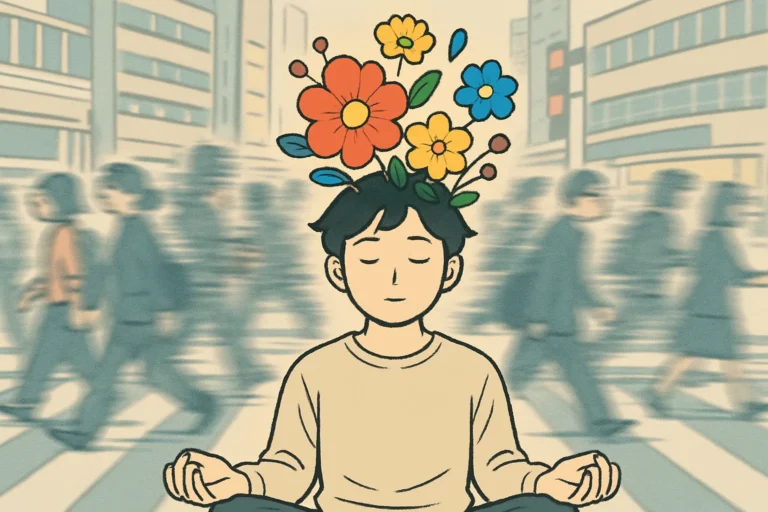
The Korean Art of Spacing Out: Unlocking Creativity Through Boredom
Hello! Welcome back to [Maeil Hangeul], your go-to source for upgrading your Korean skills!
Today, we’re moving beyond simple phrases and diving into a truly profound topic: the philosophy of boredom. Sounds heavy? Don’t worry! We’re going to explore how a state you usually try to avoid can actually be a gateway to creativity and deep thought.
Lately in Korea, there’s a fascinating trend of people actively seeking out boredom. From “spacing out” competitions (멍 때리기 대회) to digital detox cafes, Koreans are rediscovering the power of doing absolutely nothing. Let’s explore the language they use to describe this state and how you can use it to sound like a native philosopher!
Core Philosophical Expressions
Here are some key terms that will help you discuss the nuanced world of Korean boredom.
1. 지루함 (Jiruham)
- Pronunciation [Romanization]: Jiruham
- English Meaning: Boredom (from tediousness or weariness)
- Detailed Explanation: This is the negative type of boredom you’re probably most familiar with. It comes from the adjective 지루하다 (jiruhada) and describes the feeling of being weary and uninterested because something is repetitive, dull, or unengaging. Think of a monotonous lecture or a task you’ve done a thousand times. This is the kind of boredom you want to escape.
- 💡 Pronunciation Tip: The ‘ㄹ’ (r/l) in the middle of a word like in 지루함 [jiruhum] is pronounced as a soft ‘r’, almost like the ‘tt’ in the American English pronunciation of “butter.” It’s a quick tap of the tongue against the roof of your mouth.
2. 심심함 (Simsimham)
- Pronunciation [Romanization]: Simsimham
- English Meaning: Boredom (from having nothing to do)
- Detailed Explanation: This is where things get interesting. 심심함 (simsimham), from the adjective 심심하다 (simsimhada), describes a more neutral state of boredom. It’s not that you’re tired of something; it’s that you simply have nothing to occupy your time. While it can feel slightly empty, this is the state that Koreans are beginning to embrace. It’s seen as an empty canvas, a mental space free from external stimuli, where creativity and self-reflection can begin.
- 💡 Pronunciation Tip: Notice the smooth flow of the ‘m’ sounds. In Korean, sounds often blend together for easier pronunciation. The two syllables 심 (sim) and 심 (sim) connect seamlessly.
3. 멍 때리다 (Meong ttaerida)
- Pronunciation [Romanization]: Meong ttaerida
- English Meaning: To space out; to zone out; to stare blankly
- Detailed Explanation: This is a hugely popular colloquial expression! ‘멍 (meong)’ is an onomatopoeic/mimetic word for a blank or dazed state, and ‘때리다 (ttaerida)’ literally means “to hit.” So, you are “hitting a blank state.” This isn’t seen as being lazy. Rather, it’s the active practice of embracing 심심함 (simsimham). It’s a conscious decision to let your mind go blank and wander freely, providing a much-needed rest from the constant information overload of modern life.
- 💡 Pronunciation Tip: The ‘ㄸ’ in 때리다 [ttaerida] is a tensed, unaspirated consonant called ‘쌍디귿 (ssangdigeut)’. To make this sound, create tension in your throat as if you’re about to say ‘d’, but release the sound sharply without any puff of air. It’s stronger and harder than ‘ㄷ (d)’.
4. 사색에 잠기다 (Sasaege jamgida)
- Pronunciation [Romanization]: Sasaege jamgida
- English Meaning: To be lost in thought; to be immersed in contemplation
- Detailed Explanation: This is the profound, creative outcome of embracing boredom. ‘사색 (sasaek)’ means deep, philosophical thought or contemplation. ‘잠기다 (jamgida)’ means “to be submerged” or “to be immersed.” So, this phrase literally means “to be submerged in deep thought.” It’s what happens when you move through the emptiness of 심심함 and allow your mind to wander through 멍 때리기. You reach a state of deep, uninterrupted thinking where new ideas are born.
- 💡 Pronunciation Tip: This phrase is a perfect example of a pronunciation rule called liaison (연음). The final consonant ‘ㄱ’ [k] of 사색 (sasaek) moves over to the next syllable, which starts with a vowel ‘에 (e)’. Therefore, it’s not pronounced ‘sasaek-e’, but smoothly as [sasaege].
Example Dialogue
Let’s see how these concepts play out in a real conversation between two friends.
A: 요즘 아이디어가 고갈돼서 큰일이야. 창의적인 생각이 전혀 안 나.
(Yojm aidieoga gogaldwaeseo keuniriya. Chang-uijeogin saenggagi jeonhyeo an na.)
I’m in trouble because I’ve completely run out of ideas lately. I can’t think of anything creative.
B: 너무 머리를 쓰려고만 해서 그래. 가끔은 일부러 멍 때리는 시간도 필요해.
(Neomu meorireul sseuryeogoman haeseo geurae. Gakkeumeun ilbureo meong ttaerineun sigando piryohae.)
That’s because you’re trying too hard to use your brain. Sometimes you need to intentionally make time to space out.
A: 그냥 심심하게 시간 보내는 거? 그 지루함을 어떻게 견뎌?
(Geunyang simsimhage sigan bonaeneun geo? Geu jiruham-eul eotteoke gyeondyeo?)
Just spending time doing nothing? How do you endure that kind of boredom?
B: 그게 단순한 지루함이 아니야. 그 심심함을 즐기다 보면, 어느새 깊은 사색에 잠기게 될 거야. ‘멍 때리기 대회’ 우승자들 좀 봐!
(Geuge dansunhan jiruham-i aniya. Geu simsimham-eul jeulgida bomyeon, eoneusae gipeun sasaege jamgigye doel geoya. ‘Meong ttaerigi daehoe’ useungjadeul jom bwa!)
It’s not just simple tediousness. If you learn to enjoy that state of ‘nothingness,’ you’ll soon find yourself lost in deep contemplation. Just look at the winners of the ‘Spacing Out Competition’!’
Cultural Tip: The Counter-Movement to “Ppalli-Ppalli” Culture
For decades, Korea has been defined by its “빨리빨리 (ppalli-ppalli)” or “hurry, hurry” culture. While this mindset fueled incredible economic growth, it also led to widespread stress and burnout syndrome (번아웃 증후군).
The recent trend of embracing boredom—symbolized by the ‘멍 때리기 대회’ (Spacing Out Competition)—is a powerful social counter-movement. Started by the artist Woopsyang, this competition isn’t a joke; it’s a piece of performance art. Participants are judged on their ability to remain in a zoned-out state, with the winner being the person who maintains the most stable heart rate.
This shows that the younger Korean generation (often called the MZ Generation) is consciously rejecting the idea that every second must be productive. They understand that true creativity and mental well-being don’t come from a frantic pace, but from allowing the mind the space to rest, wander, and ultimately, to think deeply (사색하다). So when you use these expressions, you’re not just showing off your vocabulary; you’re tapping into a major cultural shift in modern Korea.
Let’s Review & Practice!
We learned today that not all boredom is created equal. There’s the tedious 지루함 we try to escape, and the neutral, potential-filled 심심함 we can learn to embrace. By practicing 멍 때리기, we can unlock the door to 사색, or deep contemplation.
Now, it’s your turn!
- Fill in the blank: You are on a 10-hour flight with no movies or books. You aren’t tired of anything in particular, you just have nothing to do. Would you describe this state as 지루함 or 심심함?
“비행기에서 할 게 없어서 너무 ________.”
- Short Answer: In your own words, what is the creative potential of ‘멍 때리다’?
We’d love to see your answers and thoughts! Leave a comment below using the phrases we learned today. What do you do when you feel 심심하다?
Frequently Asked Questions (FAQ)
Q: What does "지루하다" mean in Korean and how do you pronounce it?
A: In Korean, "지루하다" is pronounced [jiruhada] and means: and describes the feeling of being weary and uninterested because something is repetitive, dull, or unengaging. Think of a monotonous lecture or a task you've done a thousand times. This is the kind of boredom you want to escape.
Q: What does "지루함" mean in Korean and how do you pronounce it?
A: In Korean, "지루함" is pronounced [jiruhum] and means: is pronounced as a soft 'r', almost like the 'tt' in the American English pronunciation of "butter." It's a quick tap of the tongue against the roof of your mouth.
Q: What does "심심함" mean in Korean and how do you pronounce it?
A: In Korean, "심심함" is pronounced [simsimham] and means: , from the adjective
Q: What does "심심하다" mean in Korean and how do you pronounce it?
A: In Korean, "심심하다" is pronounced [simsimhada] and means: , describes a more neutral state of boredom. It's not that you're tired of something; it's that you simply have nothing to occupy your time. While it can feel slightly empty, this is the state that Koreans are beginning to embrace. It's seen as an empty canvas, a mental space free from external stimuli, where creativity and self-reflection can begin.







