

Let’s Cook! How to Invite Friends in Korean
Hello! Welcome to [Daily Hangul], here to upgrade your Korean skills!
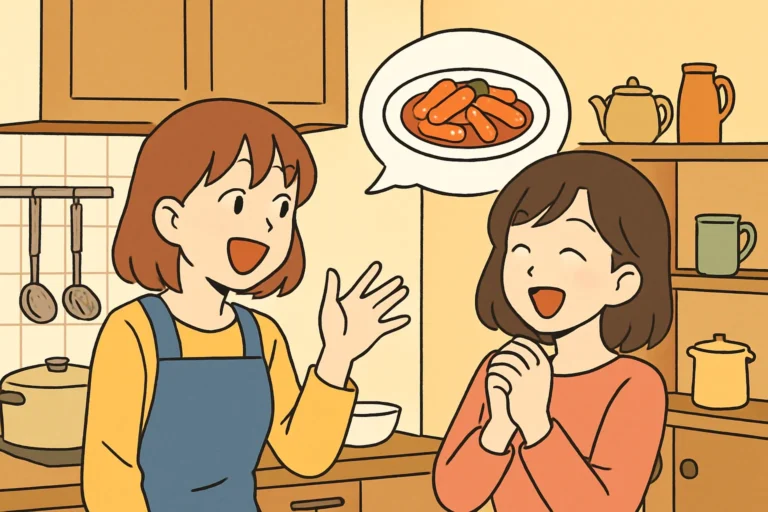
Have you ever watched a Korean drama or a mukbang (eating show) and thought, “Wow, that food looks amazing! I wish I could make that”? Well, today, you’ll learn how to invite a friend to do just that! Lately in Korea, “cookbang” (cooking shows) are incredibly popular, and cooking together with friends is a super fun way to hang out. Let’s learn some key phrases so you can suggest a fun cooking session with your friends!
Core Expressions You Need to Know
Here are three simple but essential phrases to get you started.
1. 같이 요리할래? (Do you want to cook together?)
- Pronunciation [Romanization]: Gachi yorihallae?
- English Meaning: Do you want to cook together?
- Detailed Explanation: This is a friendly and casual way to ask a friend to cook with you. It’s perfect for friends or people of the same age.
같이(gachi) means “together.”요리할래?(yorihallae?) is a casual suggestion form of the verb “to cook” (요리하다). The~ㄹ래?ending is like saying, “Do you wanna…?” in English.
- 💡 Pronunciation Tip:
Listen closely! The word같이is spelled ‘gat-i’ but pronounced [gachi]. This is because when the final consonantㅌ(t) is followed by the vowelㅣ(i), it changes to aㅊ(ch) sound. This rule is called palatalization, and it makes the pronunciation smoother. It’s the same reason굳이(gud-i) is pronounced as [guji]!
2. 뭐 만들까? (What should we make?)
- Pronunciation [Romanization]: Mwo mandeulkka?
- English Meaning: What should we make?
-
Detailed Explanation: This is the perfect follow-up question after someone agrees to cook with you.
뭐(mwo) is a casual way of saying “what.”만들까?(mandeulkka?) comes from the verb “to make” (만들다) and the~ㄹ까?grammar pattern. You use~ㄹ까?to make a suggestion or ask for someone’s opinion, like “Shall we…?” or “Should we…?”
- 💡 Pronunciation Tip:
The pronunciation of the final consonantㄹ(l) in만들can be tricky. It’s a light ‘l’ sound. When followed by까(kka), the ‘k’ sound becomes tense, almost like a double ‘k’. Practice saying [man-deul-kka?] with a soft ‘l’ and a strong ‘kk’.
3. 좋아! (Sounds good!)
- Pronunciation [Romanization]: Joa!
- English Meaning: Sounds good! / Okay! / I like it!
-
Detailed Explanation: This is a simple, enthusiastic way to agree with a suggestion. You’ll hear this all the time in Korea. It’s a positive and friendly response to almost any proposal.
-
💡 Pronunciation Tip:
Even though it’s spelled with anㅎ(h) at the end of the first syllable (좋), you don’t pronounce it! Whenㅎis a final consonant and the next syllable starts with a vowel (like아), theㅎbecomes silent. So, it’s not “joh-a,” but simply [jo-a]. Another great example is괜찮아(gwaenchan-a), which is pronounced [gwaenchana].
Example Dialogue
Let’s see how these phrases work in a real conversation. Imagine two friends, Lisa and Jisoo, planning their evening.
Lisa: 지수야, 오늘 저녁에 같이 요리할래?
Jisoo-ya, oneul jeonyeoge gachi yorihallae?
(Jisoo, do you want to cook together tonight?)
Jisoo: 좋아! 우리 뭐 만들까?
Joa! Uri mwo mandeulkka?
(Sounds good! What should we make?)
Lisa: 요즘 드라마에서 다들 떡볶이 먹던데, 우리도 떡볶이 만들자!
Yojeum deurama-eseo dadeul tteokbokki meokdeonde, urido tteokbokki mandeulja!
(Everyone’s eating tteokbokki in K-dramas lately. Let’s make tteokbokki!)
Jisoo: 와, 좋은 생각이야!
Wa, joeun saenggagiya!
(Wow, great idea!)
Culture Tip & Trend Deep Dive
In Korea, cooking and eating together is more than just a meal; it’s a social activity called ‘정 (jeong)’—a special feeling of connection and bonding. Inviting someone to cook with you is a warm and friendly gesture.
You’ll see this culture everywhere in Korean media. From popular variety shows like “Three Meals a Day” where celebrities cook together in the countryside, to the countless “cookbang” (쿡방) and “mukbang” (먹방) streams on YouTube and AfreecaTV. Making popular street foods like tteokbokki (떡볶이) or a comforting stew like kimchi-jjigae (김치찌개) at home with friends is a very common and trendy way to spend an evening.
So, when you use the phrase “같이 요리할래?”, you’re not just asking to cook. You’re inviting someone to share a fun experience and create a happy memory. You’re basically a K-drama character!
Wrap-up & Practice!
Great job today! You’ve learned how to invite a friend to cook, ask what to make, and agree to their suggestion.
Now, let’s test your skills!
Practice Question:
You want to ask a friend to make ramyeon (라면) together. How would you say it? Fill in the blank:
같이 _______ 만들래? (Gachi _______ mandeullae?)
Think you know the answer? Leave your answer and try making your own sentences using today’s phrases in the comments below! We’d love to see them







