

Mastering Eco-Debates in Korean: Beyond Just ‘Save the Planet’!
Hello! Welcome back to [Maeil Hangul], where we upgrade your Korean skills to the next level!
Are you ready to move beyond simple statements like “환경을 보호해야 해요” (We should protect the environment)? Today, we’re diving deep into the sophisticated language used in real-world environmental debates in Korea. We’ll learn how to articulate nuanced arguments, understand conflicting interests, and discuss complex conservation policies like a native speaker.
These days in Korea, discussions balancing economic development with ecological preservation are more intense than ever. From debates over offshore wind farms affecting migratory bird paths to conflicts surrounding the construction of new airports in ecologically sensitive areas, the stakes are high. Mastering the vocabulary of these debates will not only make you sound incredibly fluent but also give you a profound insight into the pressing issues of modern Korean society. Let’s get started!
Core Expressions for the Eco-Debate Stage
Here are four essential expressions that will immediately elevate your ability to discuss complex policy issues.
1. 첨예하게 대립하다 (Cheomye-hage daeripada)
- English Meaning: To be in sharp conflict / To be sharply divided.
- Detailed Explanation: This is a powerful phrase used when two sides’ opinions or interests are in extreme, direct opposition. It’s much stronger than simply ‘disagreeing’ (의견이 다르다). ‘첨예하다’ means ‘sharp’ or ‘acute,’ and ‘대립하다’ means ‘to confront.’ You’ll frequently hear this in news reports and formal debates about contentious social or political issues. Using this shows you can accurately describe the intensity of a conflict.
- 💡 Pronunciation Tip:
In ‘대립하다’, the final consonant ‘ㅂ’ (p) in ‘립’ meets the ‘ㅎ’ (h) in ‘하’. In Korean, this combination results in an aspirated sound. So, instead of a distinct daerip-hada, the sounds merge to create a strong ‘ㅍ’ (p) sound. The correct pronunciation is [대리파다 (daeripada)]. This is a common phonetic rule called aspiration.
2. 상충되다 (Sangchungdoeda)
- English Meaning: To conflict with / To be mutually exclusive.
- Detailed Explanation: This verb is perfect for describing a situation where two values, goals, or interests clash and cannot be pursued simultaneously without compromise. For example, rapid economic growth and stringent environmental protection are often seen as ‘상충되는 가치’ (conflicting values). It has a more neutral, analytical tone than ‘첨예하게 대립하다’ and is a key term in policy analysis.
- 💡 Pronunciation Tip:
This word is pronounced [상충되다 (sangchungdoeda)]. The vowel ‘ㅚ’ (oe) can be tricky for learners. While its official pronunciation is like the ‘ö’ in the German name Goethe, in modern standard Korean, it is commonly pronounced exactly the same as ‘ㅞ’ (we). So, pronouncing it as [상충뒈다 (sangchungdweda)] is perfectly natural and common.
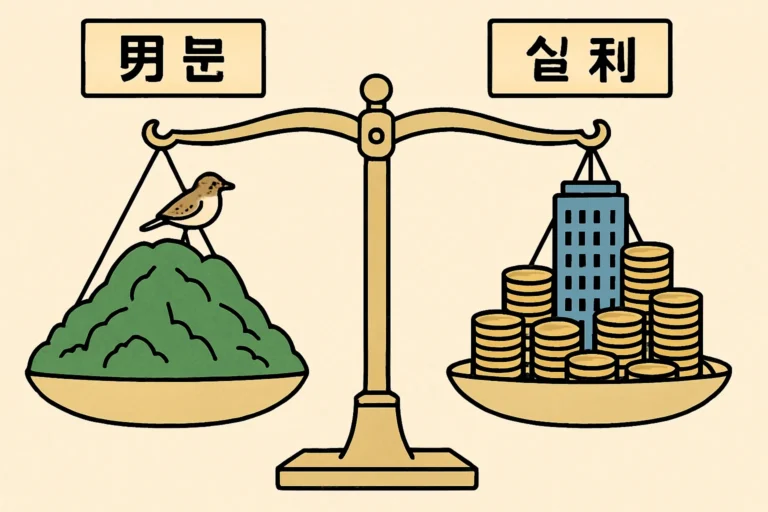
3. 명분과 실리 (Myeongbungwa silli)
- English Meaning: The justification/cause and the actual benefit/profit.
- Detailed Explanation: This is a crucial set phrase for understanding the motivations of different stakeholders.
- 명분 (Myeongbun): The official, moral, or justifiable reason for an action. It’s the “greater good” argument (e.g., “preserving our natural heritage for future generations”).
- 실리 (Silli): The practical, tangible, often economic, benefits or profits. (e.g., “creating 500 new jobs for the local community”).
Debates often involve parties emphasizing their noble ‘명분’ while strategically pursuing their ‘실리’. Recognizing this dichotomy is fundamental to analyzing Korean social and political discourse.
- 💡 Pronunciation Tip:
When a syllable ending in ‘ㄴ’ (n) is followed by a syllable beginning with ‘ㄹ’ (r/l), the ‘ㄴ’ sound is assimilated and pronounced as ‘l’. Therefore, ‘실리’ is not pronounced sil-ri but as [실리 (silli)], with a smooth, liquid ‘l’ sound. This is known as lateralization.
4. 공론화 과정 (Gongnonhwa gwajeong)
- English Meaning: The process of public deliberation / public discourse.
- Detailed Explanation: This term refers to the formal process of making an issue a subject of public discussion to gather opinions and build a social consensus. ‘공론화’ means ‘to make something a public issue,’ and ‘과정’ is ‘process.’ When a policy is controversial, stakeholders will often demand a ‘충분한 공론화 과정’ (a sufficient process of public deliberation) to ensure transparency and civic participation.
- 💡 Pronunciation Tip:
This phrase is pronounced as written: [공론화 과정 (gongnonhwa gwajeong)]. The key is to enunciate each syllable clearly. Pay attention to the ‘ㅇ’ (ng) nasal sound at the end of ‘공 (gong)’.
Example Dialogue: The National Park Debate
Let’s see how these expressions are used in a simulated town hall meeting about a proposed cable car project in a national park.
- A: 환경 운동가 (Environmental Activist)
- B: 지역 상인 대표 (Representative of Local Merchants)
A: 국립공원의 생태계를 파괴하는 케이블카 건설은 절대 안 됩니다. 환경 보존이라는 명분을 잊어서는 안 됩니다.
(Gungnipgongwonui saengtaegyereul pagoehaneun keibeulka geonseoreun jeoldae an doemnida. Hwan-gyeong bojon-iraneun myeongbuneul ijeoseoneun an doemnida.)
A: Building a cable car that destroys the national park’s ecosystem is absolutely unacceptable. We must not forget the justification of environmental conservation.
B: 하지만 케이블카가 가져올 관광 수입이라는 실리도 무시할 수 없습니다. 지역 경제 활성화와 환경 보존의 가치가 상충되는 상황이지만, 해결책을 찾아야죠.
(Hajiman keibeulkaga gajyeool gwan-gwang suib-iraneun sillido musihal su eopseumnida. Jiyeok gyeongje hwal성화wa hwan-gyeong bojonui gachiga sangchungdoeneun sanghwang-ijiman, haegyeolchaegeul chajayajyo.)
B: But we cannot ignore the actual benefit of tourism revenue the cable car will bring. While the values of revitalizing the local economy and environmental conservation do conflict, we must find a solution.
A: 양측의 입장이 이렇게 첨예하게 대립하는 만큼, 졸속으로 추진할 것이 아니라 투명한 공론화 과정을 거쳐야 합니다.
(Yangcheugui ipjang-i ireoke cheomye-hage daeripaneun mankeum, jolsogeuro chujinhal geosi anira tumyeonghan gongnonhwa gwajeongeul geochyeoya hamnida.)
A: As both sides’ positions are in such sharp conflict, this shouldn’t be rushed. It must go through a transparent process of public deliberation.
Cultural Tip & Trend Deep Dive
In Korea’s dynamic democracy, the demand for a ‘공론화 과정’ has become a powerful tool for citizen movements. It reflects a deep societal value placed on procedural justice and transparency, especially for large-scale projects with significant environmental or social impact. When you see protestors holding signs demanding this, you’ll now understand they are not just saying “let’s talk,” but are calling for a formal, structured, and inclusive public debate.
Furthermore, analyzing issues through the lens of ‘명분과 실리’ will give you a much deeper understanding of Korean news and politics. It’s a common analytical framework used by commentators to look past the public statements and understand the underlying interests driving the actions of corporations, politicians, and civic groups. Next time you read an editorial on a controversial topic, try to identify the ‘명분’ and ‘실리’ for each party involved!
Let’s Practice!
Time to put your new vocabulary to the test.
- Fill in the blank:
개발을 통해 얻는 경제적 이익과 희귀종 서식지 보존이라는 가치는 서로 (________).
(The economic profit gained from development and the value of preserving the habitat of rare species ______ with each other.) -
Short Answer Challenge:
Think about a controversial environmental issue in your country (e.g., building a dam, a new factory, etc.). In one or two sentences, try to describe the conflict using at least two of today’s expressions.
Great job today! You’ve added some incredibly powerful and sophisticated expressions to your Korean arsenal. Now you’re ready to understand and even participate in high-level discussions about critical social issues.
Try using one of the expressions you learned today in the comments below! We’d love to see you put them into practice.
Frequently Asked Questions (FAQ)
Q: What does "명분" mean in Korean and how do you pronounce it?
A: In Korean, "명분" is pronounced [Myeongbun] and means: The official, moral, or justifiable reason for an action. It's the "greater good" argument (e.g., "preserving our natural heritage for future generations").
Q: What does "실리" mean in Korean and how do you pronounce it?
A: In Korean, "실리" is pronounced [Silli] and means: The practical, tangible, often economic, benefits or profits. (e.g., "creating 500 new jobs for the local community").







