

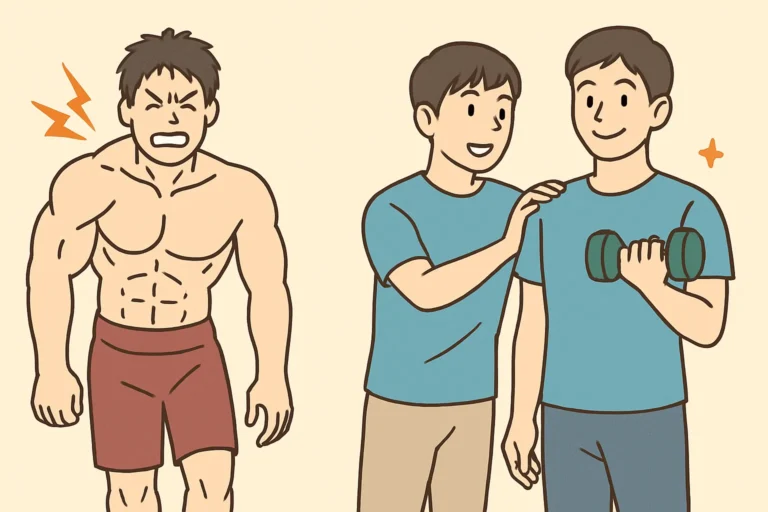
Beyond #오운완: How to Talk About Muscle Imbalance in Korean
Hello, everyone! Welcome to [Maeil Hangeul], your go-to source for leveling up your Korean skills!
Today, we’re diving into a topic that’s both incredibly relevant and crucial for your well-being: how to discuss muscle health like a pro. Ever felt a nagging pain after a workout or a long day at your desk? We’ll teach you the advanced Korean vocabulary to explain exactly what’s going on. This is especially useful if you’re into fitness or ever need to visit a physical therapist in Korea.
Lately in Korea, the #오운완 (short for 오늘 운동 완료, “Today’s Workout Complete”) and “바디프로필” (body profile photoshoot) trends are absolutely massive on social media. While these are great for motivation, they can sometimes lead to focusing too much on appearance and neglecting the body’s structural health. Let’s learn how to discuss the science behind a truly healthy body!
Core Expressions You Need to Know
Here are five key expressions that will allow you to discuss fitness and health issues with nuance and precision.
1. 근육 불균형 (Geunyuk bulgyunhyeong)
- Pronunciation [Romanized]: [Geun-yuk bul-gyun-hyeong]
- English Meaning: Muscle Imbalance
- Detailed Explanation: This is the core concept for today. 근육 (geunyuk) means ‘muscle’ and 불균형 (bulgyunhyeong) means ‘imbalance’ or ‘disproportion.’ This term is widely used in professional contexts like gyms, hospitals, and physical therapy centers. It refers to a state where some muscles are overdeveloped or tight while their opposing muscles are weak or lengthened.
- 💡 Pronunciation Tip: In 불균형 (bulgyunhyeong), the ‘ㄹ’ (l) at the end of ‘불’ can sometimes lightly influence the following ‘ㄱ’ (g), making the transition smooth. Practice saying it as one fluid phrase rather than three separate words.
2. 만성 통증 (Manseong tongjeung)
- Pronunciation [Romanized]: [Man-seong tong-jjeung]
- English Meaning: Chronic Pain
- Detailed Explanation: This term combines 만성 (manseong), meaning ‘chronic,’ with 통증 (tongjeung), meaning ‘pain’ or ‘ache.’ It’s the perfect term to describe a persistent pain that doesn’t go away, often a direct result of
근육 불균형. - 💡 Pronunciation Tip: The second syllable, 증 (jeung), starts with ‘ㅈ’. However, after the consonant ‘ㅇ’ (ng) in ‘통’, the ‘ㅈ’ sound becomes tensed. So, instead of a soft ‘j’, you should pronounce it like a strong ‘jj’ sound, as in [tong-jjeung]. This is a common rule for sounds following a final consonant.
3. 자세가 틀어지다 (Jasega teureojida)
- Pronunciation [Romanized]: [Ja-se-ga teu-reo-ji-da]
- English Meaning: For one’s posture to become distorted/crooked.
- Detailed Explanation: This is a very natural and common way to describe developing bad posture. 자세 (jase) means ‘posture,’ and the verb 틀어지다 (teureojida) means ‘to be twisted,’ ‘warped,’ or ‘distorted.’ It vividly paints a picture of the body losing its proper alignment.
- 💡 Pronunciation Tip: The verb 틀어지다 is pronounced [트러지다 (teureojida)]. The ‘으’ (eu) vowel in ‘틀’ is often reduced or glided over in natural speech, making it sound more like a quick transition from ‘t’ to ‘r’. Focus on the smooth flow from [teu] to [reo].
4. 가동 범위 (Gadong beomwi)
- Pronunciation [Romanized]: [Ga-dong beo-mwi]
- English Meaning: Range of Motion (ROM)
- Detailed Explanation: This is a technical term used in exercise science. 가동 (gadong) means ‘operable’ or ‘movable,’ and 범위 (beomwi) means ‘range’ or ‘scope.’ If a joint is stiff or restricted, you would say your
가동 범위가 줄어들었어요(My range of motion has decreased). - 💡 Pronunciation Tip: The syllable 범 (beom) ends with ‘ㅁ’ (m), and the next syllable 위 (wi) starts with a vowel. In Korean, you should connect these sounds smoothly, almost as if it’s one syllable: [beo-mwi]. Avoid a hard stop between them.
5. 재활 운동 (Jaehwal undong)
- Pronunciation [Romanized]: [Jae-hwal un-dong]
- English Meaning: Rehabilitation Exercise
- Detailed Explanation: This is the solution! 재활 (jaehwal) means ‘rehabilitation’ and 운동 (undong) is ‘exercise.’ These are exercises designed to correct imbalances, strengthen weak muscles, and restore proper function after an injury.
- 💡 Pronunciation Tip: The ‘ㅎ’ (h) in 활 (hwal) can be very soft, especially when speaking quickly. It’s not a strong, aspirated ‘h’ like in English “hello.” It’s a gentle puff of air. Listen carefully to native speakers, and you’ll notice how it blends seamlessly with the surrounding sounds.
Example Dialogue
Let’s see how these expressions work in a real conversation at the gym.
A: 아, 요즘 어깨에 계속 통증이 있네. 바디프로필 준비 때문에 무리했나 봐.
(A: Ah, I’ve had some pain in my shoulder lately. I think I overdid it preparing for my body profile photoshoot.)
B: 혹시 가슴 운동만 너무 집중한 거 아니야? 그러다 근육 불균형이 생기면 만성 통증으로 이어질 수 있어.
(B: Maybe you focused too much on just chest exercises? If you develop a muscle imbalance from that, it can lead to chronic pain.)
A: 그런 것 같아. 거울을 보니까 자세가 약간 틀어진 것 같기도 하고… 어깨 가동 범위도 줄어든 느낌이야.
(A: I think so. When I look in the mirror, it seems my posture has gotten a bit crooked, and I feel like my shoulder’s range of motion has decreased.)
B: 그럼 등 근육을 강화하는 재활 운동을 좀 해봐. 불균형을 잡는 데 도움이 될 거야.
(B: In that case, try some rehabilitation exercises to strengthen your back muscles. It will help correct the imbalance.)
Culture Tip & Trend Deep Dive
In Korea, the fitness boom has moved beyond simple weight loss. There’s a growing awareness of functional health. While #오운완 showcases daily commitment, the “바디프로필” trend has highlighted the potential dangers of aesthetic-focused training.
As a result, you’ll see many Korean gyms and physical therapists heavily advertising “체형 교정” (chehyeong gyojeong – posture correction) and “기능성 운동” (gineungseong undong – functional training). They understand that clients want to not only look good but also live without pain. Using the terms you learned today, like 근육 불균형 and 자세가 틀어지다, will show that you have a deep, contemporary understanding of Korean fitness culture. You’re not just a tourist; you’re in tune with the conversations happening right now.
Let’s Wrap It Up & Practice!
Great job today! We’ve learned some advanced, professional-level Korean to discuss the science behind a healthy body, connecting it to the latest fitness trends in Korea. You can now talk about 근육 불균형 (muscle imbalance), 만성 통증 (chronic pain), how 자세가 틀어지다 (posture gets distorted), and the importance of 가동 범위 (range of motion) and 재활 운동 (rehab exercise).
Now it’s your turn to practice!
Practice Question:
Fill in the blank with the most appropriate phrase from today’s lesson.
- 스마트폰을 너무 오래 사용하면 목과 어깨에 ________이 생겨서 통증을 유발할 수 있어요.
(If you use your smartphone for too long, you can develop a ______ in your neck and shoulders, causing pain.)
Leave your answer in the comments below! We’d also love to hear about your own fitness journey in Korean. Until next time, happy learning
Frequently Asked Questions (FAQ)
Q: What does "근육" mean in Korean and how do you pronounce it?
A: In Korean, "근육" is pronounced [geunyuk] and means: means 'muscle' and
Q: What does "불균형" mean in Korean and how do you pronounce it?
A: In Korean, "불균형" is pronounced [bulgyunhyeong] and means: means 'imbalance' or 'disproportion.' This term is widely used in professional contexts like gyms, hospitals, and physical therapy centers. It refers to a state where some muscles are overdeveloped or tight while their opposing muscles are weak or lengthened.
Q: What does "불균형" mean in Korean and how do you pronounce it?
A: In Korean, "불균형" is pronounced [bulgyunhyeong] and means: , the 'ㄹ' (l) at the end of '불' can sometimes lightly influence the following 'ㄱ' (g), making the transition smooth. Practice saying it as one fluid phrase rather than three separate words.
Q: What does "만성" mean in Korean and how do you pronounce it?
A: In Korean, "만성" is pronounced [manseong] and means: , meaning 'chronic,' with







