

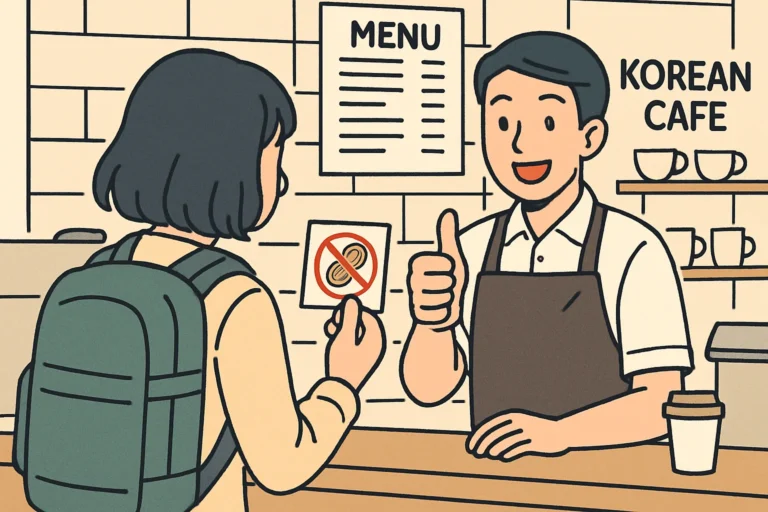
Korean Cafe Guide: How to Ask About Allergies
Hello! Welcome to [Daily Hangul], here to upgrade your Korean skills!
Have you seen all the amazing and beautiful cafes on Instagram feeds from Korea? From dalgona coffee to the trendy new salt bread, Korean cafe culture is a must-experience! But if you have a food allergy, ordering can feel a little stressful. Don’t worry! Today, we’re going to learn some essential Korean phrases to help you ask about allergens and order safely and confidently. Let’s make sure you can enjoy every delicious bite and sip without any worries!
Core Expressions You Need to Know
Here are three key phrases that will be your lifesaver in any Korean cafe or restaurant.
1. 혹시 여기에 [Allergen] 들어가요? (By any chance, does this contain [Allergen]?)
- Korean Expression: 혹시 이 빵에 견과류 들어가요?
- Pronunciation [Romanization]: Hoksi i ppang-e gyeongwaryu deureogayo?
- English Meaning: By any chance, does this bread contain nuts?
- Detailed Explanation: This is a polite and natural way to ask about ingredients.
- 혹시 (hoksi) means “by any chance” or “perhaps.” It’s a magic word that makes your question sound much softer and more polite.
- 이 빵에 (i ppang-e) means “in this bread.” You can replace 빵 (ppang) with whatever you’re asking about, like 케이크 (keikeu – cake) or 음료 (eumnyo – drink).
- 견과류 (gyeongwaryu) means “nuts.” You can swap this with your specific allergen. (e.g., 우유 (uyu – milk), 땅콩 (ttangkong – peanuts), 밀 (mil – wheat))
- 들어가요? (deureogayo?) literally means “does it go in?” and is the standard way to ask “does it contain…?”
- 💡 Pronunciation Tip:
The pronunciation of 혹시 is a bit tricky! It’s written as ‘hok-si’ but is actually pronounced [hokssi]. When the final consonant ‘ㄱ (k)’ is followed by ‘ㅅ (s)’, the ‘ㅅ’ sound becomes tense, like ‘ㅆ (ss)’. It’s a small change that makes you sound much more natural!
2. 저는 [Allergen] 알레르기가 있어요. (I have an [Allergen] allergy.)
- Korean Expression: 저는 땅콩 알레르기가 있어요.
- Pronunciation [Romanization]: Jeoneun ttangkong allereugiga isseoyo.
- English Meaning: I have a peanut allergy.
- Detailed Explanation: This is the most direct and important sentence to memorize.
- 저는 (jeoneun) is the formal way to say “I.”
- 땅콩 (ttangkong) means “peanuts.” Simply replace this with your allergen.
- 알레르기 (allereugi) is the Korean word for “allergy.” It sounds very similar to the English word, right? It’s an example of “Konglish”!
- 가 있어요 (ga isseoyo) means “I have.”
- 💡 Pronunciation Tip:
Notice the double consonant in 땅콩 [ttangkong]. The ㄸ (tt) sound is a “tense” sound. To make it, try to say ‘t’ without letting out a puff of air. It’s stronger and tighter than a regular ‘ㄷ (d/t)’ sound. Practice saying it with a little force: TTANG-KONG!
3. [Ingredient] 빼고 만들어 주실 수 있어요? (Can you make it without [Ingredient]?)
- Korean Expression: 우유 빼고 만들어 주실 수 있어요?
- Pronunciation [Romanization]: Uyu ppaego mandeureo jusil su isseoyo?
- English Meaning: Can you make it without milk?
- Detailed Explanation: This phrase is perfect for customizing your order, especially drinks.
- 우유 (uyu) means “milk.”
- 빼고 (ppaego) means “excluding” or “without.”
- 만들어 주실 수 있어요? (mandeureo jusil su isseoyo?) is a very polite way to ask, “Can you make it for me?” The 주실 수 있어요? part adds a level of respect, making it a great phrase to use with staff.
- 💡 Pronunciation Tip:
Let’s look at 만들어 (mandeureo). The consonant ㄹ (l/r) in Korean can be tricky. When it’s between two vowels like it is here, it sounds like a soft ‘r’ or a flap ‘r’, similar to the ‘tt’ in the American English pronunciation of “water.” It’s not a hard ‘L’ sound. Try to let your tongue quickly “flap” against the roof of your mouth.
Example Dialogue
Imagine you’re at a trendy cafe in Seoul famous for its “salt bread (소금빵 – sogeumppang).”
- A (You): 안녕하세요. 혹시 이 소금빵에 견과류 들어가요?
(Annyeonghaseyo. Hoksi i sogeumppang-e gyeongwaryu deureogayo?)
(Hello. By any chance, does this salt bread contain nuts?) -
B (Barista): 아니요, 견과류는 안 들어가는데, 우유랑 버터는 들어가요. 괜찮으세요?
(Aniyo, gyeongwaryuneun an deureoganeunde, uyurang beoteoneun deureogayo. Gwaenchaneuseyo?)
(No, it doesn’t contain nuts, but it does contain milk and butter. Is that okay?) -
A (You): 아, 괜찮아요! 저는 땅콩 알레르기가 있어요. 그럼 소금빵 하나 주세요.
(A, gwaenchanayo! Jeoneun ttangkong allereugiga isseoyo. Geureom sogeumppang hana juseyo.)
(Oh, that’s fine! I have a peanut allergy. I’ll have one salt bread then, please.) -
B (Barista): 네, 알겠습니다.
(Ne, algesseumnida.)
(Yes, I understand.)
Culture Tip & Trend Deep Dive
Pro-Tip for the Savvy Traveler: While cafe staff in Korea are generally very kind and helpful, awareness of less common allergies (like gluten intolerance or celiac disease) might not be as widespread as in some other countries.
For this reason, it’s a great idea to have a note saved on your phone in Korean. You can show this to the staff to be extra clear. Here’s a template:
“안녕하세요. 저는 [your allergen in Korean] 알레르기가 있습니다. 이 음식을 먹으면 안 됩니다. 재료 확인 부탁드립니다. 감사합니다.”
(Hello. I have a [your allergen] allergy. I cannot eat this food. Please check the ingredients. Thank you.)
Having this ready can prevent any miscommunication and give you extra peace of mind. You’ll look like a prepared, fluent pro!
Let’s Review & Practice!
Great job today! You’ve learned how to state your allergy, ask about ingredients, and even request a customized order. Now you’re ready to confidently explore Korea’s amazing cafes!
Let’s check what you’ve learned.
- Fill in the blank: You are allergic to milk (우유). How do you say, “I have a milk allergy”?
저는 _______ 알레르기가 있어요.
- Make a sentence: You want to ask if a smoothie (스무디) contains nuts (견과류). How would you ask politely?
What other allergy-related questions do you have? Try making your own sentence with an allergen in the comments below! We’d love to check it for you
Frequently Asked Questions (FAQ)
Q: What does "혹시" mean in Korean and how do you pronounce it?
A: In Korean, "혹시" is pronounced [hoksi] and means: means "by any chance" or "perhaps." It's a magic word that makes your question sound much softer and more polite.
Q: What does "이 빵에" mean in Korean and how do you pronounce it?
A: In Korean, "이 빵에" is pronounced [i ppang-e] and means: means "in this bread." You can replace
Q: What does "빵" mean in Korean and how do you pronounce it?
A: In Korean, "빵" is pronounced [ppang] and means: with whatever you're asking about, like
Q: What does "견과류" mean in Korean and how do you pronounce it?
A: In Korean, "견과류" is pronounced [gyeongwaryu] and means: means "nuts." You can swap this with your specific allergen. (e.g.,







