

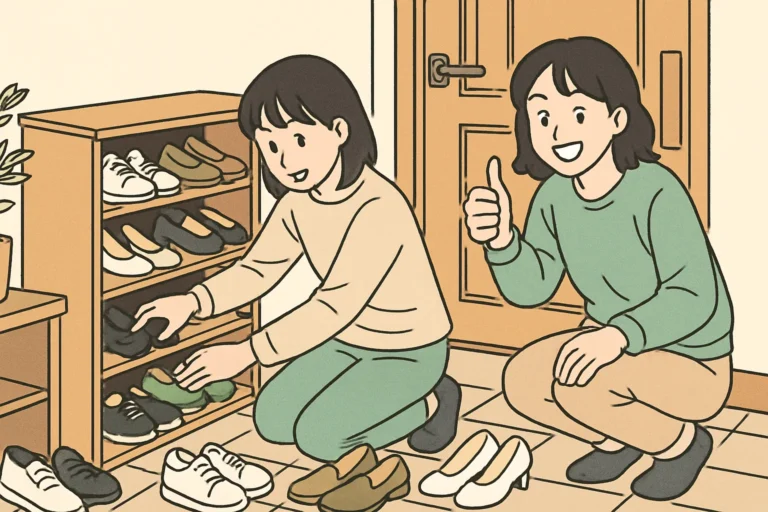
Step Up Your Korean Game: How to Organize Your Shoe Rack!
Hello! This is [Daily Hangul], here to upgrade your Korean skills! ✨
Have you ever walked into a Korean home and noticed how neat and tidy the entrance area is? Today, we’re going to learn some essential Korean phrases to talk about organizing one of the most important parts of a Korean home: the shoe rack! This will be super useful if you have a Korean roommate, visit a friend’s house, or just want to talk about tidying up your own space.
These days in Korea, it’s a huge trend for K-pop idols and YouTubers to show their homes in vlogs. You’ll often see their perfectly organized shoe racks (신발장) and hear them talk about cleaning. So, let’s learn how to talk about it just like them!
Core Expressions You Need to Know
Here are a few key expressions to get you started on your tidying journey.
1. 신발장 (Sinbaljang)
- Pronunciation [Romanized]: Sin-bal-jang
- English Meaning: Shoe rack / Shoe closet
- Detailed Explanation: This is the magic word for today!
신발 (sinbal)means ‘shoes’, and장 (jang)means ‘closet’ or ‘cabinet’. In Korea, where everyone takes their shoes off indoors, the신발장at the entrance (현관, hyeon-gwan) is an essential piece of furniture. It can be a simple rack or a tall, built-in closet.
2. 정리하다 (Jeongnihada)
- Pronunciation [Romanized]: Jeong-ni-ha-da
- English Meaning: To organize, to tidy up, to arrange
- Detailed Explanation: This is a super useful verb! You can use it for almost anything you need to organize, from your desk (
책상을 정리하다) to your thoughts (생각을 정리하다). When you want to say “Let’s organize the shoe rack,” you can say it informally to a friend like this: 신발장 정리하자! (Sinbaljang jeongnihaja!).
3. 넣어 주세요 (Neoeo juseyo)
- Pronunciation [Romanized]: Neo-eo ju-se-yo
- English Meaning: Please put (it) in.
- Detailed Explanation: This phrase comes from the verb
넣다 (neota), meaning ‘to put in’. When you add~어/아 주세요 (~eo/a juseyo), it becomes a polite request. You can point to your shoes and say, “신발장에 넣어 주세요” (Please put them in the shoe rack). - 💡 Pronunciation Tip:
The base verb is 넣다 (neota). Notice the ‘ㅎ’ (h) character in the final position (받침). When it’s followed by a vowel, like the ‘어’ (eo) in넣어 (neoeo), the ‘ㅎ’ sound becomes silent! So, you don’t pronounce it like “neo-heo.” Instead, it sounds smooth, like [너어 / neoeo]. It’s a simple trick to sound much more natural.
4. 같이 치우자! (Gachi chiuja!)
- Pronunciation [Romanized]: Ga-chi chi-u-ja!
- English Meaning: Let’s clean up together!
- Detailed Explanation: This is a friendly, informal way to suggest cleaning up with someone.
같이 (gachi)means ‘together’ and치우다 (chiuda)is another verb for ‘to clean up’ or ‘tidy up’. The~자 (~ja)ending means “Let’s…”. It’s perfect to use with friends or family. - 💡 Pronunciation Tip:
Look closely at 같이. It’s written as ‘gat-i’, but we pronounce it as [가치 / gachi]. Why? Because when the final consonant ‘ㅌ’ (t) is followed by the vowel ‘ㅣ’ (i), it makes a ‘ㅊ’ (ch) sound. This is a very common Korean pronunciation rule called palatalization. Another great example is굳이 (gud-i), which is pronounced [구지 / guji]. Remembering this will make your Korean sound amazing!
Example Conversation
Let’s see how these phrases work in a real conversation between two roommates, A and B.
A: 와, 현관이 너무 지저분해요. 신발이 너무 많아요.
(Wa, hyeongwani neomu jijeobunhaeyo. Sinbari neomu manayo.)
Wow, the entrance is so messy. There are too many shoes.
B: 맞아요. 우리 친구 오기 전에 같이 치우자!
(Majayo. Uri chingu ogi jeone gachi chiuja!)
You’re right. Let’s clean up together before our friend comes!
A: 좋아요! 이 운동화 좀 신발장에 넣어 주세요.
(Joayo! I undonghwa jom sinbaljange neoeo juseyo.)
Okay! Please put these sneakers in the shoe rack.
B: 네! 와, 이제 깨끗하네요! 아이돌 숙소 같아요!
(Ne! Wa, ije kkaekkeutaneyo! Aidol sukso gatayo!)
Okay! Wow, it’s clean now! It looks like an idol’s dorm!
Culture Tip & Trend Deep Dive 👟
In Korea, keeping the entrance (현관, hyeongwan) clean is very important because it’s the first impression of your home. Since everyone takes their shoes off, a messy pile of shoes can make the whole house feel cluttered.
Recently, a trend called 랜선 집들이 (lanseon jipdeuri), or “online housewarming party,” has become huge on YouTube and Instagram. People, including famous celebrities, give virtual tours of their homes. They almost always show off their perfectly organized closets and shoe racks! They use today’s phrases like “정리했어요” (I organized it) all the time.
So, if you use these expressions, you’re not just learning Korean; you’re also participating in a modern Korean cultural trend! To sound even more like a native, when you see a messy shoe area, you can say “신발이 왜 이렇게 많아? (Sinbari wae ireoke mana? – Why are there so many shoes?)” before suggesting, “우리 같이 정리하자!”
Let’s Practice!
Time to check what you’ve learned. You can do it!
1. Fill in the blank:
Your friend suggests cleaning the messy entrance. What do you say?
“좋아! 우리 ______ 같이 ______!” (Okay! Let’s organize the shoe rack together!)
(Hint: Use the words for ‘shoe rack’ and the informal “Let’s organize” suggestion.)
2. Quick Quiz (O/X):
Is the pronunciation of “같이” closer to [gat-i] or [ga-chi]? (O = ga-chi, X = gat-i)
Great job today! Learning these phrases will help you in everyday situations and bring you one step closer to fluency.
Now it’s your turn! Try making a sentence using one of today’s expressions and leave it in the comments below. We’d love to see it! 👇
Frequently Asked Questions (FAQ)
Q: What does "넣다" mean in Korean and how do you pronounce it?
A: In Korean, "넣다" is pronounced [neota] and means: . Notice the 'ㅎ' (h) character in the final position (받침). When it's followed by a vowel, like the '어' (eo) in
Q: What does "랜선 집들이" mean in Korean and how do you pronounce it?
A: In Korean, "랜선 집들이" is pronounced [lanseon jipdeuri] and means: , or "online housewarming party," has become huge on YouTube and Instagram. People, including famous celebrities, give virtual tours of their homes. They almost always show off their perfectly organized closets and shoe racks! They use today's phrases like "







