

Your Weekend Was Fun? Say It in Korean Like a Pro!
Hello! This is [Maeil Hangeul], here to upgrade your Korean skills!
Ever had that Monday morning chat where a Korean friend asks about your weekend, and you just freeze? You want to say it was amazing, but all you can manage is a simple “Good”? Don’t worry! Today, we’re going to learn how to talk about your awesome weekend in Korean so you can share all your fun experiences.
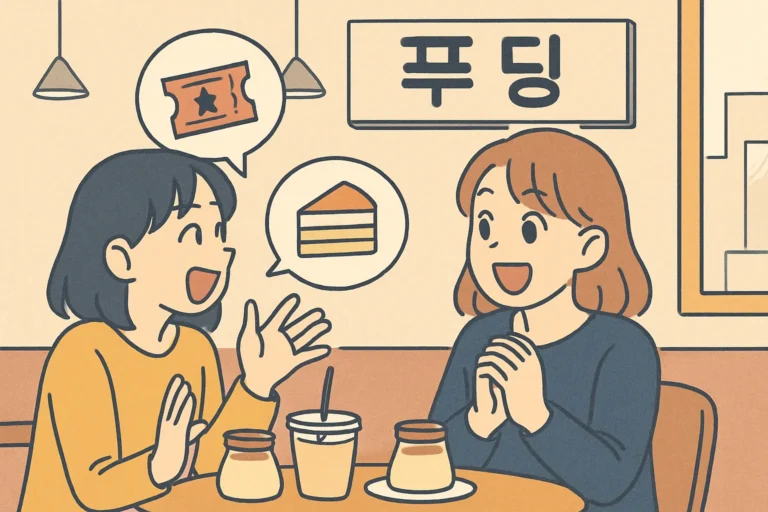
These days in Korea, everyone is talking about the unique things they did over the weekend, like visiting a new trendy “pudding cafe” or seeing the latest hit movie. After this lesson, you’ll be able to jump right into those conversations!
Core Expressions You Need to Know
Here are three essential phrases to talk about your great weekend.
1. 주말 잘 보냈어요? (Jumal jal bonaesseoyo?)
- Pronunciation [Romanization]: Ju-mal jal bo-naes-seo-yo?
- English Meaning: Did you have a good weekend?
- Detailed Explanation: This is the most common and polite way to ask someone about their weekend. Let’s break it down:
- 주말 (jumal): Weekend
- 잘 (jal): Well
- 보냈어요? (bonaesseoyo?): Did you spend/send? (Past tense of 보내다, bonaeda)
It literally means “Did you spend the weekend well?” It’s the perfect conversation starter for a Monday!
- 💡 Pronunciation Tip: The double consonant ‘ㅆ’ (ss) in ‘보냈어요’ has a tense, strong sound. Make sure to pronounce it more forcefully than a single ‘ㅅ’ (s). It’s not bo-ne-seo-yo, but bo-naes-seo-yo, with a little punch on the “ss” sound!
2. 재미있었어요 (Jaemiisseosseoyo)
- Pronunciation [Romanization]: Jae-mi-is-seos-seo-yo
- English Meaning: It was fun.
-
Detailed Explanation: This is the key phrase for today! You can use it to describe almost any enjoyable experience—a movie, a trip, a party, you name it. It comes from the verb 재미있다 (jaemiitda), which means “to be fun.” The ‘-었어요 (-eosseoyo)’ ending makes it the polite past tense.
-
💡 Pronunciation Tip: This one looks tricky, but it’s all about connecting the sounds! The word is 재미있 (jaemiit) + 었어요 (eosseoyo). The final consonant ‘ㅆ’ (ss) from ‘있’ moves over to the next syllable, so you don’t say “jae-mi-it-eos-seo-yo.” Instead, the sounds link together smoothly to become [jaemiisseosseoyo]. Practice saying it slowly first, then speed up!
3. 진짜 (Jinjja)
- Pronunciation [Romanization]: Jin-jja
- English Meaning: Really / For real
-
Detailed Explanation: Want to add some emphasis? 진짜 (Jinjja) is your best friend! You can put it before almost any adjective to strengthen its meaning. It’s a very common, casual word that makes you sound more like a native speaker.
- 진짜 재미있었어요! (Jinjja jaemiisseosseoyo!) – It was really fun!
- 💡 Pronunciation Tip: The ‘ㅉ’ (jj) sound is another tense consonant. It’s stronger and sharper than ‘ㅈ’ (j). To make this sound, press your tongue firmly against the roof of your mouth right behind your teeth, and release a short, sharp “jja” sound, almost like the “dg” in “fudge.”
Example Dialogue
Let’s see how these phrases work in a real conversation. Imagine two friends, A and B, chatting on Monday.
A: 소미 씨, 주말 잘 보냈어요?
(Somi, did you have a good weekend?)
[Somi-ssi, jumal jal bonaesseoyo?]
B: 네! 친구랑 새로 생긴 푸딩 카페에 갔어요.
(Yes! I went to a newly opened pudding cafe with a friend.)
[Ne! Chingurang saero saenggin puding kape-e gasseoyo.]
A: 와, 진짜요? 어땠어요?
(Wow, really? How was it?)
[Wa, jinjjayo? Eottaesseoyo?]
B: 진짜 재미있었어요! 케이크도 맛있었어요.
(It was really fun! The cake was delicious, too.)
[Jinjja jaemiisseosseoyo! Keikeudo masisseosseoyo.]
Culture Tip & Trend Deep Dive
In Korea, especially among the MZ generation (Millennials + Gen Z), “cafe hopping” (카페 투어, kape tueo) is a huge trend. It’s not just about getting coffee; it’s about the experience. People seek out cafes with unique themes, beautiful interiors (what Koreans call “갬성” or gaemseong vibes), and picture-perfect desserts.
When your Korean friend says they went to a cafe, they might have visited a place that looks like a European garden, a cartoon character’s house, or a minimalist art gallery! They probably took lots of photos for their Instagram.
So, when you hear about their cafe trip, responding with an enthusiastic “와, 진짜 재미있었어요?” (Wow, was it really fun?) shows that you understand this cultural trend and are genuinely interested in their experience. It’s a small phrase that builds a big connection!
Let’s Review & Practice!
Great job today! We learned how to start a conversation about the weekend (주말 잘 보냈어요?), how to say something was fun (재미있었어요), and how to add emphasis (진짜).
Now, let’s test your knowledge!
Practice Quiz:
- Fill in the blank for B’s response:
A: 어제 본 영화 어땠어요? (How was the movie you saw yesterday?)
B: _______________! 주인공이 정말 멋있었어요. (It was really fun! The main character was so cool.)
What goes in the blank? (Hint: It was really fun!)
Ready to try it yourself? Leave a comment below and tell us one thing you did last weekend using “재미있었어요”! We can’t wait to read about your fun experiences
Frequently Asked Questions (FAQ)
Q: What does "주말" mean in Korean and how do you pronounce it?
A: In Korean, "주말" is pronounced [jumal] and means: Weekend
Q: What does "잘" mean in Korean and how do you pronounce it?
A: In Korean, "잘" is pronounced [jal] and means: Well
Q: What does "보냈어요?" mean in Korean and how do you pronounce it?
A: In Korean, "보냈어요?" is pronounced [bonaesseoyo?] and means: Did you spend/send? (Past tense of 보내다, bonaeda)
Q: What does "재미있다" mean in Korean and how do you pronounce it?
A: In Korean, "재미있다" is pronounced [jaemiitda] and means: , which means "to be fun." The '-었어요 (-eosseoyo)' ending makes it the polite past tense.







