

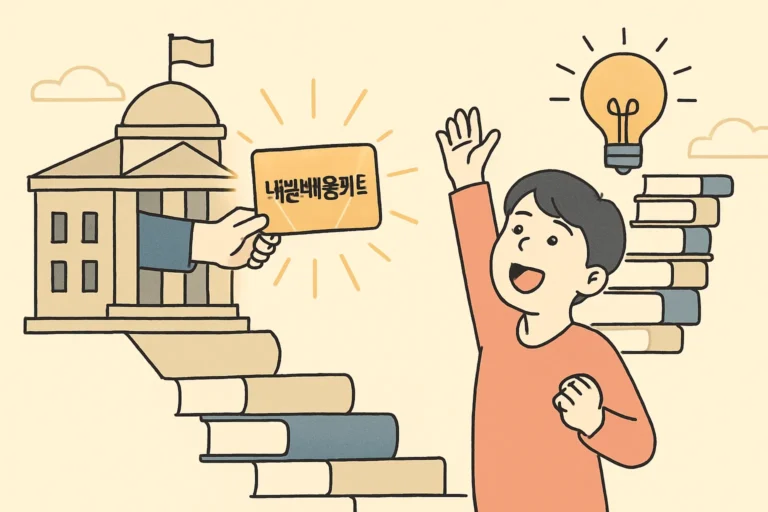
Level Up Your Career with Korean Government Support!
Hello! Welcome to [Maeil Hangeul], here to upgrade your Korean skills!
Have you ever thought about learning a new skill for your career, like coding or data analysis, while working in Korea? You might be surprised to know that you don’t have to pay for it all by yourself! Lately in Korea, the concepts of “upskilling” (역량 강화) and “reskilling” (재교육) are huge buzzwords as the job market changes rapidly. Today, we’re going to learn some essential Korean vocabulary to understand the amazing government policies that support lifelong learning for workers. This will be super useful if you’re currently working or plan to work in Korea!
Core Expressions You Need to Know
Here are the key terms that will help you navigate the world of professional development in Korea.
1. 평생 학습 (pyeongsaeng hakseup)
- Pronunciation [pyeong-saeng hak-sseup]
- English Meaning: Lifelong Learning
- Detailed Explanation: This term literally means “lifetime learning.” It reflects the strong belief in Korean society that learning shouldn’t stop after graduation. It’s about continuously acquiring new knowledge and skills throughout your life, both personally and professionally. This concept is the foundation for many government support policies.
- 💡 Pronunciation Tip: The second part, ‘학습’, is pronounced [hak-sseup], not [hak-seup]. When the syllable ‘학’ (hak) is followed by ‘습’ (seup), the ‘ㅅ’ (s) sound becomes tense, like ‘ㅆ’ (ss). This is a common sound change called ‘된소리되기’ (tensification). Practice saying it with a stronger ‘ss’ sound!
2. 내일배움카드 (Naeilbaeumkadeu)
- Pronunciation [nae-il-bae-um-ka-deu]
- English Meaning: Tomorrow Learning Card
- Detailed Explanation: This is the name of a specific, very popular government program. It’s a physical or digital card that the government loads with funds (subsidies) for citizens (and eligible foreigners!) to use for vocational training courses. ‘내일’ means ‘tomorrow’ and also ‘my job,’ so it has a clever double meaning: “a card for learning for a better tomorrow/my job.”
- 💡 Pronunciation Tip: Notice the word ‘배움’ (learning). It’s pronounced [bae-um]. The ‘ㅇ’ (ng) in the final position of ‘배’ is just a placeholder and is silent. The sound flows smoothly from the vowel ‘ㅐ’ (ae) to ‘ㅜ’ (u).
3. 국비 지원 (gukbi jiwon)
- Pronunciation [guk-ppi ji-won]
- English Meaning: Government funding / National subsidy
- Detailed Explanation: This is the magic phrase everyone wants to hear! ‘국비’ (gukbi) means “national expense,” and ‘지원’ (jiwon) means “support” or “funding.” When you see a course advertised with ‘국비 지원’, it means a significant portion, or sometimes all, of the tuition fee is covered by the government, often through the ‘내일배움카드’.
- 💡 Pronunciation Tip: The ‘ㅂ’ (b) in ‘비’ is pronounced as a strong, tense [ppi]. This is another example of ‘된소리되기’ (tensification). The final sound of the preceding syllable ‘국’ ([guk]) influences the following ‘ㅂ’ (b), making it sound like ‘ㅃ’ (pp). So, it’s not a soft guk-bi, but a stronger [guk-ppi].
4. 자기 계발 (jagi gyebal)
- Pronunciation [ja-gi gye-bal]
- English Meaning: Self-development / Self-improvement
- Detailed Explanation: This is a very common term in Korean workplaces. It refers to the activities one does to improve themselves, such as learning a new language, getting a certificate, or even exercising. Companies often encourage employees to pursue ‘자기 계발’ and may even provide financial support for it. It’s a key motivator for using programs like the ‘내일배움카드’.
- 💡 Pronunciation Tip: The pronunciation of ‘계’ can be tricky. While written as ‘gye’, in the middle of a word like this, it is often pronounced more simply as [ge]. So, instead of trying to say a distinct gyeh-bal, a more natural pronunciation is [ja-gi ge-bal].
Example Dialogue
Let’s see how these words are used in a conversation between two colleagues, Minjun (A) and Sora (B).
A (민준): 요즘 데이터 분석이 중요하다고 해서 배워보고 싶은데, 학원비가 좀 비싸네요.
(A: Minjun): I want to learn data analysis because it’s so important these days, but the academy fees are a bit expensive.
B (소라): 아, 그래요? 그럼 내일배움카드 신청해 보세요! 국비 지원을 받아서 평생 학습을 할 수 있는 좋은 제도예요.
(B: Sora): Oh, really? Then you should apply for the Naeilbaeumkadeu! It’s a great system that allows you to pursue lifelong learning with government funding.
A (민준): 정말요? 그걸로 자기 계발을 할 수 있겠네요! 좋은 정보 고마워요!
(A: Minjun): For real? I could use that for my self-development! Thanks for the great information!
Culture Tip & Trend Deep Dive
Why is 평생 학습 (lifelong learning) so important in Korea? The Korean job market is incredibly dynamic and competitive. To stay relevant and advance in their careers, employees are constantly pushed to engage in 자기 계발 (self-development).
This isn’t just an individual effort; it’s a national agenda. The government actively promotes it through policies like the 내일배움카드 (Tomorrow Learning Card). By providing 국비 지원 (government funding), they lower the financial barrier for everyone to learn new skills.
Recently, the most popular fields for upskilling are IT-related, such as programming, big data, and artificial intelligence. Many young professionals (the “Z generation”) use these government programs to completely switch careers into the tech industry. So, if you hear your Korean colleagues talking about going to a coding bootcamp after work, they are likely using one of these amazing support systems! Knowing these terms will not only help you understand policy but also the career ambitions and daily conversations of people around you.
Let’s Review & Practice!
Great job today! We learned about the Korean government’s support for workers and some very practical vocabulary.
Practice Quiz: Fill in the blanks with the words we learned today.
- I want to learn a new skill for my career. This is a form of _______________. (자기 계발)
- The government will pay for my class! I am receiving _______________. (국비 지원)
- I applied for a _______________ to get government funding for my classes. (내일배움카드)
What new skill would you like to learn in Korea? Try to make a sentence using the expressions we learned and leave a comment below! We’d love to see what you come up with
Frequently Asked Questions (FAQ)
Q: What does "'된소리되기'" mean in Korean and how do you pronounce it?
A: In Korean, "'된소리되기'" is pronounced [tensification] and means: . Practice saying it with a stronger 'ss' sound!
Q: What does "'된소리되기'" mean in Korean and how do you pronounce it?
A: In Korean, "'된소리되기'" is pronounced [tensification] and means: . The final sound of the preceding syllable '국' ([guk]) influences the following 'ㅂ' (b), making it sound like 'ㅃ' (pp). So, it’s not a soft
Q: What does "평생 학습" mean in Korean and how do you pronounce it?
A: In Korean, "평생 학습" is pronounced [lifelong learning] and means: so important in Korea? The Korean job market is incredibly dynamic and competitive. To stay relevant and advance in their careers, employees are constantly pushed to engage in
Q: What does "내일배움카드" mean in Korean and how do you pronounce it?
A: In Korean, "내일배움카드" is pronounced [Tomorrow Learning Card] and means: . By providing







