

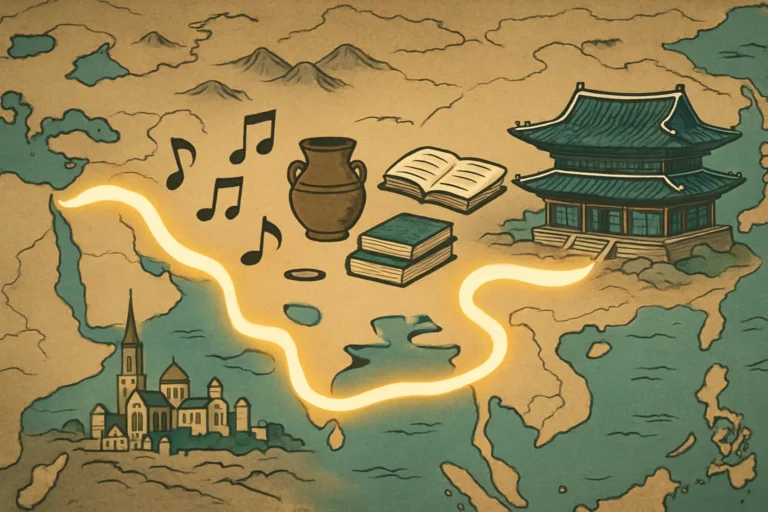
Your Korean Time Machine: Talking About the Silk Road!
Hello! This is [Daily Hangul], here to upgrade your Korean skills!
Have you ever wanted to talk about history or culture in Korean? Maybe you’re visiting a museum in Seoul or watching a historical K-drama and want to share your thoughts. Today, we’re going to travel back in time and learn how to talk about one of the most important trade routes in history: the Silk Road!
Lately in Korea, there’s been a huge surge of interest in historical documentaries and dramas that explore ancient connections between different cultures. The Silk Road is a hot topic! Learning these phrases will not only help you discuss history but also impress your Korean friends with your deep cultural knowledge. Let’s get started!
Core Expressions You Need to Know
Here are three essential phrases to help you talk about the influence of the Silk Road like a pro.
1. 영향을 주다 (yeonghyang-eul juda)
- Romanization: [Yeonghyang-eul juda]
- English Meaning: To have an influence/effect on…
- Detailed Explanation: This is a key phrase for talking about cause and effect in history. ‘영향’ (yeonghyang) means “influence” or “effect,” and ‘주다’ (juda) means “to give.” So, literally, you are “giving an influence.” You can use it to describe how one thing changed another. For example, “The Silk Road had a great influence on Korean culture.”
- 💡 Pronunciation Tip: The ‘ㅎ’ (h) sound in ‘향’ (hyang) is very soft and breathy, almost like a sigh. Be careful not to make it a hard ‘h’ sound like in the English word “hat.” It’s a gentle puff of air!
2. 교류하다 (gyoryuhada)
- Romanization: [Gyo-ryu-ha-da]
- English Meaning: To exchange / To interact
- Detailed Explanation: While you could use a word for “trade,” ‘교류하다’ (gyoryuhada) is much broader and more sophisticated. It implies an exchange of not just goods, but also ideas, culture, technology, and religion. It’s the perfect word for describing the rich interactions that happened along the Silk Road. The noun form is ‘교류’ (gyoryu).
- 💡 Pronunciation Tip: The first syllable ‘교’ (gyo) is a sound that can be tricky for English speakers. Think of saying “key-oh” very quickly, blending them into one smooth sound: [gyo].
3. A와 B를 잇다 (A-wa B-reul itda)
- Romanization: [A-wa B-reul itda]
- English Meaning: To connect A and B
- Detailed Explanation: This phrase is essential for describing the physical and cultural function of the Silk Road. ‘잇다’ (itda) means “to connect” or “to link.” You can use it to talk about connecting places (East and West), people, or even ideas. It creates a powerful image of a bridge between two different worlds.
- 💡 Pronunciation Tip: This one has a super important pronunciation rule! The letter ‘ㅅ’ at the end of a syllable block, like in ‘잇’ (it), is pronounced as a [t] sound. So, ‘잇다’ is pronounced [it-da]. But when you add a particle that starts with a vowel, like ‘있는’ (it-neun – connecting), the ‘ㅅ’ sound actually becomes an [n] sound to flow more smoothly! So, ‘있는’ is pronounced [인는 / inneun]. This is called nasalization, and mastering it will make you sound much more natural!
Example Dialogue
Let’s see how these phrases work in a real conversation. Imagine two friends, A and B, are watching a documentary about the Silk Road.
A: 와, 이 다큐멘터리 정말 흥미롭다! 실크로드가 이렇게 길었구나.
(Wa, i dakyumenteori jeongmal heungmiropda! Silkeurodeu-ga ireoke gireotguna.)
(Wow, this documentary is so interesting! I didn’t realize the Silk Road was this long.)
B: 맞아. 동양과 서양을 잇는 아주 중요한 길이었지.
(Maja. Dong-yang-gwa seo-yang-eul itneun aju jung-yohan girieotji.)
(That’s right. It was a very important road that connected the East and the West.)
A: 물건만 교류한 게 아니라, 문화도 많이 섞였겠네.
(Mulgeon-man gyoryuhan ge anira, munhwa-do mani seokkyeotgenne.)
(They didn’t just exchange goods; cultures must have mixed a lot, too.)
B: 당연하지! 그래서 실크로드가 세계 역사에 큰 영향을 준 거야.
(Dang-yeonhaji! Geuraeseo silkeurodeu-ga segye yeoksa-e keun yeonghyang-eul jun geo-ya.)
(Of course! That’s why the Silk Road had such a huge influence on world history.)
Culture Tip & Trend Deep Dive
In Korea, history isn’t just something you learn in a classroom. It’s a popular topic on TV shows, YouTube channels, and even in webtoons! When Koreans discuss history, they often focus on ‘교류’ (gyoryu) – the exchange between cultures.
You’ll see the word ‘교류’ used everywhere today, not just for history. For example, people talk about ‘문화 교류’ (munhwa gyoryu) when discussing the global popularity of K-Pop and K-dramas (Hallyu). They see Hallyu as a modern-day Silk Road, connecting Korea to the world.
So, when you use a word like ‘교류하다’, you’re not just using advanced vocabulary; you’re tapping into the way Koreans view the connection between the past and the present. Using this word shows you have a deeper understanding of Korean culture!
Let’s Practice!
Ready to test your new knowledge?
- Fill in the blank: The Silk Road was a path that ______ the cultures of the East and West.
실크로드는 동양과 서양의 문화를 ______ 길이었어요.
- Make your own sentence! Using the phrase ‘영향을 주다’, write a short sentence in the comments about something that has influenced you. (e.g., “K-Pop had a big influence on my life.”)
You did a fantastic job today! Keep practicing, and soon you’ll be able to discuss all sorts of interesting topics in Korean.
Don’t forget to leave a comment with your answers to the practice questions! We’d love to see them
Frequently Asked Questions (FAQ)
Q: What does "'영향'" mean in Korean and how do you pronounce it?
A: In Korean, "'영향'" is pronounced [yeonghyang] and means: means "influence" or "effect," and
Q: What does "'주다'" mean in Korean and how do you pronounce it?
A: In Korean, "'주다'" is pronounced [juda] and means: means "to give." So, literally, you are "giving an influence." You can use it to describe how one thing changed another. For example, "The Silk Road had a great influence on Korean culture."
Q: What does "'향'" mean in Korean and how do you pronounce it?
A: In Korean, "'향'" is pronounced [hyang] and means: is very soft and breathy, almost like a sigh. Be careful not to make it a hard 'h' sound like in the English word "hat." It's a gentle puff of air!
Q: What does "'교류하다'" mean in Korean and how do you pronounce it?
A: In Korean, "'교류하다'" is pronounced [gyoryuhada] and means: is much broader and more sophisticated. It implies an exchange of not just goods, but also ideas, culture, technology, and religion. It’s the perfect word for describing the rich interactions that happened along the Silk Road. The noun form is







