

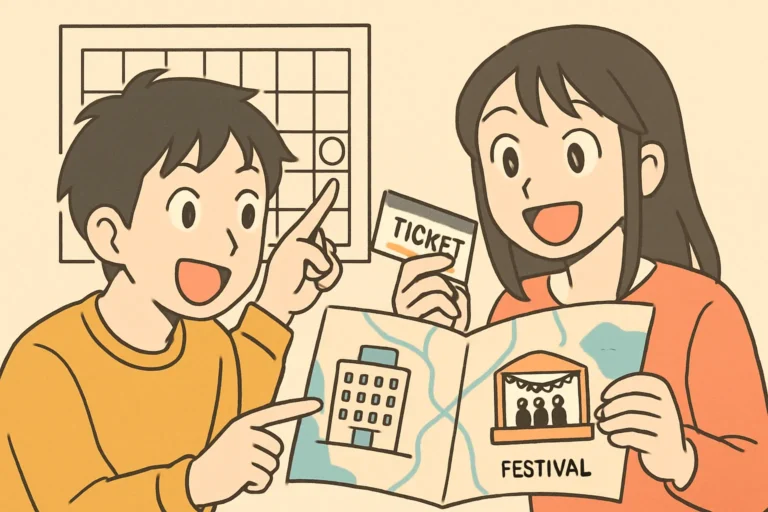
Your K-Guide to Planning the Ultimate Festival Trip!
Hello! This is Maeil Hangeul (매일한글), here to upgrade your Korean skills!
Have you ever dreamed of dancing at a music festival abroad or experiencing a magical cultural celebration like Thailand’s Lantern Festival? You’re not alone! These days in Korea, going on a “theme trip” (테마 여행) is a huge trend, and traveling specifically for a festival is at the top of the list.
Today, we’ll learn essential Korean phrases to help you plan that dream festival trip with your Korean friends. Let’s get you ready for your next adventure!
Core Expressions for Your Trip Planning
Here are four key phrases that will make you sound like a native Korean planner!
1. 축제 기간 (Chukje gigan)
- Pronunciation [Romanization]: Chukje gigan
- English Meaning: Festival period
- Detailed Explanation: This is a combination of 축제 (chukje), meaning “festival,” and 기간 (gigan), meaning “period” or “duration.” It’s the first thing you need to check! You can ask, “축제 기간이 언제예요?” (When is the festival period?).
- 💡 Pronunciation Tip: The first letter ‘ㅊ’ (ch) is an aspirated sound. You should release a strong puff of air, like the ‘ch’ in “chart.” For ‘기간’, the ‘ㄱ’ (g) at the beginning of a word block sounds closer to a ‘k’ sound. So, it’s more like [Chuk-je ki-gan].
2. 항공권 예매하다 (Hanggonggwon yemaehada)
- Pronunciation [Romanization]: Hanggonggwon yemaehada
- English Meaning: To book a flight ticket
- Detailed Explanation: Let’s break it down: 항공권 (hanggonggwon) means “flight ticket,” and 예매하다 (yemaehada) means “to book in advance.” This verb is commonly used for tickets you purchase ahead of time, like for concerts, movies, or flights. It carries a nuance of “purchasing a reservation.”
- 💡 Pronunciation Tip: A cool sound change rule called nasalization happens here! In ‘항공권’, the 받침 (final consonant) ‘ㄱ’ (k) comes before ‘ㄴ’ (n) in the next word block, but here the focus is on the sound within the word itself. The ‘ㅇ’ (ng) sound makes it flow smoothly. The pronunciation is close to [han-gong-kwon]. Practice saying it smoothly!
3. 숙소를 잡다 (Suksoreul japda)
- Pronunciation [Romanization]: Suksoreul japda
- English Meaning: To get/book accommodation
- Detailed Explanation: 숙소 (sukso) means “accommodation” or “a place to stay.” While you can say ‘숙소를 예약하다’ (suksoreul yeyakada – to reserve accommodation), using the verb 잡다 (japda) is a very common and natural-sounding colloquialism. ‘잡다’ literally means “to catch” or “to grab,” so the feeling is like you’re “securing” or “grabbing” a room before it’s gone.
- 💡 Pronunciation Tip: This is a perfect example of the linking sound rule (연음). The final consonant ‘ㄹ’ (l) in ‘숙소를’ moves over to the next syllable, which starts with a vowel. So, instead of
suk-so-eul, you pronounce it naturally as [suk-so-reul]. It makes your Korean sound much more fluid!
4. 일정을 짜다 (Iljeongeul jjada)
- Pronunciation [Romanization]: Iljeongeul jjada
- English Meaning: To plan an itinerary
- Detailed Explanation: 일정 (iljeong) means “schedule” or “itinerary.” The verb 짜다 (jjada) originally means “to weave” or “to assemble.” Isn’t that a beautiful way to think about planning? You’re “weaving” together different activities to create a perfect schedule. It’s the most natural verb to use when talking about making a plan.
- 💡 Pronunciation Tip: The ‘ㅉ’ (jj) in ‘짜다’ is a tense consonant. It’s pronounced with more tension in your throat and tongue than the regular ‘ㅈ’ (j). There’s no puff of air. It’s a short, sharp sound, similar to the ‘j’ sound in “pizza” said quickly.
Example Conversation
Let’s see how these phrases work in a real conversation between two friends planning a trip to Coachella!
A: 우리 올해 코첼라 페스티벌 갈래? 축제 기간 확인했는데, 4월이래!
(Uri olhae Kochella peseutibeol gallae? Chukje gigan hwaginhaenneunde, saworirae!)
Hey, wanna go to Coachella this year? I checked the festival period, and it’s in April!
B: 진짜? 대박! 그럼 빨리 항공권 예매해야겠다. 비싸지기 전에!
(Jinjja? Daebak! Geureom ppalli hanggonggwon yemaehaeyagetda. Bissajigi jeone!)
Really? Awesome! Then we should book the flight tickets quickly. Before they get expensive!
A: 맞아. 그리고 근처에 숙소를 잡는 게 제일 중요해. 이미 거의 다 찼을걸?
(Maja. Geurigo geuncheoe suksoreul jamneun ge jeil jungyohae. Imi geoui da chasseulgeol?)
Right. And getting accommodation nearby is the most important thing. I bet most places are already booked.
B: 알겠어. 오늘 저녁에 바로 알아보자! 숙소 잡고 나면 주말에 같이 일정을 짜자.
(Argesseo. Oneul jeonyeoge baro araboja! Sukso japgo namyeon jumare gachi iljeongeul jjaja.)
Got it. Let’s look into it tonight! After we book a place, let’s plan the itinerary together this weekend.
Culture Tip & Trend Deep Dive
In Korea, planning a trip (여행 계획) is serious business, especially for the MZ generation (Millennials + Gen Z). The concept of ‘P’ (Perceiving) vs. ‘J’ (Judging) from the MBTI personality test has become a nationwide meme.
- ‘J’ Planners (파워 J): These are the meticulous planners. They are the ones who would create a detailed Excel spreadsheet for the trip, with budgets, timetables, and backup plans. They would use the phrase 일정을 짜다 with pride! If you love to plan, you can say, “저는 ‘J’라서 일정을 미리 짜야 마음이 편해요.” (I’m a ‘J’, so I feel at ease only when I plan the itinerary in advance.)
- ‘P’ Travelers (P): These are the spontaneous adventurers. They might book a flight and figure out the rest later. They prefer a flexible trip over a tight schedule.
Which type are you? Understanding this little cultural tidbit will make your conversations about travel planning with Koreans even more fun!
Wrap-up & Practice!
Great job today! You’ve learned four essential phrases for planning the perfect festival trip:
* 축제 기간 (Chukje gigan): Festival period
* 항공권 예매하다 (Hanggonggwon yemaehada): To book a flight ticket
* 숙소를 잡다 (Suksoreul japda): To get accommodation
* 일정을 짜다 (Iljeongeul jjada): To plan an itinerary
Now, let’s put your knowledge to the test!
Quiz: Fill in the blank with the most natural expression we learned today.
Your friend says: “I just booked our flight tickets to Spain for the Tomatina festival!”
You reply: “Awesome! 그럼 이제 _________. 어디에 머물지 찾아보자.” (Great! Then let’s ________ now. Let’s find a place to stay.)
What should go in the blank? (Answer below!)
Let us know your answer in the comments! And for fun, try planning your dream festival trip using today’s expressions in the comments below!
(Quiz Answer: 숙소를 잡자 / 숙소를 잡아야지)
Frequently Asked Questions (FAQ)
Q: What does "축제" mean in Korean and how do you pronounce it?
A: In Korean, "축제" is pronounced [chukje] and means: , meaning "festival," and
Q: What does "기간" mean in Korean and how do you pronounce it?
A: In Korean, "기간" is pronounced [gigan] and means: , meaning "period" or "duration." It's the first thing you need to check! You can ask, "
Q: What does "항공권" mean in Korean and how do you pronounce it?
A: In Korean, "항공권" is pronounced [hanggonggwon] and means: means "flight ticket," and
Q: What does "예매하다" mean in Korean and how do you pronounce it?
A: In Korean, "예매하다" is pronounced [yemaehada] and means: means "to book in advance." This verb is commonly used for tickets you purchase ahead of time, like for concerts, movies, or flights. It carries a nuance of "purchasing a reservation."







