

Hello! This is Daily Hangul, here to upgrade your Korean skills!
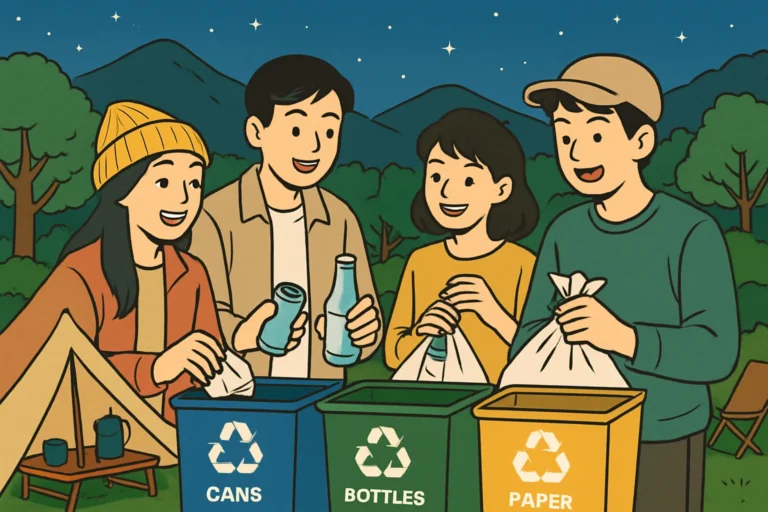
Have you ever dreamed of camping under the stars in one of Korea’s beautiful national parks? It’s an amazing experience! But to be a truly great camper, you need to know how to leave the place as beautiful as you found it.
Nowadays in Korea, “clean camping” (클린 캠핑) and “plogging” (플로깅 – jogging while picking up litter) are huge trends, especially among young people. It’s considered very cool and responsible to take care of nature. So today, let’s learn some essential Korean phrases to help you become an eco-friendly camping pro!
Core Expressions You Need to Know
Here are three key phrases for cleaning up your campsite like a local.
1. 우리 같이 치우자! (Uri gachi chiuja!)
- Romanization: Uri gachi chiuja!
- English Meaning: Let’s clean up together!
- Detailed Explanation: This is a friendly, casual phrase you use with friends to suggest cleaning up. 우리 (uri) means “we” or “our,” 같이 (gachi) means “together,” and 치우자 (chiuja) is the “let’s clean up” form of the verb 치우다 (chiuda). It creates a great team atmosphere!
-
💡 Pronunciation Tip:
Listen closely to 같이 (gachi). You might expect it to sound like “gat-i,” but it’s actually pronounced [gachi]. This is because when the final consonant ‘ㅌ’ (t) is followed by the vowel ‘ㅣ’ (i), it transforms into a ‘ㅊ’ (ch) sound. This sound change is called ‘palatalization’ (구개음화), and it makes the pronunciation much smoother and more natural. Another example is 굳이 (gudi), which is pronounced as [guji].
2. 이거 어디에 버려요? (Igeo eodie beoryeoyo?)
- Romanization: Igeo eodie beoryeoyo?
- English Meaning: Where do I throw this away?
-
Detailed Explanation: This is an incredibly useful and polite question. 이거 (igeo) means “this,” 어디에 (eodie) means “where,” and 버려요 (beoryeoyo) is the standard polite form of “to throw away.” You can use this phrase when talking to campsite staff or fellow campers you don’t know well.
-
💡 Pronunciation Tip:
The vowel ㅕ (yeo) in 버려요 (beoryeoyo) can be tricky. It’s a “y” sound combined with “eo” (like the ‘u’ in ‘but’). Try saying “yuh” but keep your jaw relaxed. Practice saying it smoothly: [beo-ryeo-yo].
3. 쓰레기는 분리수거해야 돼요. (Sseuregineun bullisugeohaeya dwaeyo.)
- Romanization: Sseuregineun bullisugeohaeya dwaeyo.
- English Meaning: You have to separate the trash.
-
Detailed Explanation: This phrase is key to understanding Korean daily life, not just camping! 쓰레기 (sseuregi) is “trash,” and 분리수거 (bullisugeo) means “separating trash for recycling.” The grammar pattern -아야/어야 되다 (a-ya/eo-ya doeda) means “have to” or “must.” Knowing this shows you respect Korean culture.
-
💡 Pronunciation Tip:
Let’s look at 분리 (bun-ri). When a syllable ending in ‘ㄴ’ (n) is followed by a syllable starting with ‘ㄹ’ (r/l), the ‘ㄴ’ sound often changes to an ‘ㄹ’ sound to make it easier to say. So, instead of a clunky “bun-ri,” it flows smoothly as [bulli]. The whole word sounds like [bullisugeo]. This is called ‘assimilation’ (동화).
Example Dialogue
Here’s how these phrases might sound at a real campsite after a fun BBQ.
- A: 와, 캠핑 정말 재밌었다! 이제 정리할까?
(Wa, kaemping jeongmal jaemisseotda! Ije jeongnihalkka?)
(Wow, that camping trip was so fun! Should we start cleaning up now?) -
B: 응, 좋아! 우리 같이 치우자!
(Eung, joa! Uri gachi chiuja!)
(Yeah, sounds good! Let’s clean up together!) -
A: 알겠어. 이 플라스틱 병은… 이거 어디에 버려요?
(Agesseo. I peullaseutik byeong-eun… Igeo eodie beoryeoyo?)
(Okay. This plastic bottle… Where do I throw this away?) -
B: 아, 한국에서는 쓰레기는 분리수거해야 돼요. 저기 플라스틱 버리는 곳에 둬.
(A, hangugeseoneun sseuregineun bullisugeohaeya dwaeyo. Jeogi peullaseutik beorineun gose dwo.)
(Ah, in Korea, you have to separate the trash. Put it over there where they collect plastic.)
Culture Tip & Trend Deep Dive
In Korea, being eco-conscious is more than a responsibility; it’s a trend. The MZ Generation (Millennials + Gen Z) often posts their “clean camping” adventures on Instagram with hashtags like #클린캠핑 (Clean Camping) or #쓰줍 (a cute slang term for 쓰레기 줍기, meaning “picking up trash”).
When you correctly use a phrase like “쓰레기는 분리수거해야 돼요,” you’re doing more than just speaking Korean. You’re showing that you understand and respect a fundamental part of modern Korean culture. It tells people you’re a considerate and aware person, which will definitely earn you some bonus points with your Korean friends!
Wrap-up & Practice Time!
Great job today! You’ve learned three fantastic phrases to help you camp responsibly and connect with Korean culture on a deeper level.
Now, let’s test your knowledge!
Quiz: Fill in the blank.
You see your friend about to throw a can into the general waste bin. You want to tell them they have to separate it. What do you say?
“이건 캔이야! 쓰레기는 ______해야 돼요.”
(Igeon kaen-iya! Sseuregineun ______haeya dwaeyo.)
Leave your answer in the comments below using one of the expressions we learned today! Happy and clean travels
Frequently Asked Questions (FAQ)
Q: What does "우리" mean in Korean and how do you pronounce it?
A: In Korean, "우리" is pronounced [uri] and means: means "we" or "our,"
Q: What does "같이" mean in Korean and how do you pronounce it?
A: In Korean, "같이" is pronounced [gachi] and means: means "together," and
Q: What does "치우자" mean in Korean and how do you pronounce it?
A: In Korean, "치우자" is pronounced [chiuja] and means: is the "let's clean up" form of the verb 치우다 (chiuda). It creates a great team atmosphere!
Q: What does "같이" mean in Korean and how do you pronounce it?
A: In Korean, "같이" is pronounced [gachi] and means: . You might expect it to sound like "gat-i," but it's actually pronounced







