

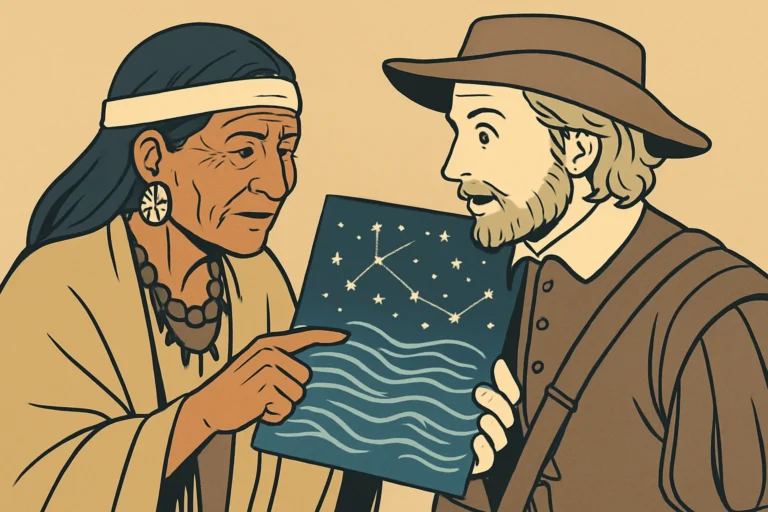
The Unsung Guides: Korea’s Vocabulary of Discovery
Hello! Welcome to [Maeil Hangeul], here to upgrade your Korean skills to the next level!
Today, we’re embarking on a journey into the past, but with a fresh perspective. We’ll explore the history of exploration, not just through the eyes of the adventurers, but by focusing on the crucial role of the original inhabitants of the lands they “discovered.” Recently in Korea, as around the globe, there’s a growing and important conversation about re-evaluating history and acknowledging the contributions of indigenous peoples. This vocabulary will not only enrich your understanding of historical texts but also empower you to participate in these sophisticated, modern discussions in Korean.
Let’s dive in and learn how to talk about the true guides of history!
Core Expressions You Need to Know
Here are some key terms that will help you discuss this complex and fascinating topic with nuance.
1. 토착 지식 (土着 知識)
- Pronunciation [Romaja]: Tochak jishik
- English Meaning: Indigenous knowledge; native knowledge
- Detailed Explanation: This is a formal, academic term perfect for C1 learners. It’s built from Hanja: 토(土) meaning ‘earth’ or ‘soil’, and 착(着) meaning ‘to attach to’. So, it literally means “knowledge attached to the land.” This beautifully captures the idea of knowledge that is deeply connected to a specific environment and culture, developed over countless generations. It’s the perfect term to use when contrasting local wisdom with scientific or Western knowledge (서구 지식).
- 💡 Pronunciation Tip:
The ‘ㅈ’ in 지식 [jishik] is an unaspirated consonant. It’s softer than the English ‘j’ in ‘jeep’. To make the sound, your tongue should be in the same position, but you release less air. Also, notice the tense ‘ㅆ’ sound. It’s a short, sharp [sh] sound with a bit of tension in your vocal cords, different from the softer ‘ㅅ’ (s).
2. 대대로 이어지다
- Pronunciation [Romaja]: Daedaero ieojida
- English Meaning: To be passed down through generations.
- Detailed Explanation: This is an essential phrase for describing cultural heritage and oral traditions. 대대로 means “generation after generation,” and 이어지다 is the passive form of 잇다 (to connect), meaning “to be connected” or “to be continued.” You can use this to talk about stories, skills, or knowledge that have been transmitted orally, without written records. For example, “그 부족의 생존 기술은 대대로 이어져 왔다” (The tribe’s survival skills have been passed down through generations).
- 💡 Pronunciation Tip:
This phrase demonstrates the Korean linking rule, or 연음 (yeoneum). The final consonant of a syllable block moves to the next syllable if it starts with a vowel (ㅇ). So, even though it’s written이-어-지-다, the sounds flow together. The ‘o’ from 로(ro) in대대로smoothly connects to 이(i) in이어지다. Practice saying it as one fluid phrase: [daedaero-ieojida].
3. 길잡이가 되다
- Pronunciation [Romaja]: Giljabiga doeda
- English Meaning: To become a guide; to serve as a guide.
- Detailed Explanation: 길잡이 literally means “way-catcher” or guide. While it can refer to a person, it’s often used metaphorically, which is where its power for advanced learners lies. You can say that indigenous knowledge itself served as a guide for the explorers. For example, “원주민들의 토착 지식이 탐험가들에게 훌륭한 길잡이가 되어 주었다.” (The indigenous people’s native knowledge served as an excellent guide for the explorers.)
- 💡 Pronunciation Tip:
Here’s 연음 (yeoneum) in action again! The final consonant ‘ㅂ(b)’ from 잡(jap) moves over to the next syllable, which starts with the vowel ‘ㅣ(i)’. Therefore, it is not pronounced ‘jap-i’ but as one smooth sound: [jabi]. So, the whole phrase is pronounced [gil-ja-bi-ga doe-da].
4. 공존(共存)하다
- Pronunciation [Romaja]: Gongjonhada
- English Meaning: To coexist.
- Detailed Explanation: This is a vital Hanja-based verb for discussing complex relationships. 공(共) means ‘together’ and 존(存) means ‘to exist’. This word allows you to move beyond a simple narrative of conflict and discuss how different cultures, peoples, or even systems of knowledge can exist together. It’s crucial for discussing modern solutions, such as how traditional ecological knowledge and modern science can 공존하며 environmental problems.
- 💡 Pronunciation Tip:
Pay attention to the vowel sounds. The ‘오(o)’ in 공(gong) is a pure, round vowel, like the ‘o’ in the word “more”. Avoid making it a diphthong like the English “go”. Similarly, the ‘어(eo)’ in 존(jon) is an open sound made in the back of the mouth, similar to the ‘u’ in “stuck”.
Example Dialogue
Let’s see how these expressions work in a natural conversation between two university students.
A (민준): “최근에 초기 남극 탐험에 관한 다큐멘터리를 봤는데, 원주민들의 도움이 없었다면 탐험가들은 절대 살아남지 못했을 거야.”
(I recently watched a documentary about early Antarctic expeditions, and without the help of the indigenous people, the explorers never would have survived.)
B (Sora): “맞아. 혹독한 환경에 대한 그들의 토착 지식이 결정적이었지. 지도에는 없는 정보였으니까.”
(Exactly. Their indigenous knowledge about the harsh environment was decisive. It was information that wasn’t on any map.)
A (민준): “응. 수천 년간 대대로 이어져 온 그 지혜야말로 최고의 생존 지침서였던 셈이지.”
(Yeah. That wisdom, passed down through generations for thousands of years, was essentially the ultimate survival manual.)
B (Sora): “결국 그들의 지식이 탐험가들에게 가장 중요한 길잡이가 되어 준 거야. 현대 사회가 전통 지식과 어떻게 공존해야 하는지에 대해 다시 생각하게 돼.”
(In the end, their knowledge served as the most important guide for the explorers. It makes me rethink how modern society must coexist with traditional knowledge.)
Culture Tip & Trend Deep Dive
This conversation isn’t just about history; it’s incredibly relevant in Korea today. There is a strong and growing movement to preserve and re-evaluate ‘토종 지식 (tojong jishik)’—a very similar concept that refers to native Korean knowledge.
This includes everything from documenting traditional farming techniques that are naturally pest-resistant to recording the knowledge of 해녀 (haenyeo), the famous female divers of Jeju Island whose understanding of the sea has been 대대로 이어져 on for centuries. Local governments and research institutes are actively working to ensure this wisdom doesn’t disappear, recognizing that it can offer valuable solutions for a sustainable future. When you use these expressions, you’re not just talking about the past; you’re connecting with a living, breathing part of modern Korean culture!
Let’s Practice!
Ready to test your new vocabulary?
1. Fill in the blanks:
서양의 탐험가들은 별자리를 보고 길을 찾았지만, 폴리네시아인들은 파도의 미세한 움직임처럼 (______________) 온 (______________)을 이용해 망망대해를 항해했다.
Western explorers navigated by the stars, but Polynesians navigated the vast ocean using (_____________), which was (______________) like the subtle movements of the waves.
(Answers: 대대로 이어져, 토착 지식)
2. Sentence Making:
Using the phrase 길잡이가 되다, write a short Korean sentence about a person, a book, or an experience that has been a guide for you in your life.
Great job today! You’ve unlocked a sophisticated set of words to discuss history, culture, and society with greater depth.
Now it’s your turn! Try using one of today’s expressions in the comments below. We can’t wait to see what you come up with
Frequently Asked Questions (FAQ)
Q: What does "토" mean in Korean and how do you pronounce it?
A: In Korean, "토" is pronounced [土] and means: meaning 'earth' or 'soil', and
Q: What does "착" mean in Korean and how do you pronounce it?
A: In Korean, "착" is pronounced [着] and means: meaning 'to attach to'. So, it literally means "knowledge attached to the land." This beautifully captures the idea of knowledge that is deeply connected to a specific environment and culture, developed over countless generations. It's the perfect term to use when contrasting local wisdom with scientific or Western knowledge (서구 지식).
Q: What does "지식" mean in Korean and how do you pronounce it?
A: In Korean, "지식" is pronounced [jishik] and means: is an unaspirated consonant. It's softer than the English 'j' in 'jeep'. To make the sound, your tongue should be in the same position, but you release less air. Also, notice the tense 'ㅆ' sound. It’s a short, sharp [sh] sound with a bit of tension in your vocal cords, different from the softer 'ㅅ' (s).
Q: What does "연음" mean in Korean and how do you pronounce it?
A: In Korean, "연음" is pronounced [yeoneum] and means: . The final consonant of a syllable block moves to the next syllable if it starts with a vowel (ㅇ). So, even though it's written







