

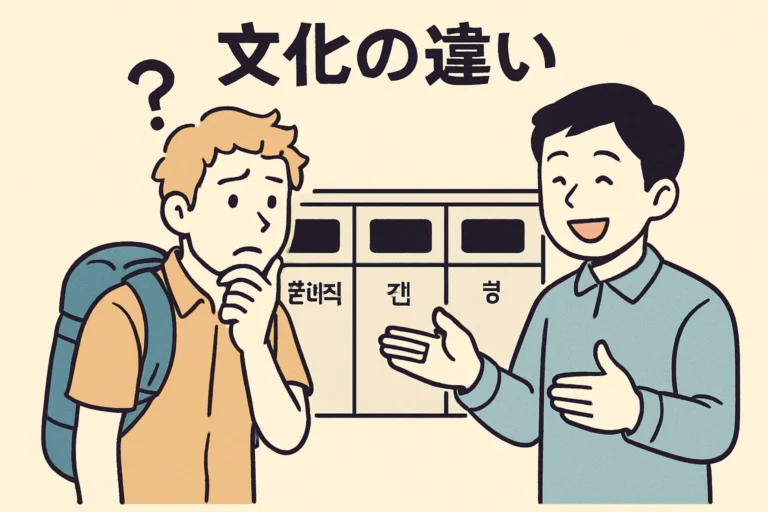
When in Rome… Korean Tips for Adapting to a New Culture!
Hello! Welcome to [Maeil Hangeul], your go-to blog for upgrading your Korean skills!
Have you ever moved to a new country or traveled somewhere completely different? It can be exciting, but also a little challenging, right? Today, we’re going to learn some essential Korean expressions for sharing tips on how to adapt to a new culture.
With globalization, our worlds are more connected than ever. 요즘 한국에서는 (yojeum hangugeseoneun – Nowadays in Korea), there’s a huge interest in different cultures, both from foreigners living in Korea and Koreans traveling abroad. So, knowing how to talk about this topic will make you sound super natural and insightful. Let’s dive in!
Key Expressions You Need to Know
Here are three core expressions to help you talk about cultural adaptation like a pro.
1. 문화 차이 (Munhwa Chai)
- Pronunciation [Romanization]: Mun-hwa cha-i
- English Meaning: Cultural difference
- Detailed Explanation: This is a fundamental term you’ll hear and use a lot.
문화 (munhwa)means ‘culture’ and차이 (chai)means ‘difference’. You can use it to point out anything from different table manners to different ways of thinking. It’s a neutral term, so it’s perfect for starting a conversation about things you’ve observed. - 💡 Pronunciation Tip:
The ‘ㅎ’ (h) in문화 (munhwa)is very soft, almost like a breath of air. Also, notice that차이 (chai)is two distinct syllables, ‘cha’ and ‘i’. Don’t blend them together. The ‘ㅊ’ (ch) sound is aspirated, meaning you should release a puff of air when you say it, like the “ch” in “chart.”
2. 로마에 가면 로마법을 따르라 (Roma-e gamyeon Roma-beobeul ttareura)
- Pronunciation [Romanization]: Ro-ma-e ga-myeon Ro-ma-beo-beul tta-reu-ra
- English Meaning: When in Rome, do as the Romans do.
- Detailed Explanation: This is a proverb, or
속담 (sokdam), that exists in many languages! It literally means “If you go to Rome, follow Roman law.” It’s used to advise someone to follow the customs and practices of the place they are visiting or living in. It’s a great way to express the importance of respecting local culture. - 💡 Pronunciation Tip:
Listen for the linking sound (연음 – yeoneum)! In로마에 (Roma-e), the sound flows smoothly from ‘ma’ to ‘e’. In로마법을 (Roma-beobeul), the ‘ㅂ’ (b) sound from법links to the next syllable, making it sound like [로마버블 | Ro-ma-beo-beul]. This is a key rule to make your Korean sound more fluid!
3. 적응하다 (Jeogeunghada)
- Pronunciation [Romanization]: Jeo-geung-ha-da
- English Meaning: To adapt; to adjust
- Detailed Explanation: This is the verb you need when talking about the process of getting used to a new environment. You can use it for anything: adapting to new food, a new job, or a new country. For example, “한국 생활에 빨리 적응했어요 (Hanguk saenghware ppalli jeogeunghaesseoyo)” means “I adapted to life in Korea quickly.”
- 💡 Pronunciation Tip:
The final consonant ‘ㅇ’ (ng) in적응 (jeogeung)is a nasal sound made in the back of your throat, just like the “-ng” in the English word “singing.” Be careful not to pronounce it as “n” or “g.” It’s a soft, continuous sound.
Example Dialogue
Let’s see how these expressions are used in a real conversation! Alex has just moved to Seoul and is talking to his Korean friend, Minjun.
Alex: 와, 한국은 배달이 정말 빠르네요! 그런데 분리수거는 너무 어려워요. 이게 바로 문화 차이인가 봐요.
(Wa, hangug-eun baedari jeongmal ppareuneyo! Geureonde bullisugeoneun neomu eoryeowoyo. Ige baro munhwa chai-inga bwayo.)
(Wow, food delivery in Korea is so fast! But separating the recycling is so difficult. I guess this is a real cultural difference.)
Minjun: 하하, 맞아요. 처음에는 다들 헷갈려 해요. 그래도 로마에 가면 로마법을 따르라고 하잖아요. 금방 적응할 수 있을 거예요!
(Haha, majayo. Cheoeumeneun dadeul hetgallyeo haeyo. Geuraedo Roma-e gamyeon Roma-beobeul ttareura-go hajanayo. Geumbang jeogeunghal su isseul geoyeyo!)
(Haha, that’s right. Everyone gets confused at first. But you know what they say, “When in Rome, do as the Romans do.” You’ll be able to adapt soon!)
Alex: 네, 도와줘서 고마워요. 빨리 적응하고 싶어요.
(Ne, dowajwoseo gomawoyo. Ppalli jeogeunghago sipeoyo.)
(Yes, thanks for your help. I want to adapt quickly.)
Culture Tip & Trend Analysis
In Korea, the concept of 눈치 (nunchi) is deeply related to cultural adaptation. Nunchi is the subtle art of understanding the social situation and other people’s thoughts and feelings without them being said explicitly.
When you’re trying to 적응하다 (jeogeunghada) to Korean culture, having good nunchi is like having a superpower! For example, noticing when to pour drinks for others at a dinner or sensing the mood in a meeting are all part of nunchi.
You’ll see this play out in popular Korean TV shows like “어서와~ 한국은 처음이지?” (Welcome, First Time in Korea?). In this show, foreigners experience Korea for the first time, and their journey of navigating 문화 차이 (munhwa chai) and learning through observation is a perfect example of developing nunchi and adapting. While no one expects a foreigner to be perfect, showing that you are trying to understand and respect these unspoken rules will earn you a lot of appreciation!
Let’s Review and Practice!
Great job today! We learned three key expressions for talking about adapting to a new culture: 문화 차이 (cultural difference), 로마에 가면 로마법을 따르라 (When in Rome…), and 적응하다 (to adapt).
Now, it’s your turn to practice! Fill in the blanks with the expressions we learned today.
Quiz:
새로운 나라에서는 그 나라의 ________를 존중하고 빨리 ________하는 것이 중요해요.
(Sae-roun nara-eseoneun geu nara-ui ________reul jonjunghago ppalli ________haneun geosi jung-yohaeyo.)
(In a new country, it’s important to respect the country’s ________ and ________ quickly.)
What do you think the answers are? Leave your answer and try making your own sentence with today’s expressions in the comments below! We’d love to hear about your experiences
Frequently Asked Questions (FAQ)
Q: What does "눈치" mean in Korean and how do you pronounce it?
A: In Korean, "눈치" is pronounced [nunchi] and means: is deeply related to cultural adaptation.
Q: What does ""어서와~ 한국은 처음이지?"" mean in Korean and how do you pronounce it?
A: In Korean, ""어서와~ 한국은 처음이지?"" is pronounced [Welcome, First Time in Korea?] and means: . In this show, foreigners experience Korea for the first time, and their journey of navigating
Q: What does "로마에 가면 로마법을 따르라" mean in Korean and how do you pronounce it?
A: In Korean, "로마에 가면 로마법을 따르라" is pronounced [When in Rome...] and means: , and







