

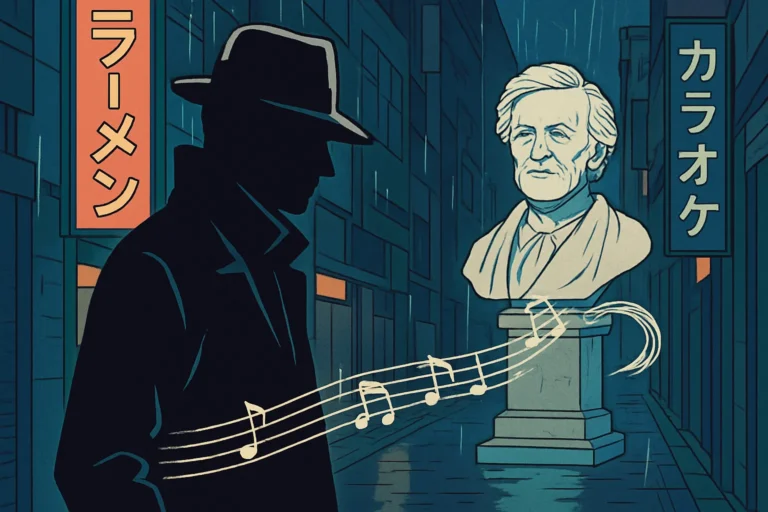
From Wagner to K-Thrillers: Decode the Leitmotif
Hello! It’s your guide to upgrading your Korean skills, [Maeil Hangul]!
Ready to dive into a topic that will impress your Korean friends? Today, we’re moving beyond everyday conversation and into the sophisticated world of artistic critique. We’ll be exploring Richard Wagner’s groundbreaking “Leitmotif” technique and how to discuss its influence in fluent, academic Korean. You might be thinking, “Classical music? How is that useful?” Well, recently in Korea, the blockbuster neo-noir film ‘서울의 그림자’ (Shadows of Seoul) has become a massive hit, and critics and fans alike are buzzing about its powerful musical score, which masterfully uses… you guessed it, leitmotifs! Let’s learn the vocabulary to join that conversation.
Core Expressions for Your Inner Critic
Here are three essential terms to help you analyze and discuss artistic influence like a pro.
1. 유도동기 (Yudodonggi)
- Pronunciation [Romanization]: Yudodonggi
- English Meaning: Leitmotif
- Detailed Explanation: This is the direct Korean translation for the German term Leitmotiv. 유도 (Yudo) means ‘to guide’ or ‘to lead’, and 동기 (donggi) means ‘motive’ or ‘motif’. So, it’s a “guiding motif.” This term refers to a recurring musical phrase associated with a particular person, place, or idea. It’s the key vocabulary for discussing the musical storytelling in Wagner’s operas, as well as in iconic film scores like Star Wars, The Lord of the Rings, and of course, the trending Korean film ‘서울의 그림자’.
- 💡 Pronunciation Tip:
The pronunciation is quite straightforward and follows the spelling. Focus on pronouncing each syllable block clearly: 유 (Yu) – 도 (do) – 동 (dong) – 기 (gi). Ensure the ‘o’ in ‘도’ and ‘동’ is a pure vowel, not a diphthong like the ‘o’ in the English word “go.”
2. 선구적인 (Seongujeogin)
- Pronunciation [Romanization]: Seongujeogin
- English Meaning: Pioneering, groundbreaking
- Detailed Explanation: This is an adjective derived from 선구자 (seonguja), which means ‘pioneer’. You use 선구적인 to describe a work, an idea, or a person that was ahead of its time and paved the way for others. It carries a nuance of respect for innovation and historical importance. It’s the perfect word to describe Wagner’s influence on modern music.
- 💡 Pronunciation Tip:
Let’s break it down: 선 (seon) – 구 (gu) – 적 (jeok) – 인 (in). Pay attention to the last two syllables. The consonant ‘ㄱ(k)’ at the end of ‘적(jeok)’ links smoothly to the vowel ‘ㅣ(i)’ in ‘인(in)’, making the sound flow naturally as [jeogin]. Practice saying it smoothly rather than as two separate blocks.
3. 맥을 같이하다 (Maegeul gachi hada)
- Pronunciation [Romanization]: Maegeul gachi hada
- English Meaning: To be in the same vein as; to share a common thread with.
- Detailed Explanation: This is a fantastic idiomatic expression for advanced learners. 맥 (Maek) means ‘pulse’ or ‘vein’. So, the literal meaning is “to share the same pulse.” It’s used to say that two different things (e.g., artworks, theories, movements) share a fundamental philosophy, style, or characteristic. It’s much more nuanced than simply saying ‘비슷하다’ (to be similar).
- 💡 Pronunciation Tip:
The key here is the word ‘같이’. Although it’s spelled ‘gat-i’, it is pronounced [gachi]. This is a classic example of palatalization (구개음화) in Korean. When the final consonants ‘ㄷ(d)’ or ‘ㅌ(t)’ are followed by a syllable starting with the vowel ‘ㅣ(i)’ or a ‘y’ sound, they transform into a ‘ㅈ(j)’ or ‘ㅊ(ch)’ sound, respectively. This makes the pronunciation smoother. Think of ‘굳이 (gud-i)’ becoming [guji].
Example Dialogue: At a Café in Seoul
Let’s see how these expressions work in a real conversation about that hit movie!
A: ‘서울의 그림자’ 드디어 봤어! 영화 음악이 정말 인상적이더라.
(A: I finally saw ‘Shadows of Seoul’! The film score was so impressive.)
[A: ‘Seourui geurimja’ deudieo bwasseo! Yeonghwa eumagi jeongmal insangjeogideora.]
B: 맞아요! 감독이 인터뷰에서 바그너의 유도동기 기법을 적극 활용했다고 했어요. 각 인물마다 테마가 명확하잖아요.
(B: I know! The director said in an interview that he actively used Wagner’s leitmotif technique. Each character has a clear theme, right?)
[B: Majayo! Gamdogi inteobyueseo Bageuneoui yudodonggi gibeobeul jeokgeuk hwaryonghaetdago haesseoyo. Gak inmulmada temaga myeonghwakajanayo.]
A: 아, 그래서 그랬구나. 바그너의 선구적인 시도가 21세기 한국 영화에까지 영향을 미치다니, 정말 대단해요.
(A: Ah, that explains it. It’s incredible how Wagner’s pioneering attempts are influencing 21st-century Korean cinema.)
[A: A, geuraeseo geuraetguna. Bageuneoui seongujeogin sidoga isibilsegi hanguk yeonghwaekkaji yeonghyangeul michidani, jeongmal daedanhaeyo.]
B: 네, 그런 면에서 보면 ‘서울의 그림자’의 음악은 존 윌리엄스의 ‘스타워즈’ 스코어와도 맥을 같이하는 셈이죠.
(B: Yes, in that respect, you could say the music of ‘Shadows of Seoul’ is in the same vein as John Williams’s score for ‘Star Wars’.)
[B: Ne, geureon myeoneseo bomyeon ‘Seourui geurimja’ui eumageun Jon Willieomseoui ‘Seutawojeu’ seuko-eowado maegeul gachihaneun semijyo.]
Culture Tip & Trend Analysis
What’s truly fascinating is how deeply this conversation is embedded in current Korean culture. The success of ‘서울의 그림자’ has sparked a mainstream interest in film composition. You’ll see YouTube video essays and blog posts analyzing the movie’s score, frequently using the term 유도동기.
Furthermore, critics are praising the film for achieving what Wagner called a Gesamtkunstwerk, or 총체 예술 (Chongche yesul) in Korean—a “total work of art” where music, narrative, and visuals are perfectly integrated. Mentioning 총체 예술 in a discussion about the film will instantly mark you as a knowledgeable and insightful speaker. By using these terms, you’re not just showing off your vocabulary; you’re participating in a live, ongoing cultural conversation in Korea.
Let’s Practice!
Time to put your new knowledge to the test.
- Fill in the blanks:
존 윌리엄스는 바그너의 ______ 기법을 영화 음악에 적용한 ______ 작곡가로, 두 사람의 음악은 서로 ______고 할 수 있다.
(John Williams is a ______ composer who applied Wagner’s ______ technique to film scores, and you could say their music is ______.) -
Your Turn:
Think of two movies, artists, or books that you believe share a common spirit. Using the expression 맥을 같이하다, write a short sentence in Korean explaining their connection.
You’ve done an amazing job today tackling a high-level topic! Now you’re ready to discuss music and film with more depth and precision.
Try answering the practice questions in the comments below! I can’t wait to see your sentences.
Frequently Asked Questions (FAQ)
Q: What does "유도" mean in Korean and how do you pronounce it?
A: In Korean, "유도" is pronounced [Yudo] and means: means 'to guide' or 'to lead', and
Q: What does "동기" mean in Korean and how do you pronounce it?
A: In Korean, "동기" is pronounced [donggi] and means: means 'motive' or 'motif'. So, it's a "guiding motif." This term refers to a recurring musical phrase associated with a particular person, place, or idea. It's the key vocabulary for discussing the musical storytelling in Wagner's operas, as well as in iconic film scores like
Q: What does "선구자" mean in Korean and how do you pronounce it?
A: In Korean, "선구자" is pronounced [seonguja] and means: , which means 'pioneer'. You use
Q: What does "맥" mean in Korean and how do you pronounce it?
A: In Korean, "맥" is pronounced [Maek] and means: means 'pulse' or 'vein'. So, the literal meaning is "to share the same pulse." It's used to say that two different things (e.g., artworks, theories, movements) share a fundamental philosophy, style, or characteristic. It’s much more nuanced than simply saying '비슷하다' (to be similar).







