

Unlocking the Stone Age: Korea’s Paleolithic Vocabulary
Hello! Welcome back to Maeil Hangeul, the place to upgrade your Korean skills to the highest level!
Today, we’re journeying back in time—way back. We’ll be exploring the sophisticated vocabulary used to describe the development of Paleolithic stone tool technology. This is perfect for when you’re visiting a national museum, watching a historical documentary, or engaging in a deep academic conversation in Korean. Recently, archaeological discussions have been buzzing in Korea with ongoing research at major Paleolithic sites like Yeoncheon Jeongok-ri, making this topic more relevant than ever. Ready to sound like a history expert? Let’s begin!
Core Expressions
Here are some essential terms that will help you discuss early human history with precision and nuance.
1. 뗀석기 (Ttenseokgi)
- Pronunciation [Romanization]: Tten-seok-gi
- English Meaning: Flaked stone tool (or chipped stone tool)
- Detailed Explanation: This is the general term for all stone tools made by striking or applying pressure to a stone, as opposed to grinding it (which is 간석기 [ganseokgi], a ground stone tool from the Neolithic era). The verb 떼다 (tteda) means ‘to detach’ or ‘to chip off’, and 석기 (seokgi) means ‘stone tool’. So, it literally means “a stone tool made by chipping.” This term is fundamental for any discussion about the Paleolithic period.
- 💡 Pronunciation Tip:
The ‘ㄸ’ (tt) in 뗀 is a tensed consonant. It’s pronounced with no puff of air, creating a sharper, tighter sound than ‘ㄷ’ (d) or ‘ㅌ’ (t). Imagine holding your breath for a split second before saying the ‘t’ sound. This tensing is crucial for native-like pronunciation.
2. 몸돌 (Momdol) & 격지 (Gyeokji)
- Pronunciation [Romanization]: Mom-dol & Gyeok-ji
- English Meaning: Core & Flake
- Detailed Explanation: These two terms are a pair and describe the basic process of creating a 뗀석기.
- 몸돌 (Momdol): The main stone block from which pieces are struck off. 몸 (mom) means ‘body’, and 돌 (dol) means ‘stone’, so it’s the ‘body stone’.
- 격지 (Gyeokji): The piece of stone that is intentionally struck off from the core. This ‘flake’ could either be the desired tool itself or be discarded as debris (박편, bakpyeon).
Understanding the relationship between the momdol and the gyeokji is key to explaining the technological leap of our ancestors.
- 💡 Pronunciation Tip:
For 격지 [gyeokji], the second syllable starts with ‘ㅈ’, but it sounds much stronger, almost like ‘ㅉ’ [jj]. This is due to a phenomenon called 된소리되기 (doensoridwaegi), or ‘tensing’. When a syllable ending in an unreleased stop consonant (like the ‘ㄱ’ in 격) is followed by another stop consonant (like ‘ㅈ’), the second consonant becomes tensed. So, instead of a soft ‘ji’, you pronounce it with a sharp [jji].
3. 주먹도끼 (Jumeokdokki)
- Pronunciation [Romanization]: Ju-meok-dok-kki
- English Meaning: Hand axe
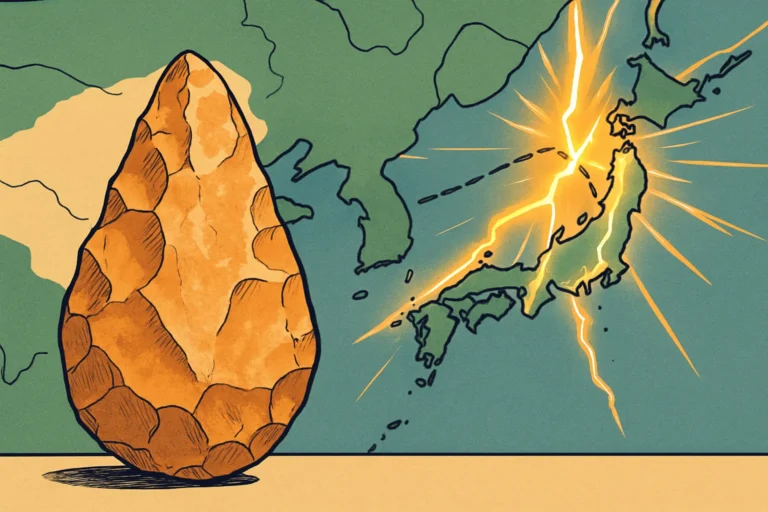
- Detailed Explanation: This is one of the most iconic tools of the Lower Paleolithic period, particularly the Acheulean industry. The name is very descriptive: 주먹 (jumeok) means ‘fist’ and 도끼 (dokki) means ‘axe’. It’s a pear-shaped, bifacial tool (양면가공 석기) that was likely a multi-purpose tool used for butchering animals, digging, and cutting wood. In the context of Korean archaeology, the jumeokdokki is incredibly significant (more on that in the Culture Tip!).
- 💡 Pronunciation Tip:
Similar to 격지, the ‘ㄲ’ in 도끼 [dokki] is a tensed sound. Notice the difference in your mouth between ‘ㄱ’ (g/k), ‘ㅋ’ (k), and ‘ㄲ’ (kk). The ‘ㄲ’ is sharp, unaspirated, and produced with tension in the vocal cords.
Example Dialogue
Let’s see how these terms are used in a natural conversation at the National Museum of Korea.
A: 와, 이 주먹도끼 좀 봐. 정말 정교하게 만들어졌네.
(Wa, i jumeokdokki jom bwa. Jeongmal jeonggyohage mandeureojeonne.)
Wow, look at this hand axe. It’s made so elaborately.
B: 맞아. 당시 인류가 큰 몸돌에서 원하는 모양의 격지를 떼어내기 위해 얼마나 많은 노력을 했을지 상상이 안 가.
(Maja. Dangsi illyuga keun momdoreseo wonhaneun moyangui gyeokjireul tte-eonaegi wihae eolmana maneun noryeogeul haesseulji sangsangi an ga.)
I know. I can’t even imagine how much effort early humans must have put into detaching flakes of the right shape from a large core.
A: 이게 바로 전곡리에서 발견된 아슐리안형 뗀석기구나. 교과서에서만 봤는데.
(Ige baro Jeongongni-eseo balgyeondoen Asyullian-hyeong ttenseokkiguna. Ggwagwaseo-eseoman bwanneunde.)
So this is the Acheulean-type flaked stone tool discovered in Jeongok-ri. I’ve only ever seen it in textbooks.
B: 응. 이 발견이 동아시아 구석기 연구의 흐름을 완전히 바꿨다고 하잖아.
(Eung. I balgyeoni dong-asia guseokgi yeon-gu-ui heureumeul wanjeonhi bakkwotdago hajana.)
Yep. They say this very discovery completely changed the course of East Asian Paleolithic research.
Culture Tip & Trend Deeper Dive
The Jeongok-ri Discovery: Putting Korea on the Paleolithic Map
When you mention 주먹도끼 (jumeokdokki) to a Korean who is interested in history, they will immediately think of one place: 전곡리 유적 (Jeongok-ri yujeok), the Jeongok-ri archaeological site.
For decades, the global archaeological community was influenced by the “Movius Line,” a theoretical line drawn across northern India that suggested early hominids in East Asia did not possess the advanced Acheulean hand axe technology common in Africa, Europe, and Western Asia.
However, the discovery of numerous Acheulean 주먹도끼 at Jeongok-ri in 1978 shattered this theory. It proved that sophisticated tool-making traditions were present in East Asia, fundamentally rewriting our understanding of human cognitive and technological development in the region.
So, if you’re ever in a conversation about Korean history, casually mentioning, “전곡리 주먹도끼가 모비우스 학설을 반박하는 중요한 증거가 되었죠” (The Jeongok-ri hand axe became crucial evidence in refuting the Movius theory), you will instantly demonstrate a profound, C2-level understanding of Korean archaeology and its global significance.
Conclusion & Practice
Today, we’ve delved into the specialized vocabulary for discussing Paleolithic stone tools, moving from the basic 뗀석기 to the specific relationship between a 몸돌 and a 격지, and the historically significant 주먹도끼.
Now, let’s test your knowledge!
1. Fill in the blank:
구석기 시대 인류는 큰 ( A )에서 돌조각을 떼어내 ( B )를 만들었으며, 이러한 도구를 통틀어 ( C )라고 부른다.
(Paleolithic humans detached stone fragments from a large (A) to create a (B), and these tools are collectively called (C).)
2. Short Answer:
In your own Korean words, briefly explain the significance of the jumeokdokki found at the Jeongok-ri site.
Great job today! Don’t forget to try using these new terms. Leave a comment below with your answers or try making your own sentence! See you next time at Maeil Hangeul
Frequently Asked Questions (FAQ)
Q: What does "간석기" mean in Korean and how do you pronounce it?
A: In Korean, "간석기" is pronounced [ganseokgi] and means: , a ground stone tool from the Neolithic era). The verb
Q: What does "떼다" mean in Korean and how do you pronounce it?
A: In Korean, "떼다" is pronounced [tteda] and means: means 'to detach' or 'to chip off', and
Q: What does "석기" mean in Korean and how do you pronounce it?
A: In Korean, "석기" is pronounced [seokgi] and means: means 'stone tool'. So, it literally means "a stone tool made by chipping." This term is fundamental for any discussion about the Paleolithic period.
Q: What does "몸돌" mean in Korean and how do you pronounce it?
A: In Korean, "몸돌" is pronounced [Momdol] and means: The main stone block from which pieces are struck off.






