

Show Off Your Room in Korean: Join the “Desk-terior” Trend! 🇰🇷✨
Hello! This is Maeil Hangul (Daily Korean), here to upgrade your Korean skills!
Have you ever wanted to show your room to a Korean friend during a video call? Or maybe you want to post a picture of your awesome room on social media with a Korean caption? Today, we’re going to learn exactly how to do that!
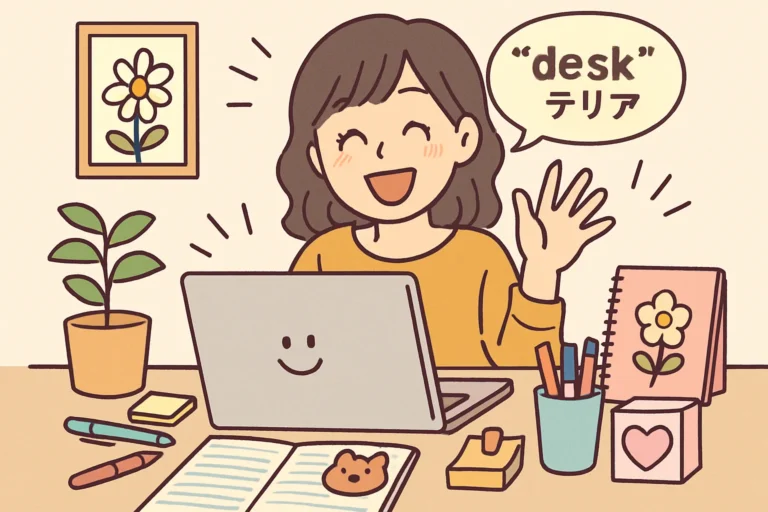
Lately in Korea, there’s a huge trend called “desk-terior” (데스크테리어), which is a mix of “desk” and “interior.” People love decorating their desks beautifully and sharing photos online. Today, you’ll learn the essential phrases to give a mini “room tour” in Korean and join in on the fun!
Core Expressions You Need to Know
Here are three key phrases to describe your personal space like a pro.
1. 제 방이에요 (Je bang-ieyo)
- Pronunciation [Romanization]: Je bang-ieyo
- English Meaning: This is my room.
- Detailed Explanation: This is the most basic and important phrase! 제 (je) means “my” (formal/polite), 방 (bang) means “room,” and -이에요 (ieyo) is the polite way to say “it is…” when the noun ends in a consonant. You can use this when someone enters your room for the first time or when you show it on a video call.
-
💡 Pronunciation Tip:
Even though it’s written asbang-i-e-yo, native Koreans say it smoothly like one word: [방이에요 – bang-ieyo]. The sound flows naturally from one syllable to the next. Practice saying it without pausing!
2. 책상이 있어요 (Chaeksang-i isseoyo)
- Pronunciation [Romanization]: Chaeksang-i isseoyo
- English Meaning: There is a desk. / I have a desk.
-
Detailed Explanation: This is how you talk about what’s in your room. 책상 (chaeksang) means “desk,” and -이 있어요 (i isseoyo) means “there is…” for nouns ending in a consonant. If you want to say “there is a bed,” you would say “침대가 있어요 (chimdaega isseoyo)” because 침대 (chimdae) ends in a vowel.
-
💡 Pronunciation Tip:
This is a great example of a Korean sound rule called “linking sound” (연음 – yeoneum). The final consonant of a syllable, in this case, the ‘ㅇ (ng)’ in ‘상 (sang)’, moves to the next syllable if it starts with a vowel. So, 책상 + 이 is not pronouncedchaeksang / i, but smoothly as [책상-이 / chaek-sang-i]. It makes the pronunciation much smoother!
3. 창문 옆에 (Changmun yeop-e)
- Pronunciation [Romanization]: Changmun yeop-e
- English Meaning: Next to the window
-
Detailed Explanation: Want to say where something is? This phrase is your best friend! 창문 (changmun) means “window,” and 옆에 (yeop-e) means “next to.” You can combine this with our second expression. For example: “My desk is next to the window” is “창문 옆에 책상이 있어요 (Changmun yeop-e chaeksang-i isseoyo).”
-
💡 Pronunciation Tip:
Here’s another linking sound! The letter ‘ㅍ (p)’ in ‘옆 (yeop)’ moves over to the ‘에 (e)’. So, instead of sayingyeop / e, you pronounce it as [여페 / yeo-pe]. It feels a bit strange at first, but this will make you sound so much more natural.
Example Dialogue: An Online Room Tour!
Let’s see how these phrases work in a real conversation. Imagine friends A and B are on a video call.
A: 와! 여기가 B의 방이야? (Wa! Yeogiga B-ui bang-iya?)
Wow! Is this your room, B?
B: 응, 제 방이에요. 환영합니다! (Eung, je bang-ieyo. Hwanyonghamnida!)
Yep, this is my room. Welcome!
A: 방이 정말 깨끗해요! (Bang-i jeongmal kkaekkeuthaeyo!)
Your room is so clean!
B: 고마워! 새로 꾸몄어. 봐, 이게 내 책상이에요. 창문 옆에 있어서 좋아.
(Gomawo! Saero kkumyeosseo. Bwa, ige nae chaeksang-ieyo. Changmun yeop-e isseoseo joa.)
Thanks! I just decorated it. Look, this is my desk. I like it because it’s next to the window.
Culture Tip: Inside the #데스크테리어 (Desk-terior) Trend
Why are Koreans, especially the Z generation, so obsessed with decorating their desks?
- A Small Personal Haven: For many students and young professionals living in small apartments or with family, their desk is their own personal space. Decorating it is a way to express their personality and create a happy, productive environment.
- Sharing on Social Media: The trend is fueled by Instagram and blogs. People post pictures of their setup with hashtags like #데스크테리어 (desk-terior), #책상꾸미기 (chaeksang-kkumigi – desk decorating), and #온라인집들이 (onlain-jipdeuri – online housewarming party).
- Key Items: Popular items for “desk-terior” include cute stationery, pastel-colored keyboards, nice monitors, mood lighting, and small plants.
If you use the phrases you learned today to post a picture of your desk with the hashtag #데스크테리어, you’ll look just like a local!
Let’s Review & Practice!
Great job today! We learned how to say “This is my room,” talk about what’s in it, and describe where things are. Now it’s your turn to practice!
Quiz Time!
- How would you say, “There is a bed next to the desk”? (Hint: “bed” is 침대 (chimdae))
- 책상 옆에 ______ 있어요.
- You are showing your friend your room for the first time on a video call. What’s the first thing you should say?
- A) 책상이 있어요.
- B) 제 방이에요.
- C) 창문 옆에.
Leave your answers and try to make your own sentence describing your room in the comments below! We’d love to see them. Happy learning
Frequently Asked Questions (FAQ)
Q: What does "제" mean in Korean and how do you pronounce it?
A: In Korean, "제" is pronounced [je] and means: means "my" (formal/polite),
Q: What does "방" mean in Korean and how do you pronounce it?
A: In Korean, "방" is pronounced [bang] and means: means "room," and
Q: What does "-이에요" mean in Korean and how do you pronounce it?
A: In Korean, "-이에요" is pronounced [ieyo] and means: is the polite way to say "it is..." when the noun ends in a consonant. You can use this when someone enters your room for the first time or when you show it on a video call.
Q: What does "책상" mean in Korean and how do you pronounce it?
A: In Korean, "책상" is pronounced [chaeksang] and means: means "desk," and







