

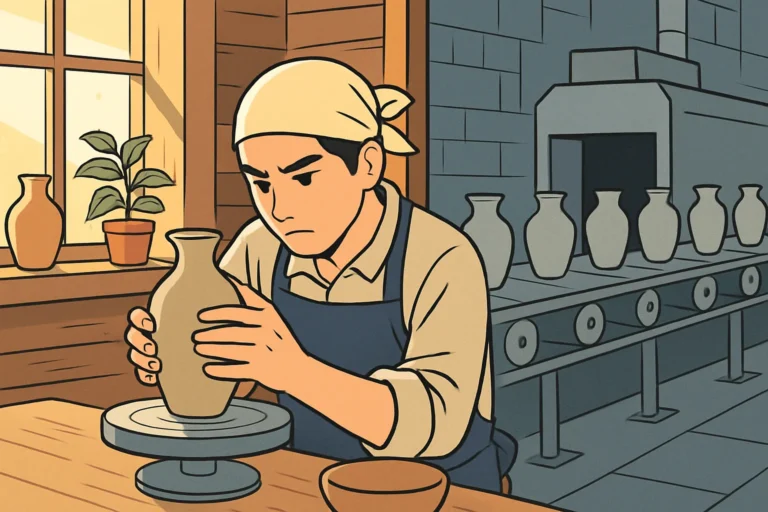
Crafting Authenticity: The Philosophy of the Arts & Crafts Movement
Hello! Welcome to [Maeil Hangeul], here to upgrade your Korean skills to the next level!
Today, we’re diving deep into a fascinating topic: explaining the philosophical background of the Arts and Crafts Movement. This isn’t just art history; these expressions are perfect for discussing philosophy, design, and the value of craftsmanship in any professional or academic setting.
Recently in Korea, there has been a huge resurgence in appreciating handmade goods. From artisanal cafes in Seongsu-dong to one-day pottery and leatherworking classes becoming a popular hobby, people are actively seeking out unique, handcrafted items over mass-produced ones. This modern trend beautifully mirrors the core ideas of the Arts and Crafts Movement, making today’s lesson incredibly relevant! Let’s get started.
Core Expressions
Here are some key expressions you’ll need to sound like a true expert.
1. -에 입각하여 (e ipgak-hayeo)
- Pronunciation [e ip-ga-ka-yeo]
- English Meaning: Based on / Founded on
- Detailed Explanation: This is a formal, academic phrase used to indicate that a theory, action, or creation is based on a specific principle, philosophy, or fact. It’s more sophisticated than the simpler ‘-에 따라서’ (according to). Use it when you want to sound knowledgeable and precise, especially in presentations, reports, or serious discussions.
- 💡 Pronunciation Tip: Notice the sound change! The final consonant ‘ㄱ’ (k) in ‘입각’ links with the following ‘하’ (ha), making the sound [이파카여 (i-pa-ka-yeo)]. This is a classic example of linking sound (연음 법칙) where a final consonant moves to the next syllable if it starts with a vowel (or ㅇ). Practicing this will make your Korean sound incredibly smooth.
2. 획일성 (hoek-il-seong)
- Pronunciation [회길썽 (hoegil-sseong)]
- English Meaning: Uniformity / Homogeneity
- Detailed Explanation: This noun carries a negative nuance, referring to a lack of individuality or variety, often due to mass production or rigid systems. The Arts and Crafts Movement was a direct reaction against the hoek-il-seong of the Industrial Revolution. The verb form is 획일화되다 (hoek-il-hwa-doeda), meaning “to become uniform.”
- 💡 Pronunciation Tip: The first character ‘획’ is pronounced [획 (hoek)], not [획 (hwoek)]. The ‘ᅬ’ vowel is pronounced like ‘we’ in ‘wet’. Also, the final ‘성’ is pronounced with a tense sound, [썽 (sseong)], due to tensing (경음화) after the consonant ‘ㄹ’.
3. 고유성 (goyuseong)
- Pronunciation [고유썽 (goyu-sseong)]
- English Meaning: Uniqueness / Inherent quality / Originality
- Detailed Explanation: This is the direct opposite of ‘획일성’. It refers to the unique, intrinsic quality that something or someone possesses. In the context of the Arts and Crafts Movement, it emphasizes the distinctive character of a handcrafted object that cannot be replicated by a machine. It’s a powerful word to praise individuality and originality.
- 💡 Pronunciation Tip: Just like with ‘획일성’, the ‘성’ here is tensed to [썽 (sseong)]. This is a common pattern in Sino-Korean words. Remembering to tense the ‘ㅅ’ after a vowel in words like this will make you sound much more like a native speaker.
4. 장인 정신 (jang-in jeongsin)
- Pronunciation [장인 정신 (jang-in jeong-sin)]
- English Meaning: Artisan spirit / Craftsmanship
- Detailed Explanation: This term is a cornerstone of Korean culture and refers to the deep dedication, skill, and pride an artisan takes in their work. It’s not just about technical ability; it’s a philosophy of pursuing perfection and pouring one’s soul into a creation. It perfectly encapsulates the values the Arts and Crafts Movement championed.
- 💡 Pronunciation Tip: The pronunciation here is quite straightforward and follows the letters. Focus on clearly articulating each syllable: [장 (jang)] – [인 (in)] – [정 (jeong)] – [신 (sin)].
Example Dialogue
Let’s see how these expressions work in a real conversation. Imagine two friends, A and B, at a design museum in Seoul.
A: 이 전시, 정말 인상 깊네요. 특히 예술 공예 운동의 철학이 작품에 잘 녹아든 것 같아요.
(i jeonsi, jeongmal insang gimneyo. teuki yesul gong-ye undong-ui cheolhagi jakpume jal nogadeun geot gatayo.)
This exhibition is so impressive. I feel the philosophy of the Arts and Crafts Movement is really well integrated into the works.
B: 맞아요. 산업 혁명으로 인한 대량 생산의 획일성을 비판하는 것에서 시작되었잖아요. 모든 작품이 장인 정신에 입각하여 만들어져서 그런지, 저마다의 고유성이 뚜렷하게 느껴져요.
(majayo. saneop hyeongmyeong-euro inhan daeryang saengsan-ui hoek-il-seong-eul bipanhaneun geoseseo sijakdoe-eotjanayo. modeun jakpumi jang-in jeongsin-e ipgak-hayeo mandeureojyeoseo geureonji, jeomadaui goyuseong-i tturyeotage neukkyeojyeoyo.)
Exactly. It began as a critique of the uniformity of mass production from the Industrial Revolution. Perhaps because every piece is created based on an artisan spirit, you can clearly feel the uniqueness of each one.
A: 그래서인지 기계로는 표현할 수 없는 따뜻함이 있어요. 요즘 한국 젊은 세대 사이에서 수공예 공방이 다시 인기를 끄는 걸 보면, 이 정신이 현대적으로 계승되고 있는 것 같아 흥미롭네요.
(geuraeseoinji gigyero-neun pyohyeonhal su eomneun ttatteutam-i isseoyo. yojeum hanguk jeolmeun sedae sai-eseo su-gong-ye gongbang-i dasi in-ggi-reul kkeuneun geol bomyeon, i jeongsin-i hyeondaejeogeuro gyeseungdoego inneun geot gata heungmiromneyo.)
That must be why there’s a warmth that machines can’t replicate. Seeing handmade workshops gaining popularity again among the younger generation in Korea, it’s fascinating how this spirit is being carried on in a modern way.
Cultural Tip & Trend Analysis
The spirit of the Arts and Crafts Movement is alive and well in modern Korea, especially among the Z generation. The trend of ‘원데이 클래스’ (one-day class) is a perfect example. Young Koreans are flocking to ‘공방’ (gongbang – workshops/studios) to learn pottery, jewelry making, baking, and even traditional crafts like mother-of-pearl inlay (자개 공예).
Why is this so popular? It’s a reaction against the digital world’s 획일성. In a society saturated with fast trends and digital content, creating a tangible object with your own hands provides a sense of accomplishment and individuality. Posting a picture of a slightly imperfect but unique ceramic bowl you made yourself on Instagram holds more value than showing off another mass-produced item. This reflects a deep appreciation for 고유성 and the human touch—the very essence of 장인 정신. So, when you use these expressions, you’re not just talking about history; you’re connecting with a powerful contemporary cultural current in Korea.
Let’s Wrap Up & Practice!
Today, we learned four sophisticated expressions to discuss the philosophy of craftsmanship and art: -에 입각하여, 획일성, 고유성, and 장인 정신. These words will elevate your Korean and allow you to engage in much deeper conversations.
Now, it’s your turn to practice!
Quiz: Fill in the blanks with the expressions we learned today.
예술 공예 운동은 기계 생산의 ( ① )을 비판하고, 인간의 손길과 ( ② )을 강조하는 철학에 ( ③ ) 시작되었다. 모든 수공예품은 자신만의 ( ④ )을 지닌다.
(The Arts and Crafts Movement began ____ a philosophy that criticized the ( ① ) of machine production and emphasized the human touch and ( ② ). Every handicraft possesses its own ( ④ ).)
Try to complete the sentence and share your answer in the comments! Or, even better, tell us about an art movement you admire using today’s vocabulary. We’d love to see what you come up with
Frequently Asked Questions (FAQ)
Q: What does "획일화되다" mean in Korean and how do you pronounce it?
A: In Korean, "획일화되다" is pronounced [hoek-il-hwa-doeda] and means: , meaning "to become uniform."
Q: What does "'원데이 클래스'" mean in Korean and how do you pronounce it?
A: In Korean, "'원데이 클래스'" is pronounced [one-day class] and means: is a perfect example. Young Koreans are flocking to
Q: What does "'공방'" mean in Korean and how do you pronounce it?
A: In Korean, "'공방'" is pronounced [gongbang - workshops/studios] and means: to learn pottery, jewelry making, baking, and even traditional crafts like mother-of-pearl inlay (







