

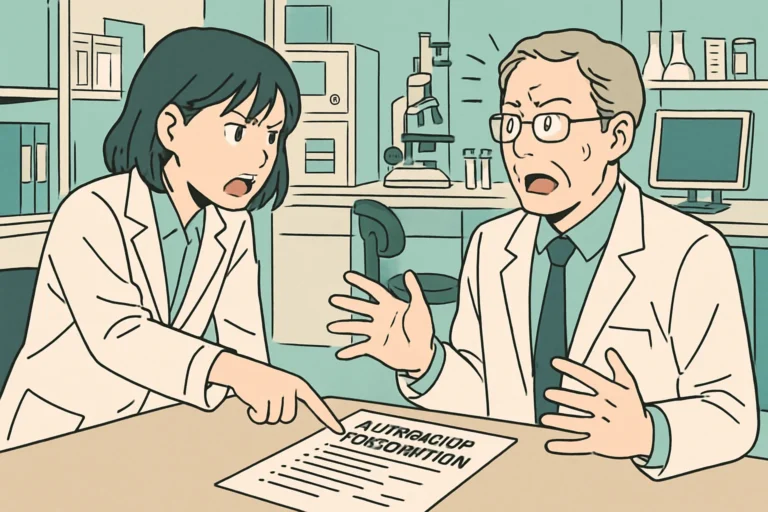
이 논문, 네 거 아니고 우리 거야!
Hello! This is Daily Hangul (매일한글), here to upgrade your Korean skills!
Today, we’re diving into a sophisticated topic perfect for advanced learners: navigating academic authorship disputes. Imagine pouring your heart and soul into a research paper, only to find your name missing from the final draft. What do you do? How do you professionally and effectively state your case in Korean?
You might have seen this exact situation in the hit new K-drama, ‘Stars of the Lab’ (연구실의 별들)! In Korea, conversations around fair credit and intellectual property are becoming more prominent, especially among young researchers. So, let’s learn how to handle these delicate negotiations with the confidence of a seasoned academic.
Core Expressions for Negotiation
Here are three essential phrases to help you claim the credit you deserve.
1. 기여도를 인정받다 (To have one’s contribution recognized)
- Pronunciation [Romanization]: Giyeodoreul injeongbatda
- English Meaning: To have one’s contribution recognized.
- Detailed Explanation: This is the ultimate goal in any authorship dispute. It’s a formal and precise phrase that clearly states your desire for professional acknowledgment. It consists of 기여도 (giyeodo – degree of contribution) and 인정받다 (injeongbatda – to be recognized/acknowledged). Use this phrase to emphasize that your work was substantial and deserves to be credited.
- 💡 Pronunciation Tip:
The pronunciation of the consonant ‘ㄷ’ (d) can be tricky. When it’s between two vowels, as in 기여도 (gi-yeo-do), it has a soft ‘d’ sound, similar to the ‘d’ in the English word “water.” However, at the beginning of a word like 다시 (dasi), it has a slightly stronger, unaspirated ‘d/t’ sound. Mastering this subtle difference will make your Korean sound much more natural.
2. 이의를 제기하다 (To raise an objection)
- Pronunciation [Romanization]: Iuireul jegihada
- English Meaning: To raise an objection; to formally dispute.
- Detailed Explanation: This is a powerful, formal phrase used to officially state your disagreement. It’s not for casual arguments with friends. You would use 이의를 제기하다 in a formal meeting, a legal context, or a serious academic discussion. It signals that you are moving beyond a simple complaint to a formal challenge of a decision.
- 💡 Pronunciation Tip:
The Korean vowel ‘의’ (ui) has complex pronunciation rules!- At the beginning of a word, it’s pronounced [ui], like in 의사 (uisa – doctor).
- As a possessive particle (e.g., 나의 – my), it’s pronounced [e].
- In any other syllable, it’s usually simplified to [i].
Therefore, in 이의 (i-ui), the first syllable is [이/i] and the second is [의/ui], but many speakers simplify it to [이이/i-i] in casual speech. For clarity in a formal setting, pronouncing it as [이의/i-ui] is best.
3. 원만하게 합의하다 (To reach an amicable agreement)
- Pronunciation [Romanization]: Wonmanhage habuihada
- English Meaning: To reach an amicable agreement.
- Detailed Explanation: This phrase expresses the ideal outcome of any negotiation. 원만하게 (wonmanhage) means “smoothly” or “amicably,” and 합의하다 (habuihada) means “to agree” or “to reach a consensus.” It highlights the goal of finding a peaceful resolution that satisfies all parties, a concept highly valued in Korean professional culture.
- 💡 Pronunciation Tip:
Listen for the weakening of ‘ㅎ’ (h)! In the word 원만하게 (wonmanhage), the ‘ㅎ’ (h) sound is positioned between two voiced sounds (‘ㄴ’ and ‘ㅏ’). In natural, fast speech, this ‘ㅎ’ often becomes very soft or even silent, making the word sound closer to [원마나게/wonmanage]. This is a common feature of connected speech in Korean that will make you sound like a native speaker.
Example Dialogue
Let’s see how these expressions might be used in a scene straight out of ‘Stars of the Lab’, between a junior researcher (Minjun) and a senior researcher (Sora).
- 민준 (Minjun): 선배님, 논문 최종본을 확인했는데 제 이름이 공동 저자 명단에서 빠져 있더군요.
- Sunbaenim, I checked the final manuscript of the paper, and I noticed my name was omitted from the co-author list.
- 소라 (Sora): 아, 민준 씨. 그건 실험 데이터 정리만 도와준 것으로 생각해서…
- Oh, Minjun. I thought you only assisted with organizing the experimental data…
- 민준 (Minjun): 아닙니다. 저는 데이터 분석 모델링과 이론 정립 과정에도 깊이 관여했습니다. 따라서 제 기여도를 인정받아야 한다고 생각하며, 이 결정에 대해 공식적으로 이의를 제기합니다.
- That’s not correct. I was also deeply involved in modeling the data analysis and in the process of establishing the theory. Therefore, I believe I must have my contribution recognized, and I formally raise an objection to this decision.
- 소라 (Sora): 그랬군요. 제가 그 부분까지는 미처 파악하지 못했네요. 다시 논의해서 원만하게 합의하도록 하죠.
- I see. I wasn’t fully aware of your involvement to that extent. Let’s discuss this again so we can reach an amicable agreement.
Cultural Tip: ‘Nunchi’ and Hierarchy in the Lab
In traditional Korean academic and professional settings, the 선후배 (seonhubae – senior/junior) relationship is extremely important. Directly challenging a senior’s decision, as Minjun did, can be seen as a very bold, even confrontational, act.
This is where the formality of the language becomes crucial. By using phrases like “기여도를 인정받고 싶습니다” and “이의를 제기합니다,” Minjun frames his complaint not as a personal attack on his senior, but as a professional and procedural issue. This strategy uses a high level of formality to bypass the emotional complexities of the hierarchy, allowing the issue to be discussed on its merits.
The recent popularity of storylines like this in K-dramas reflects a societal shift. The younger MZ Generation in Korea increasingly values fairness and transparency over blind adherence to traditional hierarchy, and they are developing the linguistic and social tools to advocate for themselves effectively.
Let’s Practice!
Ready to put your knowledge to the test?
- Fill in the blanks:
You spent months developing a key algorithm for a project, but your team leader didn’t mention your work in a major presentation. You decide to speak with them.제가 개발한 알고리즘 덕분에 프로젝트를 완성할 수 있었습니다. 제 ___________를 정식으로 ___________ 주셨으면 합니다.
(Thanks to the algorithm I developed, we were able to complete the project. I would like you to formally _______________ my _______________.) - Scenario Question:
You are in a meeting to decide the order of authors on a paper. The proposed order doesn’t reflect the amount of work you did. How could you state your goal for the meeting using one of today’s key phrases?
Now it’s your turn! Try creating your own sentence using one of today’s expressions and share it in the comments below. We’d love to see what you come up with
Frequently Asked Questions (FAQ)
Q: What does "기여도" mean in Korean and how do you pronounce it?
A: In Korean, "기여도" is pronounced [gi-yeo-do] and means: , it has a soft 'd' sound, similar to the 'd' in the English word "water." However, at the beginning of a word like
Q: What does "다시" mean in Korean and how do you pronounce it?
A: In Korean, "다시" is pronounced [dasi] and means: , it has a slightly stronger, unaspirated 'd/t' sound. Mastering this subtle difference will make your Korean sound much more natural.
Q: What does "'의'" mean in Korean and how do you pronounce it?
A: In Korean, "'의'" is pronounced [ui] and means: has complex pronunciation rules!
Q: What does "이의" mean in Korean and how do you pronounce it?
A: In Korean, "이의" is pronounced [i-ui] and means: , the first syllable is [이/i] and the second is [의/ui], but many speakers simplify it to







