

Your Ticket to Seoul: Mastering the Subway!
Hello! This is Maeil Hangul, here to upgrade your Korean skills!
Today, we’re going to learn one of the most essential skills for any traveler in Korea: how to buy a subway or bus ticket at a ticket office. Being able to do this will give you the freedom and confidence to explore amazing cities like Seoul, Busan, and more, all on your own!
You might be thinking, “But don’t people use apps for everything?” Yes! Lately in Korea (요즘 한국에서는), most people use rechargeable cards or their smartphones to tap and go. But knowing how to buy a ticket from a person is a fundamental skill, especially when you first arrive or if your card isn’t working. Let’s get you ready for your adventure!
Core Expressions for Your Journey
Here are the three key phrases you need to know to successfully buy your ticket.
1. The Question You’ll Hear: “Where are you going?”
- Korean Expression: 어디까지 가세요?
- Pronunciation [Romanized]: Eodikkaji gaseyo?
- English Meaning: Where are you going (to)?
- Detailed Explanation: This is a polite question you will hear from the staff at the ticket counter. Let’s break it down:
어디(eodi) = “where”까지(kkaji) = “to” or “until”가세요(gaseyo) = a polite form of the verb “to go”
- 💡 Pronunciation Tip:
Theㄲin 까지 (kkaji) is a “tense consonant.” It’s different from the regularㄱ(g/k). To make this sound, you shouldn’t release a puff of air. Think of the ‘k’ sound in the English word “sky” rather than the ‘k’ in “kite.” It’s a stronger, tighter sound: [kkaji], not [kaji].
2. Your Magic Answer: “One ticket to [Place], please.”
- Korean Expression: [장소] 한 장 주세요.
- Pronunciation [Romanized]: [Jangso] han jang juseyo.
- English Meaning: One ticket to [Place], please.
- Detailed Explanation: This is the most important phrase for you to say!
[장소](jangso) = a placeholder for your destination (e.g., Myeongdong, Hongdae).한(han) = “one”장(jang) = a counter for flat objects like paper or tickets.주세요(juseyo) = “Please give me.” It’s the polite way to ask for something.
- 💡 Pronunciation Tip:
Theㅈin 장 (jang) can be tricky. It’s a sound that sits between an English ‘j’ and ‘ch’. It’s softer than the ‘j’ in “jungle.” Try to say it gently: [jang].
3. The Essential Question: “How much is it?”
- Korean Expression: 얼마예요?
- Pronunciation [Romanized]: Eolmayeyo?
- English Meaning: How much is it?
- Detailed Explanation: This is one of the most useful phrases you’ll ever learn in Korean! You can use it when buying tickets, shopping for clothes, or ordering food. It’s your key to buying anything.
- 💡 Pronunciation Tip:
Pay attention to theㄹsound in 얼마 (eolma). Whenㄹis at the end of a syllable (a position called batchim), it sounds like a light English ‘L’. Your tongue should gently touch the roof of your mouth right behind your front teeth. It’s different from the ‘R’ sound you hear whenㄹis at the beginning of a word, like in라면(ramyeon). So, it’s [eol-ma], not [eor-ma].
Example Dialogue in Action!
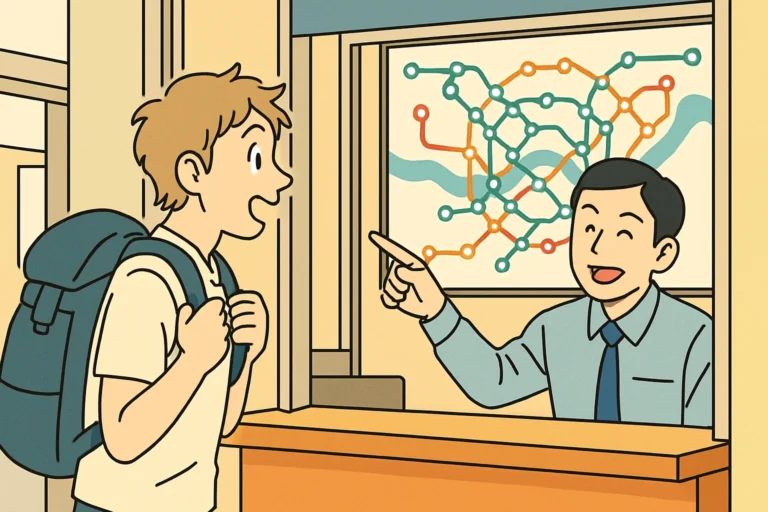
Imagine you’re at a subway station in Seoul. You want to go to Hongdae (홍대), a popular area known for its arts and music scene.
- (B) Ticket Staff: 어서 오세요. 어디까지 가세요?
- (Eoseo oseyo. Eodikkaji gaseyo?)
- (Welcome. Where are you going to?)
- (A) You: 홍대 한 장 주세요.
- (Hongdae han jang juseyo.)
- (One ticket to Hongdae, please.)
- (B) Ticket Staff: 네.
- (Ne.)
- (Okay.)
- (A) You: 얼마예요?
- (Eolmayeyo?)
- (How much is it?)
- (B) Ticket Staff: 1,400원입니다. (천사백 원입니다.)
- (Cheon-sabaek won-imnida.)
- (It is 1,400 won.)
See? With just these three phrases, you can handle the entire conversation!
Culture Tip & Trend Deep Dive
Travel Like a Local: The T-money Card Secret!
While the phrases we learned are perfect for the ticket office, here’s an insider tip to make you look like a seasoned pro. Almost no Koreans buy single-journey tickets anymore.
Instead, everyone uses a 교통카드 (gyotong kadeu), which means “transportation card.” The most famous brand is T-money.
- What is it? It’s a rechargeable card you can buy at any convenience store (like 7-Eleven, GS25, CU).
- How to use it? You “tap” it on the sensor when you enter and exit the subway gates or get on/off a bus.
- The Trend: Lately, Korean Gen Z (and most other people!) don’t even carry a physical card. They have the T-money function built into their smartphones via apps like Samsung Pay or other mobile payment systems. They simply tap their phone!
Your Pro-Tip: On your first day, go to a convenience store and say “티머니 카드 주세요 (T-money kadeu juseyo).” It will make your travels much faster, more convenient, and it even gives you a small discount on each ride!
Let’s Review & Practice!
Great job today! You’ve learned how to confidently buy a ticket by stating your destination and asking for the price.
Now, let’s see what you remember with a quick quiz!
- Fill in the Blank: You want to go to Gangnam (강남). What do you say to the ticket staff?
_________ 한 장 주세요.
- Your Turn: You are at a market and want to buy a cool hat. How do you ask the seller for the price?
Leave your answers in the comments below! And for extra practice, tell us where you want to go in Korea using the phrase we learned today. We can’t wait to read your responses
Frequently Asked Questions (FAQ)
Q: What does "까지" mean in Korean and how do you pronounce it?
A: In Korean, "까지" is pronounced [kkaji] and means: is a "tense consonant." It's different from the regular
Q: What does "장" mean in Korean and how do you pronounce it?
A: In Korean, "장" is pronounced [jang] and means: can be tricky. It's a sound that sits between an English 'j' and 'ch'. It's softer than the 'j' in "
Q: What does "얼마" mean in Korean and how do you pronounce it?
A: In Korean, "얼마" is pronounced [eolma] and means: . When
Q: What does "교통카드" mean in Korean and how do you pronounce it?
A: In Korean, "교통카드" is pronounced [gyotong kadeu] and means: , which means "transportation card." The most famous brand is







