

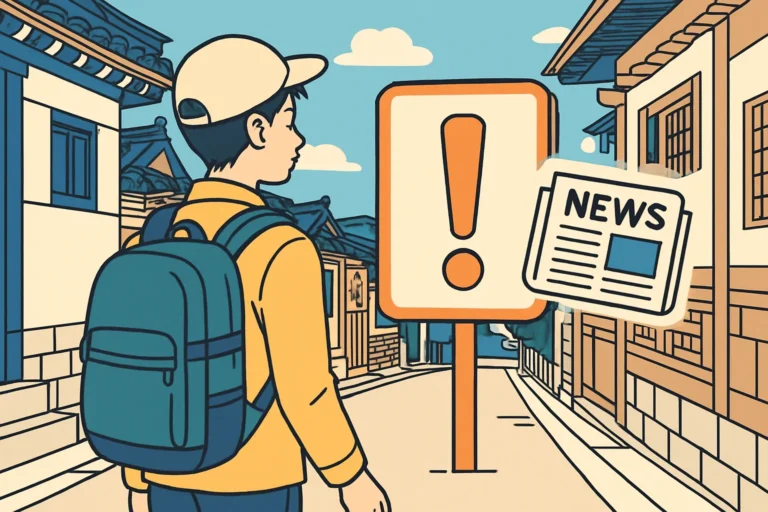
Unlock Korean News: Your Guide to Safe Travels!
Hello! This is [Maeil Hangul], here to upgrade your Korean skills!
Are you planning a trip soon? Or maybe you just want to understand what’s happening in Korea by reading the news? Today, we’re going to learn some essential Korean vocabulary that will help you do both! Lately in Korea, with summer vacation season just around the corner, everyone is busy planning their trips abroad. That’s why Korean news sites are buzzing with articles about travel safety! By learning a few key phrases, you can not only understand these helpful articles but also keep yourself safe on your future adventures. Let’s get started!
Core Expressions for Travel Safety
Here are three key phrases you’ll see all the time in Korean news articles about staying safe while traveling.
1. 조심하세요 (Josimhaseyo)
- Pronunciation [Romanization]: Jo-sim-ha-se-yo
- English Meaning: Please be careful / Watch out.
- Detailed Explanation: This is the polite way to say “be careful.” It comes from the verb 조심하다 (josimhada), which means “to be cautious” or “to be careful.” You can use this phrase to warn a friend, or you’ll see it written in public safety announcements and news articles. It’s a very common and caring expression.
- 💡 Pronunciation Tip:
The letter ‘ㅅ’ (s) is usually pronounced like an ‘s’, but when it’s followed by the vowel ‘ㅣ’ (i), it sounds more like ‘sh’. So, 조심 (josim) is pronounced like [jo-shim], not [jo-sim]. Think of the ‘sh’ sound in the English word “shoe.” This small change will make your pronunciation sound much more natural!
2. 소지품 (Sojipum)
- Pronunciation [Romanization]: So-ji-pum
- English Meaning: Belongings / Possessions.
- Detailed Explanation: This word is a little more formal and is often used in writing, like in news articles or on signs at the airport. It specifically refers to the things you carry with you, like your wallet, phone, and passport. You’ll often see it paired with 조심하세요, as in “소지품 조심하세요!” (Watch your belongings!).
- 💡 Pronunciation Tip:
Pay attention to the final consonant ‘ㅁ’ (m) in 품 [pum]. To make this sound correctly, you need to close your lips completely at the end of the syllable, just like you do for the letter ‘m’ in the English word “room.” It’s a clear stop: [so-ji-pum].
3. 위험해요 (Wiheomhaeyo)
- Pronunciation [Romanization]: Wi-heom-hae-yo
- English Meaning: It’s dangerous.
- Detailed Explanation: This is the polite, present-tense form of the adjective 위험하다 (wiheomhada), meaning “to be dangerous.” News articles use this word to describe risky situations, unsafe places, or dangerous activities you should avoid while traveling.
- 💡 Pronunciation Tip:
In the middle of a word, the Korean ‘ㅎ’ (h) sound can be very soft, almost silent. In 위험해요 (wiheomhaeyo), the ‘ㅎ’ in ‘험’ (heom) blends smoothly with the next vowel. So, instead of a strong “wi-heom-HA-yo,” it flows more like [wi-heom-mae-yo]. It’s a subtle but important detail that makes you sound like a local!
Example Dialogue
Let’s see how these words are used in a real conversation! Two friends, Alex and Minjun, are talking about their upcoming trip.
- A (Alex): 민준 씨, 우리 유럽 여행 기사 읽고 있어요.
(Minjun, I’m reading a news article about our Europe trip.) - B (Minjun): 정말요? 뭐라고 쓰여 있어요?
(Oh, really? What does it say?) - A (Alex): 밤에는 조금 위험해요. 그리고 소지품을 잘 챙겨야 한대요.
(It says it’s a little dangerous at night. And that we have to look after our belongings well.) - B (Minjun): 맞아요. 기사가 맞네요. 우리 항상 조심하세요!
(That’s right. The article is correct. Let’s always be careful!)
Culture Tip & Trend Analysis
In Korea, safety (안전, anjeon) is a very important topic, especially during peak travel seasons like summer vacation and national holidays. News channels and websites will run special reports on everything from pickpockets in famous tourist spots to travel scams.
When a Korean friend tells you “조심하세요!“, it’s more than just a simple warning. It’s a genuine expression of their care and concern for your well-being. It carries a warm feeling, like saying, “I care about you, so please stay safe.” So, if you’re reading a news article that uses these words, know that it’s written with the public’s best interest at heart. Using these phrases yourself shows that you are a thoughtful and aware traveler!
Let’s Practice!
Great job today! You’ve learned three essential words for understanding Korean travel news and staying safe. Now, let’s check your understanding.
1. Fill in the blanks:
A crowded market can be ______(1)______, so you should watch your ______(2)______ carefully.
(붐비는 시장은 (1)______ 수 있으니, (2)______을/를 잘 보세요.)
2. Make your own sentence!
Imagine your friend is going on a trip. What would you say to them using 조심하세요?
Leave your answers in the comments below! We are excited to see what you’ve learned. Happy studying
Frequently Asked Questions (FAQ)
Q: What does "조심하다" mean in Korean and how do you pronounce it?
A: In Korean, "조심하다" is pronounced [josimhada] and means: , which means "to be cautious" or "to be careful." You can use this phrase to warn a friend, or you'll see it written in public safety announcements and news articles. It's a very common and caring expression.
Q: What does "조심" mean in Korean and how do you pronounce it?
A: In Korean, "조심" is pronounced [josim] and means: is pronounced like
Q: What does "품" mean in Korean and how do you pronounce it?
A: In Korean, "품" is pronounced [pum] and means: . To make this sound correctly, you need to close your lips completely at the end of the syllable, just like you do for the letter 'm' in the English word "room." It's a clear stop:
Q: What does "위험하다" mean in Korean and how do you pronounce it?
A: In Korean, "위험하다" is pronounced [wiheomhada] and means: , meaning "to be dangerous." News articles use this word to describe risky situations, unsafe places, or dangerous activities you should avoid while traveling.







