

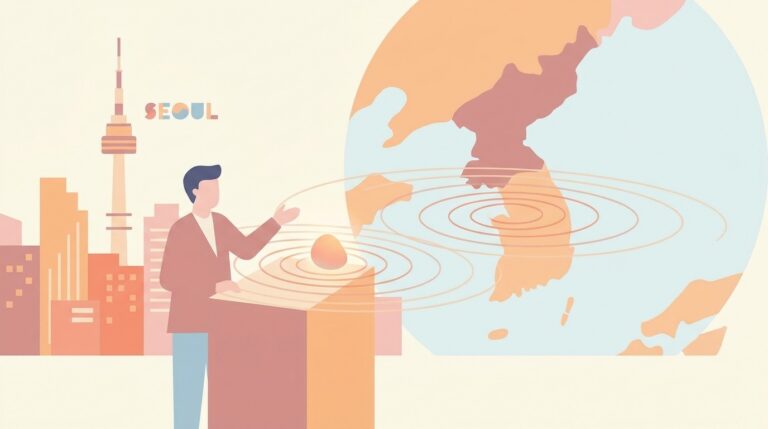
Phase 1: Why Flawless Korean Still Falls Flat
안녕하세요! 매일한글 에디터입니다. (Annyeonghaseyo! Maeilhangeul editeo-imnida. — Hello! I’m your Daily Hangul editor.) Picture yourself backstage at a Seoul forum, gripping your cue cards. Your Korean grammar is Level 5 flawless, yet last time you presented, the audience polite-clapped and checked their phones. Why? Because reciting facts feels like a textbook, whereas Korean listeners crave jeomcheungbeop (점층법, climax)—starting with one vivid, tiny detail and swelling into a truth about humanity. Drawing on ten years of coaching advanced learners through K-culture speeches and essays, I built this guide to help you weave metaphor, paradox, and irony into unforgettable Korean.
Phase 2: 3 Key Expressions for Building a Rhetorical Climax
1. 작은 날갯짓이 거대한 폭풍을 일으키듯 (Jageun nalgaetjisi geodaehan pokpungeul ireukideut)
- Pronunciation: [Ja-geun nal-gaet-ji-si geo-dae-han pok-pung-eul i-reu-ki-deut] — Think of pokpung as a crisp popping “pohk-poong,” while ireukideut glides softly like “ee-ruh-kee-deut.”
- Meaning: Literally “just as a small flap of wings stirs up a giant storm.” In practice, it serves as your poetic bridge from a microscopic personal anecdote to a sweeping national or global consequence.
- K-Culture Moment: Imagine the hushed climax of a Korean documentary or a Sebasi (세상을 바꾸는 시간 15분) talk right as the speaker pivots from a single child’s notebook to nationwide educational reform.
- Editor’s Insight: Replacing everyday
처럼(cheoreom, like) with~듯(deut, as if) instantly elevates your speech into literary, essay-grade Korean. It signals to native ears that a major thematic shift is coming. - Situation Spectrum: Casual 🚫 / Semi-formal ⚠️ / Formal ✅
- 🤔 Think About It: English speeches often state the big thesis upfront and drop an anecdote as evidence. Why does Korean rhetoric prefer letting a metaphor carry the listener slowly from small to vast before revealing the main point?
2. 개인의 아픔을 넘어 시대의 질문으로 (Gaeinui apeumeul neomeo sidaeeui jilmuneuro)
- Pronunciation: [Gae-in-ui a-peum-eul neo-meo si-dae-ui jil-mun-eu-ro] — Remember that the possessive
의softens to an airy “eh” sound here (gae-in-eh, si-dae-eh), keeping your cadence silky rather than choppy. - Meaning: Literally “crossing beyond an individual’s pain into the question of our era.” It frames personal struggle as a mirror reflecting society’s larger moral dilemma.
- K-Culture Moment: Think of courtroom monologues in Extraordinary Attorney Woo or quiet confessions in My Mister, where one character’s misfortune quietly indicts an entire system.
- Editor’s Insight: Pairing
~을/를 넘어(transcending X) with~으로(toward Y) creates clean parallel rhythm. Better yet, it carries subtle paradox: private vulnerability becomes public strength. - Situation Spectrum: Casual 🚫 / Semi-formal ✅ / Formal ✅
- 🤔 Think About It: While Western speeches often celebrate lone-hero triumph, Korean speeches gain moral weight by connecting the “I” to the “era” (sidae). How would you reframe your favorite personal story through that lens?
3. 가장 사적인 것이 가장 보편적이다 (Gajang sajeogin geosi gajang bopyeonjeogida)
- Pronunciation: [Ga-jang sa-jeok-in geo-si ga-jang bo-pyeon-jeok-i-da] — Link the final consonant in
사적인so it flows like “sa-juh-gin,” and hit보편crisply like “bo-pyuhn.” - Meaning: Literally “the most private thing is the most universal thing.” This paradoxical maxim (yeokseol) justifies why tiny, hyper-specific memories move strangers across the globe.
- K-Culture Moment: Korean film lovers know this line well from Director Bong Joon-ho’s iconic Oscars moment quoting Martin Scorsese—a philosophy that captures how Korean cinema turns local alleys into global art.
- Editor’s Insight: Repeating
가장(the most) on both sides of the sentence turns a contradiction into an unforgettable rhetorical punchline at the peak of a speech. - Situation Spectrum: Casual ⚠️ / Semi-formal ✅ / Formal ✅
- 🤔 Think About It: Does linking “private” and “universal” as equals feel bolder in Korean than in your native language, or do both cultures share this storytelling instinct?
Phase 3: Textbook Korean vs. Real Korean
Situation 1: Escalating from a Tiny Incident to a National Issue
- 📖 Textbook Korean:
이 작은 문제는 결국 큰 사회 문제가 됩니다.(I jageun munjeneun gyeolguk keun sahoe munjega doemnida. — This small problem eventually becomes a big social problem.) - 🗣️ Real Korean:
단순한 해프닝으로 치부하기엔, 이미 우리 사회의 민낯을 적나라하게 드러내고 있죠.(Dansunhan haepeuningeuro chibuhagien, imi uri sahoeui minnatcheul jeongnarahage deureonaego itjyo. — Far from being dismissed as a mere incident, it already starkly exposes the bare face of our society.) - 💡 Why Is It Different?: At Level 5, native speakers ditch flat adjectives like
큰(big) for visceral metaphors like민낯(bare/unvarnished face) and sharp verbs like치부하다(to dismiss as).
Situation 2: Delivering an Ironic Punchline About Modern Life
- 📖 Textbook Korean:
우리가 편리해질수록 서로 멀어지는 것은 모순입니다.(Uriga pyeollihaejilsurok seoro meoreojineun geoseun mosunimnida. — It is a contradiction that the more convenient we become, the further apart we grow.) - 🗣️ Real Korean:
아이러니하게도 손끝 하나로 세상과 연결될수록, 마음의 거리는 더 아득해지기 마련입니다.(Aireonihagedo sonkkeut hanaro sesanggwa yeongyeoldoelsurok, maeumui georineun deo adeukhaejigi maryeonimnida. — Ironically, the more we connect to the world with one fingertip, the more distant the gap between our hearts inevitably grows.) - 💡 Why Is It Different?: Real Korean eloquence pairs natural loanwords (
아이러니하게도) with tactile imagery (손끝 하나로, with a single fingertip) and softens sweeping claims with~기 마련이다(is bound to).
Phase 4: K-Culture Deep Dive & Non-Verbal Manners
4-1. Nunchi (눈치) & Delivery Gestures for a Climax Speech
In Korea, theatrical arm-waving during a serious speech can feel overly aggressive rather than inspiring. Start grounded: rest your hands lightly on the lectern or clasp them relaxedly at waist level while sharing your small opening anecdote, keeping your voice conversational. As you escalate toward the paradox or universal claim, drop your pitch slightly for gravitas rather than shouting, and open one palm smoothly toward the room (손짓, sonjit) only at the climax. Most importantly, sweep eye contact calmly across sections (시선 분산) and hold two full seconds of silence right after your final line so the yeoun (여운, lingering resonance) lands.
4-2. Cultural Code Analysis: From Local Alleys to Global Stages
Whether it is BTS addressing the United Nations—starting with a nervous kid from Ilsan or Busan before expanding to youth worldwide—or K-dramas using one cramped rooftop room (옥탑방) to examine class inequality, Korean storytelling thrives on So-seung-dae (소승대, seeing the vast universe inside something small). Rather than lecturing listeners with abstract morality from the start, Korean speakers invite empathy first through sensory detail, then widen the lens until everyone in the room sees themselves inside the story.
Phase 5: Real-Life Roleplay Scenario
Setting: Backstage at the Seoul Youth Forum (서울 청년 포럼) near Gwanghwamun. Scent of roasted coffee lingers in the air as you rehearse your 3-minute speech with Min-seo (민서), a razor-sharp Korean speech coach who drinks iced Americano even in freezing January.
- Min-seo:
방금 도입부에서 낡은 동네 자판기 얘기는 정말 좋았어요. 귀에 쏙 들어와요.(Banggeum doipbueseo nalgeun dongne japangi yaegineun jeongmal joasseoyo. Guie ssok deureowayo. — Your opening story about the broken neighborhood vending machine was great. It really sticks in the ear.) 🎭 She takes a brisk sip of iced coffee and taps her pen against your script. - You:
감사해요! 그런데 거기서 어떻게 지구촌 소비 문제로 넓혀야 할지 막막해요.(Gamsahaeyo! Geureonde geogiseo eotteoke jiguchon sobi munjero neolpyeoya halji mangmakhaeyo. — Thanks! Still, I’m stuck on how to expand from there to global consumerism.) 🎭 You nervously crease the corner of your cue card. - Min-seo:
바로 거기서 점층법이 필요해요. 작은 동전 하나가 시대의 자화상을 비춘다고 해 보세요.(Baro geogiseo jeomcheungbeobi piryohaeyo. Jageun dongjeon hanaga sidaeeui jahwasangeul bichundago hae boseyo. — That’s exactly where climax escalation comes in. Try framing that single coin as a mirror of our era’s self-portrait.) 🎭 She gestures outward with an open palm. - You:
아, 개인의 사소한 불편을 넘어 우리 모두의 민낯을 보여 준다는 식으로요?(A, gaeinui sasohan bulpyeoneul neomeo uri modueui minnatcheul boyeo jundaneun sigeuroyo? — Oh, as in going beyond minor personal inconvenience to reveal all of our true faces?) 🎭 Your eyes light up as you jot down the phrase. - Min-seo:
정확해요! 거기에 역설을 하나 얹으면 청중이 숨을 딱 멈출 거예요.(Jeonghwakhaeyo! Geogie yeokseoreul hana eonjeumyeon cheongjungi sumeul ttak meomchul geoyeyo. — Spot on! Layer one paradox on top of that, and the audience will hold their breath.) 🎭 She leans forward, lowering her voice conspiratorially. - You:
음... "넘쳐나는 물건 속에서 우리는 오히려 결핍을 산다"는 표현은 어때요?(Eum… “Neomchyeonaneun mulgeon sogeseo urineun ohiryeo gyeolpibeul sanda”neun pyohyeoneun eottaeyo? — Hmm… how about “Surrounded by overflowing goods, we paradoxically buy scarcity”?) 🎭 You test the rhythm aloud, pausing before “scarcity.” - Min-seo:
와, 소름 돋았어요! 그런데 마지막 절정 문장은 어떤 톤으로 끝낼 건가요?(Wa, soreum dodasseoyo! Geureonde majimak jeoljeong munjangeun eotteon toneuro kkeutnael geongayo? — Whoa, I just got chills! So what tone will you use to land your final climax sentence?) - You:
잠깐만요, 이 세 가지 연결 문장 중에 제일 자연스러운 걸 골라 볼게요.(Jamkkanmanyo, i se gaji yeongyeol munjang junge jeil jayeonseureoun geol golla bolgeyo. — One sec, let me pick the smoothest transition among these three lines.)
🔀 Interactive Branching Point: How Will You Land the Climax?
Choose your closing line for Min-seo’s feedback:
* Option A: 작은 자판기의 침묵은, 결국 더 빠른 것만 쫓느라 스스로를 소모하는 인류의 자화상입니다. (Jageun japangiui chimmugeun, gyeolguk deo ppareun geotman jjotneura seuseuroreul somohaneun illyuui jahwasangimnida. — The silence of a small vending machine is, ultimately, the self-portrait of a humanity consuming itself in its chase for speed.)
* Option B: 그래서 자판기 고장은 나쁘고 지구 환경도 나쁘니까 다 같이 조심해야 합니다. (Geuraeseo japangi gojangeun nappeugo jigu hwangyeongdo nappeunikka da gachi josimhaeya hamnida. — Therefore broken vending machines are bad and the global environment is bad too, so we should all be careful.)
* Option C: 어차피 인간은 똑똑한 척하면서 매일 쓰레기만 만드는 한심한 존재 아니겠습니까? (Eochapi inganeun ttokttokhan cheokhamyeonseo maeil sseuregiman mandeuneun hansimhan jonjae anigetseumnikka? — After all, aren’t humans pathetic beings pretending to be smart while only making trash?)
Coach Min-seo’s Feedback:
* If you chose A (Best!): Brilliant! You connected the tiny vending machine (작은 자판기) to humanity (인류) using crisp metaphor (자화상) and subtle irony (스스로를 소모하다, consuming ourselves). Standing ovation energy!
* If you chose B (Bad): Too flat and abrupt! Jumping straight from a machine to the planet with 나쁘고 breaks the emotional spell and sounds like an elementary essay.
* If you chose C (Risk): Watch out—this crosses from witty irony (baneo) into cynical lecturing! Korean audiences respond far better to shared reflection (우리) than harsh scolding.
Phase 6: 10-Second Emotional Shadowing Drill
Read these aloud, pausing briefly at every / and matching the emotional cue:
- [😌 Calmly, drawing listeners into a tiny memory]
골목길 끝의 / 낡은 가로등 하나가 / 그날 밤 유독 / 길게 흔들렸습니다.
(Golmokgil kkeuteui / nalgeun garodeung hanaga / geunal bam yudok / gilge heundeullyeotseumnida. — At the end of the alley / one old streetlight / swayed unusually long / that night.) -
[🤨 With sharp, thoughtful irony]
모두가 연결된 시대라지만, / 정작 내 이름을 불러 주는 목소리는 / 왜 이토록 낯설까요?
(Moduga yeongyeoldoen sidaerajiman, / jeongjak nae ireumeul bulleo juneun moksorineun / wae itorok natseolkkayo? — They call it an era where everyone is connected, / yet why does a voice calling my real name / feel so unfamiliar?) -
[🔥 Rising conviction, holding steady at the climax]
작은 시선 하나가 / 시대의 온도를 바꾸듯, / 오늘 우리의 질문이 / 내일의 세계를 엽니다.
(Jageun siseon hanaga / sidaeeui ondoreul bakkudeut, / oneul urieui jilmuni / naeirui segyereul yeomnida. — Just as one small gaze / shifts the temperature of an era, / our question today / opens tomorrow’s world.)
Phase 7: K-Culture Mini Dictionary
- 점층법 (Jeomcheungbeop) | Climax / Gradation | Used in TOPIK writing, persuasive speeches, and journalism to escalate scope or intensity step by step from micro to macro.
- 역설 (Yeokseol) | Paradox | Essential in Korean book reviews, debates, and essays to spotlight deep truths hidden inside apparent contradictions.
- 여운 (Yeoun) | Lingering emotional aftertaste | Praise used after a moving speech, indie film ending, or ballad that keeps resonating in your heart long after it finishes.
- 공감대 (Gonggamdae) | Shared common ground / empathy | A staple keyword in Korean marketing, politics, and workplace presentations for uniting diverse listeners.
Phase 8: Traveler’s Survival Kit (For Attending Korean Talks & Forums)
Top 3 Survival Phrases
방금 말씀하신 비유가 정말 인상 깊었습니다.(Banggeum malsseumhasin biyuga jeongmal insang gipeotseumnida. — The metaphor you just shared left a deep impression.) — Pro Tip: Say this during Q&A or book signings; Korean speakers adore hearing which specific image moved you.혹시 이 주제를 일상적인 사례로도 풀어 주실 수 있나요?(Hoksi i jujereul ilsangjeogin saryerodo pureo jusil su innayo? — Could you perhaps unpack this theme with an everyday example too?) — Pro Tip: A polite, high-level way to ask a panelist for a concrete anecdote.강연 내내 큰 여운이 남는 시간이었습니다.(Gangyeon naenae keun yeouni namneun siganieotseumnida. — It was a lecture that left a deep lingering resonance throughout.) — Pro Tip: Instant native-level compliment for a professor, author, or mentor.
Editor’s Travel Note
Heading to a public talk or book concert (북콘서트) in Seoul’s Gwanghwamun or Hongdae? Be sure to Download Naver Map App for Korean Venue Navigation since global map apps miss tiny basement lecture halls, and check Seoul Metropolitan Library Cultural Talk Schedules for free weekend author events. Tap your T-money or Climate Card cleanly at subway gates, and remember: if you rehearse your speech at a Korean café, keep your voice at a gentle murmur (소곤소곤)—cafés here double as quiet study zones!
Phase 9: One Step Deeper — Why “I” Becomes “We” in Korean Rhetoric
In Korean discourse, the word 우리 (uri, we/our) carries a warmth far deeper than simple plural grammar—it reflects jeong (정, deep communal affection) woven through shared history. When an advanced speaker begins with a personal memory and widens it into a universal human question, they are not abandoning individuality; they are inviting the audience inside the same 우리 umbrella. Paradoxes and metaphors act as bridges across that distance, proving that one person’s quiet ache belongs to the whole era. Once you master that upward arc, your Korean stops sounding translated and starts sounding truly lived-in.
💬 Your Turn: Think of a tiny, everyday moment from your life—a delayed train, a burnt piece of toast, a stray umbrella. How would you turn it into a universal human message in one Korean sentence? Drop your attempt in the comments!
Phase 10: FAQ & Myth Busting (FAQ Schema)
Q: Do I need obscure four-character idioms (사자성어) to sound Level 5 advanced in a Korean speech?
A: Not at all! While one well-placed idiom adds polish, overuse makes you sound stiff and dated. Clean metaphors paired with structured climax escalation (jeomcheungbeop) and vivid everyday verbs sound far more modern and persuasive.
Q: Can I use sarcasm or irony (반어법) in formal Korean presentations or TOPIK essays?
A: Yes, but handle it with grace. In Korean formal settings, gentle situational irony—highlighting a contradiction in modern habits—works wonderfully, whereas biting sarcasm aimed at specific people can seem rude and break nunchi.
Q: How long should the opening anecdote be before I escalate to the bigger issue?
A: Keep your concrete story tight—about 20 to 30 percent of your speech. Spend just enough time to paint one sensory scene, then use a pivot phrase like ~을 넘어 to widen the lens toward society and humanity.
🚨 Common Mistakes TOP 3
- Mistake: Stacking three dramatic metaphors in one sentence until the meaning blurs. → Correct Action: Pick one clear anchor metaphor (like a wingbeat or a coin) and let it echo consistently up to your climax.
- Mistake: Switching abruptly from casual speech (
~해요) to stiff written endings (~다) mid-speech. → Correct Action: Keep your speech ending consistent (~습니다/ㅂ니다for formal stages,~해요for intimate talks), reserving plain~다endings strictly for quoted maxims or essays. - Mistake: Rushing straight off the stage or ending abruptly with
끝입니다(That’s the end). → Correct Action: Deliver your paradoxical climax line, pause two seconds for yeoun, and close calmly with경청해 주셔서 감사합니다(Thank you for listening attentively).
Phase 11: Action Mission & K-Culture Quest
- 🥉 Bronze Mission (Solo Practice): Record a 30-second voice memo on your phone escalating one tiny morning routine into a reflection on modern life using
~듯. - 🥈 Silver Mission (Community Share): Rewrite a famous quote from your country into a Korean paradox and share it with fellow learners on social media or your study group.
- 🥇 Gold Mission (Real-World Use): Next time you write a journal entry, work email pitch, or TOPIK 54 essay, consciously structure your final paragraph from individual → society → humanity.
- 🎮 K-Culture Mission: Watch one 15-minute talk on YouTube from Sebasi (세바시) or rewatch a K-drama finale monologue—spot the exact second the speaker shifts from “my story” to “our era”!
Phase 12: Interactive Quiz Challenge
Test your Level 5 rhetorical instincts! Try answering before opening each toggle.
Quiz 1 (Situation Judgment): You are giving a formal speech in Seoul about urban loneliness. You just described eating instant noodles alone at a convenience store window. Which transition builds the best jeomcheungbeop climax?
* A) 아무튼 라면이 짜서 물을 많이 마셨습니다.
* B) 이 작은 컵라면의 김 너머로, 연결될수록 고립되어 가는 현대인의 모순이 보입니다.
* C) 혼자 먹는 건 다 여러분이 게을러서 그런 겁니다.
Click to Reveal Answer & Feedback for Quiz 1
Answer: B!
* Why B wins: It uses sensory imagery (컵라면의 김 너머로, beyond the steam of this cup ramen) to pivot smoothly into a sharp modern paradox (연결될수록 고립되다, growing isolated the more connected we are).
* Why A fails: It stays trapped in a trivial detail without escalating.
* Why C fails: Blaming the audience destroys empathy and violates Korean speech etiquette.
Quiz 2 (Fill in the Blank): Complete this Level 5 paradoxical climax:
개인의 작은 경험을 ( ____ ) 인류 보편의 질문으로 나아갈 때, 비로소 이야기는 힘을 얻습니다.
(Hint: “Transcending” / “going beyond” — 2 syllables)
Click to Reveal Answer & Explanation for Quiz 2
Answer: 넘어 (neomeo)
* Full Sentence: 개인의 작은 경험을 넘어 인류 보편의 질문으로 나아갈 때, 비로소 이야기는 힘을 얻습니다. (Only when going beyond one person’s small experience toward universal human questions does a story gain true power.)
* Tip: ~을/를 넘어 is your go-to hinge for scaling up any essay or speech!
Quiz 3 (True / False Cultural Quiz): In a Korean formal speech, shouting loudly and waving both arms rapidly at the climax is always seen as the best sign of passion.
Click to Reveal Answer & Cultural Insight for Quiz 3
Answer: False!
* Insight: Excessive volume or frantic hand gestures often feel distracting in Korean formal settings. Dropping your tone slightly for weight, opening one palm cleanly, and holding two seconds of silence for yeoun (여운) creates far stronger authority.
🎬 Watch Our Daily Videos! (Daily Hangul Official Instagram)
Review the expressions you learned in this article with our fun daily short videos! Check out native pronunciation and real-life nuances in action.
- Instagram @dailyhangul_en







