

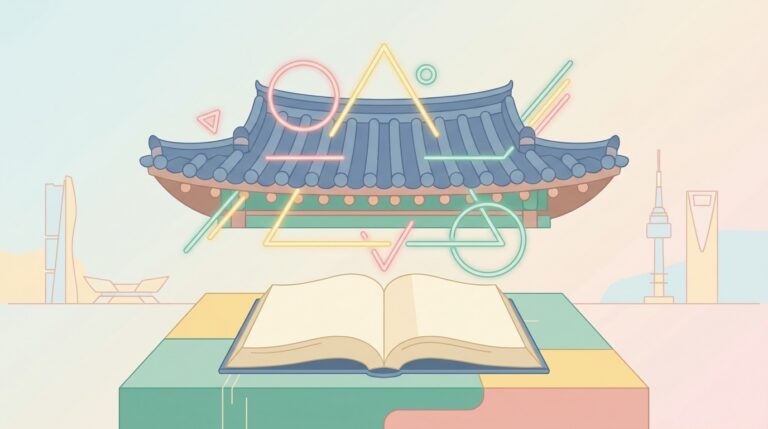
Phase 1: Empathy — Beyond Just Quoting the Classics
안녕하세요! 매일한글 에디터입니다. (Annyeonghaseyo! Maeil Hangeul editeoimnida. – Hello! I am your Daily Hangul Editor.) Picture this: you are sipping craft makgeolli in a cozy Seochon book-pub, chatting with Korean friends about the latest prestige K-drama. You drop a classical quote from Confucius or Shakespeare word-for-word to sound smart. Everyone nods politely, yet the vibe turns slightly stiff. Why? In advanced Korean discourse, simply reciting old wisdom feels like wearing your grandfather’s oversized suit. What truly captivates Koreans is taking a familiar classic, giving it a sharp modern twist, and asking bold questions. Built on real feedback from our Level 6 learners, this guide unlocks the art of creative reinterpretation so you can shine in any debate.
Phase 2: Deep Dive into 3 Essential Expressions
To move from merely reciting 전고 (jeongo – classical allusions) to engaging in critical dialogue with them, you need the exact vocabulary Koreans use in literary criticism, film reviews, and high-level debates.
1. 법고창신 (法古創新 – Beopgochangsin / Creating the New from the Old)
- Pronunciation: Beop-go-chang-sin (Sounds like bup-go-chahng-sheen — imagine saying ‘bump-go’ softly without the ‘m’, followed by ‘chahng’ like a gong and ‘sheen’ like clean)
- Meaning: Literally ‘modeling after the old and creating the new.’ In modern nuance, it means honoring classical roots not by copying them blindly, but by breathing contemporary life into them.
- K-Culture Moment: Think of Park Ji-won, a brilliant Joseon-era writer who championed this exact philosophy, or modern K-Pop producers who weave traditional pansori (판소리) rhythms into fierce hip-hop tracks, asking what traditional Korean spirit sounds like in the 21st century.
- Editor’s Insight: Unlike the more common 온고지신 (ongojisin – learning from the past), 법고창신 carries a much stronger artistic and rebellious spark. It implies active transformation rather than passive preservation.
- Situation Spectrum: Casual ⚠️ (Slightly heavy for beer-and-chicken banter) | Semi-formal ✅ | Formal ✅
- 🤔 Think About It: In Western discourse, breaking from tradition is often framed as ‘rebellion’ or ‘rupture.’ Why do you think Korean aesthetics so often frame innovation as an evolutionary dialogue with the past?
2. 의도적 비틀기 (Uidojeok biteulgi / Intentional Twisting or Subversion)
- Pronunciation: Ui-do-jeok bi-teul-gi (Sounds like wee-doh-juhk bee-teul-gee — start with a crisp ‘wee’, soft ‘uh’ in ‘juhk’, and ‘teul’ like ‘tull’ with your tongue flat)
- Meaning: Literally ‘purposeful twisting.’ In practice, it refers to a sharp, deliberate subversion of an expected classical trope, proverb, or narrative.
- K-Culture Moment: Remember how director Bong Joon-ho or hit K-dramas like Mr. Queen (철인왕후) take rigid Joseon Confucian etiquette or classic fairy tales and flip them upside down? Critics praise that exact move as 의도적 비틀기 (uidojeok biteulgi – intentional subversion).
- Editor’s Insight: Saying someone simply ‘changed’ a story (바꿨다 – bakkwotda) sounds flat. 비틀기 (biteulgi – twisting) captures the tactile tension—like wringing out a towel or turning a kaleidoscope—where you recognize the original shape even as it transforms into something startlingly new.
- Situation Spectrum: Casual ✅ | Semi-formal ✅ | Formal ✅
- 🤔 Think About It: When does a playful twist on a beloved classic cross the line into disrespect in your culture, and where does that boundary lie in Korea?
3. 기존 서사의 전복 (Gijon seosa-ui jeonbok / Subverting the Established Narrative)
- Pronunciation: Gi-jon seo-sa-ui jeon-bok (Sounds like gee-john suh-sah-eh juhn-bohk — hard ‘g’ like ‘go’, open ‘suh-sah’, and a punchy ‘bohk’ at the end)
- Meaning: Literally ‘overturning the existing narrative.’ Used when a modern creator or speaker challenges the power dynamics or moral assumptions baked into a classic text.
- K-Culture Moment: Picture modern Korean feminist retellings of The Tale of Simcheong (심청전), where instead of praising blind filial sacrifice, writers ask why society demanded a young girl jump into the sea in the first place. Book clubs in Hongdae buzz with 기존 서사의 전복 (gijon seosa-ui jeonbok – subverting the established narrative).
- Editor’s Insight: This phrase signals C2-level analytical fluency. Dropping 전복 (jeonbok – overturning/subversion) shows you aren’t just summarizing a plot—you are interrogating its ideology.
- Situation Spectrum: Casual ⚠️ (Best for serious discussions) | Semi-formal ✅ | Formal ✅
- 🤔 Think About It: Many Western myths celebrate individual defiance, while East Asian classics often emphasize harmony and duty. Which classic from your own childhood deserves a 기존 서사의 전복 today?
Phase 3: Textbook Korean vs. Real Korean
I once quoted a classical proverb stiffly at a Seoul dinner party, and my friends joked I sounded like a time-traveling Joseon scholar! Here is how real Koreans actually talk when they reinterpret classics.
Situation 1: Questioning an Outdated Proverb
- 📖 Textbook Korean: 그 속담은 현대 사회의 가치관과 맞지 않는다고 생각합니다. (Geu sokdameun hyeondae sahoe-ui gachigwan-gwa matji anneundago saenggakhamnida. – I think that proverb does not match modern society’s values.)
- 🗣️ Real Korean: 요즘 시대에 그 말은 좀 낡은 프레임 아닌가요? 오히려 ‘고생을 왜 사서 하냐’고 반문하게 되네요. (Yojeum sidae-e geu mareun jom nalgeun peureim aningayo? Ohiryeo ‘gosaeng-eul wae saseo hanya’go banmunhage doeneyo. – Isn’t that phrase a bit of an outdated frame nowadays? It actually makes me ask back, ‘Why on earth would you buy hardship?’)
- 💡 Why the difference? Real Koreans love using the loanword 프레임 (peureim – frame/framing) and directly quoting-and-flipping the proverb itself (고생은 사서도 한다 -> 고생을 왜 사서 하냐) to spark witty dialogue rather than lecturing.
Situation 2: Praising a Clever Modern Twist on a Classic
- 📖 Textbook Korean: 이 작품은 고전 소설을 현대적으로 훌륭하게 재해석했습니다. (I jakpumeun gojeon soseoreul hyeondaejeogeuro hullyunghage jaehaeseokhaetseumnida. – This work wonderfully reinterpreted the classical novel in a modern way.)
- 🗣️ Real Korean: 원작의 클리셰를 아주 맛깔나게 비틀었네. 고전한테 제대로 한 방 먹인 사이다 전개야! (Wonjag-ui keullisyereul aju matkkallage biteureotne. Gojeonhante jedaero han bang meogin saida jeongaeya! – They twisted the original’s clichés so deliciously. It’s a refreshing plot that really landed a punch on the classic!)
- 💡 Why the difference? Koreans use sensory food metaphors like 맛깔나다 (matkkallada – flavorful/deliciously executed) and 사이다 (saida – Sprite/refreshingly cathartic) even when analyzing highbrow literature or cinema!
Phase 4: K-Culture Deep Dive & Non-Verbal Manners
4-1. Nunchi (눈치) & Gestures
Challenging a respected classic—or questioning an elder’s favorite 사자성어 (sajaseongeo – four-character idiom)—requires supreme 눈치 (nunchi – social awareness). If you shoot down a classical quote abruptly, Koreans may perceive it as 건방지다 (geonbangjida – arrogant). Instead, use the ‘Pause, Nod, and Pivot’ technique: nod slowly while saying 음, 옛말이긴 한데요… (Eum, yenmarigin handeyo… – Hmm, while it is an old saying…), tilt your head slightly to signal curiosity rather than hostility, and soften your gaze before offering your modern counter-question. Your tone should sound like an invitation to think together, not a courtroom cross-examination.
4-2. Cultural Code Analysis: K-Pop & K-Cinema
Korean pop culture is a global masterclass in creative allusion. In K-Pop, groups like BTS have woven Hermann Hesse’s Demian and Carl Jung’s psychology into music videos—not as mere book reports, but to question the pressures placed on modern Korean youth. Similarly, in K-Cinema, directors frequently take Confucian expectations of family loyalty and place them inside hyper-capitalist Seoul apartments, forcing classical morality into uncomfortable dialogue with modern inequality. To understand modern Korea, watch how artists use classics as a mirror—and then deliberately crack the glass.
Phase 5: Real-Life Roleplay Scenario
Setting: Friday night at Chaek-ba (책바), a dimly lit, jazz-filled book-pub in Yeonnam-dong, Seoul. Rain taps against the window.
NPC: Min-jun (민준) — A 34-year-old literary magazine editor with round glasses, a warm smile, and a habit of playfully testing people’s cultural takes.
- Min-jun: 오늘 본 영화 어땠어요? 고전 《춘향전》을 그대로 가져왔던데. (Oneul bon yeonghwa eottaesseoyo? Gojeon ‘Chunhyangjeon’-eul geudaero gajyeowatdeonde.) – How was the film we saw today? It brought in the classic Tale of Chunhyang pretty directly.
🎭 (Resting his chin on his hand, swirling a glass of whiskey slowly.) - You: 표면적으로는 그렇죠. 근데 사실은 춘향이의 ‘지조’라는 가치를 오늘날의 시선으로 비틀어 본 게 인상적이었어요. (Pyomyeonjeogeureoneun geureotjyo. Geunde sasireun Chunhyang-i-ui ‘jijo’-raneun gachireul oneullal-ui siseoneuro biteureo bon ge insangjeogieosseoyo.) – On the surface, yes. But actually, twisting Chunhyang’s value of ‘fidelity’ through a modern lens was what impressed me.
🎭 (Leaning forward slightly with an intrigued smile.) - Min-jun: 오, 날카로운데요? 원작에선 미덕이었던 기다림을 현대적으론 수동성으로 재해석했다는 거군요. (O, nalkaroundeyo? Wonjageseon mideogieotdeon gidarimeul hyeondaejeogeuron sudongseong-euro jaehaeseokhaetdaneun geogunyo.) – Oh, sharp! You mean it reinterpreted the waiting—which was a virtue in the original—as passivity in modern terms.
🎭 (Adjusting his glasses, eyes lighting up.) - You: 맞아요. 저는 감독이 고전에게 ‘왜 꼭 기다려야만 했을까?’라고 질문을 던졌다고 봐요. (Majayo. Jeoneun gamdogi gojeonege ‘wae kkok gidaryeoyaman haesseulkka?’rago jilmuneul deonjyeotdago bwayo.) – Exactly. I think the director threw a question at the classic: ‘Why did she have to wait?’
🎭 (Gesturing gently with open palms to invite his thoughts.) - Min-jun: 그게 바로 창조적 재해석이죠. 고전을 박물관에 가두지 않고 살아 숨 쉬게 만드는 법이랄까요. (Geuge baro changjojeok jaehaeseogijyo. Gojeoneul bangmulgwane gaduji anko sara sum swige mandeuneun beobiralkkayo.) – That’s creative reinterpretation right there. A way of keeping classics alive and breathing instead of locking them in a museum.
🎭 (Nodding enthusiastically and raising his glass slightly.) - You: 그렇죠. 일종의 법고창신이라고 볼 수도 있겠네요. (Geureotjyo. Iljong-ui beopgochangsin-irago bol sudo itgetneyo.) – Right. You could even see it as a form of beopgochangsin.
🎭 (Smiling warmly as you clink glasses lightly.) - Min-jun: 와, 한국어 어휘력이 대단하시네요! 그런데 원작 팬들은 이 전복을 좀 불편해하지 않을까요? (Wa, Hangugeo eohwiryeogi daedanhasineyo! Geureonde wonjak paendeureun i jeonbogeul jom bulpyeonhaehaji aneulkkayo?) – Wow, your Korean vocabulary is amazing! Still, wouldn’t fans of the original find this subversion a bit uncomfortable?
🎭 (Tilting his head playfully, tossing you a tough follow-up question.)
🔀 Interactive Branching Point: How do you respond to Min-jun’s final question?
- Option A: 불편함이야말로 고전이 오늘날에도 여전히 유효하다는 증거 아닐까요? (Bulpyeonhamiyamallo gojeoni oneullaledo yeojeonhi yuhyohadaneun jeunggeo anilkkayo? – Isn’t that discomfort itself proof that the classic is still relevant today?)
- Feedback (Best): Brilliant Level 6 response! Using ~이야말로 (iyamallo – the very thing that) turns his counter-argument into your strongest point with poetic grace.
- Option B: 원작 팬들은 너무 보수적이라서 그렇게 생각하는 거예요. (Wonjak paendeureun neomu bosujeogiraseo geureoke saenggakhaneun geoyeyo. – Fans of the original only think that way because they are too conservative.)
- Feedback (Bad): Too dismissive! Labeling people 보수적 (conservative) shuts down nuanced dialogue and breaks nunchi.
- Option C: 맞아요, 저도 사실 원작을 건드리는 건 좀 위험하다고 생각해요. (Majayo, jeodo sasil wonjageul geondeurineun geon jom wiheomhadago saenggakhaeyo. – True, I actually think touching the original is a bit risky too.)
- Feedback (Risk): Polite, yet you suddenly retreated from your own insightful thesis! In advanced Korean intellectual chats, sticking warmly to your perspective earns more respect.
Phase 6: 10-Second Emotional Shadowing Drill
Read these aloud, pausing briefly at / and matching the emotional cue:
[🧐 Thoughtful & questioning]
옛말이 틀렸다는 게 아니라, / 오늘날의 시선으로 / 다시 질문을 던져 보자는 거죠.
(Yenmari teullyeotdaneun ge anira, / oneullal-ui siseoneuro / dasi jilmuneul deonjyeo bojaneun geojyo.)
— It’s not that the old saying is wrong, / it’s that we should try tossing a question at it again / through today’s lens.-
[😏 Witty & playfully subversive]
고전 속 비극을 / 현대적인 블랙 코미디로 비틀어 버린 / 센스가 정말 돋보이네요.
(Gojeon sok bigeugeul / hyeondaejeogin beullaek komidiro biteureo beorin / senseuga jeongmal dotboineyo.)
— Their wit in twisting a classical tragedy / into a modern black comedy / truly stands out. -
[🔥 Passionate & persuasive]
진정한 고전의 힘은 / 시대를 건너뛰어 / 끊임없이 재해석되는 데 있습니다.
(Jinjeonghan gojeon-ui himeun / sidaereul geonneottwieo / kkeunimeopsi jaehaeseokdoeneun de itseumnida.)
— The true power of a classic / lies in crossing eras / and being endlessly reinterpreted.
Phase 7: K-Culture Mini Dictionary (4 Key Terms)
| Term (Hangul + Romanization) | English Translation | Real-Life & Business Usage |
|---|---|---|
| 1. 전고 (Jeongo) | Classical allusion / historical precedent | Used in essays, speeches, and branding pitches when referencing famous historical stories or classics. |
| 2. 온고지신 (Ongojisin) | Reviewing the old to learn the new | Very common in Korean corporate New Year speeches and academic essays to emphasize heritage-driven growth. |
| 3. 클리셰 비틀기 (Keullisye biteulgi) | Twisting a cliché | Essential phrase in K-drama YouTube reviews, webtoon comments, and marketing brainstorms. |
| 4. 재조명 (Jaejomyeong) | Re-illumination / re-evaluation | Heard constantly in Korean news and arts media when an overlooked classic or artist gets fresh modern appreciation. |
Phase 8: Survival Kit for Travelers
Planning to explore Seoul’s literary hubs like Gwanghwamun, Seochon, or Paju Book City? Keep these top 3 phrases handy!
- 이 고전을 현대적으로 재해석한 책이 있나요? (I gojeoneul hyeondaejeogeuro jaehaeseokhan chaegi innayo? – Are there any books that reinterpret this classic in a modern way?)
- Pro Tip: Ask this at the humanities desk in Kyobo Bookstore! Staff love recommending trendy Korean 리텔링 (ritelling – retelling) novels.
- 작품 속 숨은 전고가 궁금해요. (Jakpum sok sumeun jeongoga gunggeumhaeyo. – I’m curious about the hidden classical allusions in this artwork.)
- Pro Tip: Use this with museum docents at the National Museum of Korea—they will light up and give you an unforgettable backstage story.
- 원작과 어떤 점이 달라졌나요? (Wonjakgwa eotteon jeomi dallajeotnayo? – What aspects changed compared to the original?)
- Pro Tip: Perfect icebreaker at indie theaters like Seoul Art Cinema.
Editor’s Travel Note
Before hitting Seoul’s book-pubs and theaters, make sure to Download the Naver Map App for Korean Transit since Google Maps doesn’t offer reliable walking directions in Korea. Also, pick up a WOWPASS or T-money card at Incheon Airport—Seoul’s cozy independent bookstores in Seochon are best reached by jumping off at Gyeongbokgung Station (Line 3) and strolling past traditional Hanok alleys!
Phase 9: One Step Deeper — Respectful Rebellion
In Korean culture, shaped deeply by 예 (ye – propriety and respect), directly dismissing tradition can feel jarring. Yet Korean intellectual history is filled with thinkers who honored their elders precisely by arguing with them. Creative reinterpretation (창조적 재해석 – changjojeok jaehaeseok) is not about tearing down the past; it is an acknowledgment that the classic is still alive enough to handle our hardest modern questions. When you twist an old Korean proverb or ask a tough question of a classic text, you aren’t being an outsider—you are stepping right into the living heartbeat of Korean discourse.
💬 Your Turn: Which classic story, myth, or proverb—Eastern or Western—do you think desperately needs a modern Korean-style twist? Share your creative pitch in the comments below!
Phase 10: FAQ & Misunderstanding Prevention
Q: Is it rude for a foreigner to question a Korean proverb or classical quote in conversation?
A: Not at all—as long as you frame it as curiosity rather than dismissal! Using softeners like 요즘 관점에서 보면… (yojeum gwanjeomeseo bomyeon… – looking from a modern perspective…) shows cultural sophistication and earns genuine admiration.
Q: What is the difference between 온고지신 (Ongojisin) and 법고창신 (Beopgochangsin)?
A: 온고지신 focuses on learning wisdom from the past to apply today, while 법고창신 emphasizes actively breaking past formulas to create something original on a classical foundation. For creative reinterpretation, 법고창신 is the sharper choice.
Q: Can I mix Western allusions (like Greek myths) with Korean discourse?
A: Yes! Educated Koreans love cross-cultural parallels—comparing Promethean fire or Pandora’s box to Korean folktales or modern tech ethics makes you sound effortlessly eloquent.
🚨 Common Mistakes Warning Board
- Mistake: Using 왜곡 (waegok – distortion) instead of 비틀기 (biteulgi – creative twist). 왜곡 sounds like malicious falsification! Correct Action: Use 재해석 (jaehaeseok) or 유쾌한 비틀기 (yukwaehan biteulgi – playful twist).
- Mistake: Quoting a four-character idiom (사자성어) without checking its modern connotation—some sound overly stiff or patriarchal today. Correct Action: Ask, 요즘도 이 표현을 긍정적으로 쓰나요? (Yojeumdo i pyohyeoneul geungjeongjeogeuro sseunayo? – Is this expression still used positively today?).
- Mistake: Explaining the entire classic plot first before making your point. Correct Action: Assume shared knowledge of major classics and jump straight to your modern contrast!
Phase 11: Action Mission & Engagement
- 🥉 Bronze Mission: Pick one Korean proverb you learned in Level 3 or 4 (like 구슬이 서 말이라도 꿰어야 보배) and write a 1-sentence modern twist questioning it in Korean.
- 🥈 Silver Mission: Share your favorite K-drama 클리셰 비틀기 (cliché twist) on Instagram or X using the hashtag
#DailyHangulLevel6. - 🥇 Gold Mission: Next time you speak with a Korean friend or tutor, smoothly weave in 법고창신 (beopgochangsin) or 기존 서사의 전복 (gijon seosa-ui jeonbok) during a movie or book chat.
🎮 K-Culture Mission: Watch an episode of a modern Korean adaptation (like Little Women / 작은 아씨들 or The Tale of Lady Ok / 옥씨부인전) and spot one moment where the writer flipped the original moral expectation on its head!
Phase 12: Interactive Quiz Challenge
1. Situational Judgment: You are praising a director who brilliantly turned a tragic classical folktale into a sharp feminist thriller. Which comment sounds most natural and sophisticated?
A) 감독이 원작을 완전히 왜곡해서 너무 좋았어요.
B) 감독이 기존 서사를 전복하고 시대에 맞는 질문을 던진 게 인상적이었어요.
C) 감독이 옛날 책을 그대로 베껴서 아주 훌륭했어요.
Click to reveal Answer & Explanation
Answer: B
Option A uses 왜곡 (distortion), which carries a negative nuance of falsifying facts. Option C says the director ‘copied it verbatim’ (그대로 베꼈다), which misses the creative twist. Option B (기존 서사를 전복하고… – subverting the established narrative and posing a timely question) hits peak Level 6 elegance!
2. Fill in the Blank: Fill in the exact noun meaning ‘twisting/subversion’ in this Korean review:
“이 드라마는 뻔한 로맨스 클리셰를 아주 유쾌하게 [ ______ ] 데 성공했다.” (I deuramaneun ppeonhan romaenseu keullisyereul aju yukwaehage [ ______ ] de seonggonghaetda.)
Click to reveal Answer & Explanation
Answer: 비트는 (biteuneun) — from 비틀기 (biteulgi / 비틀다)
Full phrase: 클리셰를 유쾌하게 비트는 데 성공했다 (succeeded in playfully twisting the cliché). Notice the irregular ㄹ conjugation: 비틀다 + -는 becomes 비트는!
3. True or False (Cultural Quiz): In Korea, using 법고창신 (beopgochangsin) means rejecting all traditional classics and starting completely from zero.
Click to reveal Answer & Explanation
Answer: False!
법고창신 means modeling after the old (법고) to create the new (창신). It is a respectful, creative dialogue with the past—never an erasure of it.
🎬 Watch Our Daily Videos! (Daily Hangul Official Instagram)
Review the expressions you learned in this article with our fun daily short videos! Check out native pronunciation and real-life nuances in action.
- Instagram @dailyhangul_en







