

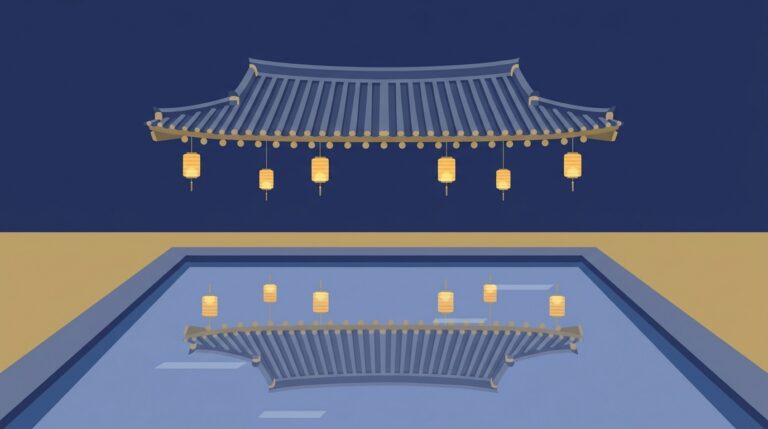
Phase 1: Why Planning Your Gyeongju Trip in Korean Feels Tricky (And How to Nail It!)
안녕하세요! 매일한글 에디터입니다. (Annyeonghaseyo! Maeil Hangeul editeo-imnida. / Hello! I’m your Daily Hangul editor.) Imagine sitting in a cozy café, mapping out your dream Korean trip to Jeju, Gangneung, and Gyeongju. You finally book a charming Hanok in Gyeongju and picture yourself strolling around Donggung Palace and Wolji Pond under the moonlight, just like a K-Drama scene! Then your Korean friend asks about your itinerary, and suddenly your mind goes blank. How do you connect staying at a Hanok AND seeing the night view in one smooth sentence? Based on real feedback from our Level 2 learners, linking two plans together is the biggest hurdle when talking about domestic travel. Today, let’s fix that forever so you can share your Gyeongju plans like a natural!
Phase 2: Top 3 Core Expressions Deep Dive
1. 경주에서는 한옥 숙소에서 잘 거예요 (Gyeongju-eseoneun hanok sukso-eseo jal geoyeyo)
- Pronunciation: Gyeong-ju-e-seo-neun ha-nok suk-sso-e-seo jal geo-ye-yo (Say “Gyeong-ju” like “Kyung-joo” with a soft K/G; “suk-sso” sounds like “sook-so” with a punchy double S; “jal geo-ye-yo” flows like “jahl guh-yeh-yo”).
- Meaning: Literal: “As for in Gyeongju, I will sleep at a Hanok accommodation.” / Actual nuance: “For the Gyeongju part of my trip, I’m staying at a Hanok!”
- K-Culture Moment: Picture the cast of the hit travel variety show 2 Days & 1 Night (1박 2일) excitedly comparing where they’re sleeping tonight—one team gets a luxury hotel, while the other cheers about sleeping in a cozy traditional Hanok.
- Editor’s Insight: Notice the magic combo 에서는 (-eseoneun)! Adding 는 (-neun) after 에서 (-eseo) contrasts Gyeongju with other cities on your itinerary (like Jeju or Gangneung). It tells the listener, “Unlike Jeju, in Gyeongju specifically, this is my plan!”
- Situation Spectrum: Casual (잘 거야) ✅ | Semi-formal (잘 거예요) ✅ | Formal (잘 것입니다) ⚠️ (Slightly stiff for casual chat)
- 🤔 Think About It: In English, you just say “In Gyeongju…” with vocal stress. In Korean, we snap the topic marker 는 (-neun) onto 에서 (-eseo) to spotlight the city! How do you usually emphasize one destination over another in your native language?
2. 한옥에서 자고 밤에 동궁과 월지 야경을 볼 거예요 (Hanok-eseo jago bam-e Donggung-gwa Wolji yagyeong-eul bol geoyeyo)
- Pronunciation: Ha-no-ge-seo ja-go ba-me Dong-gung-gwa Wol-ji ya-gyeong-eul bol geo-ye-yo (“Ha-nok” flows smoothly into “-eseo” like “ha-no-ge-suh”; “yagyeong” sounds like “yah-gyung”).
- Meaning: Literal: “I will sleep at a Hanok and at night see the Donggung and Wolji night view.” / Actual nuance: “We’re staying at a Hanok and checking out the Donggung and Wolji night view!”
- K-Culture Moment: Just like characters in K-Dramas such as Hwarang or modern travel vlogs on YouTube, visitors love connecting their daytime Hanok aesthetic straight into a glowing evening walk at Silla’s historic pond.
- Editor’s Insight: The connector -고 (-go) is your Level 2 best friend! Instead of chopping your itinerary into two awkward baby sentences, 자고 (jago / sleep and…) glues your plans together effortlessly. Remember: you only put the future tense -(으)ㄹ 거예요 at the very end!
- Situation Spectrum: Casual (볼 거야) ✅ | Semi-formal (볼 거예요) ✅ | Formal (볼 예정입니다) ✅
- 🤔 Think About It: Korean packs the tense (past, present, or future) strictly at the end of the whole sentence, keeping the first verb (자고) neutral. Does your language keep the first verb tense-free when listing plans, or do you conjugate every single verb?
3. 동궁과 월지는 밤에 가야 돼요 (Donggung-gwa Wolji-neun bam-e gaya dwaeyo)
- Pronunciation: Dong-gung-gwa Wol-ji-neun ba-me ga-ya dwae-yo (“ga-ya dwae-yo” sounds like “gah-yah dweh-yo”).
- Meaning: Literal: “As for Donggung and Wolji, you must go at night.” / Actual nuance: “You have to visit Donggung and Wolji at night (it’s a must-see!).”
- K-Culture Moment: Whenever a Korean friend recommends Gyeongju on Instagram or in a travel chat, this exact line pops up in the comments—warning travelers not to waste their ticket during plain daylight!
- Editor’s Insight: Don’t worry, -아/어야 되다 (-a/eoya doeda) doesn’t mean someone will arrest you if you go at noon! In travel talk, Koreans use “you have to” warmly to give strong, friendly insider advice—just like saying “You gotta try this!”
- Situation Spectrum: Casual (가야 돼) ✅ | Semi-formal (가야 돼요) ✅ | Formal (가셔야 합니다) ⚠️
- 🤔 Think About It: In Korean culture, sharing the best timing for a place is a sign of deep care and hospitality. When you recommend a spot back home, do you focus more on what to see or when to go?
Phase 3: Textbook Korean vs. Real Korean
Situation 1: Saying you will stay at a Hanok
- 📖 Textbook Korean: 저는 경주에 있는 전통 한옥에서 숙박할 것입니다. (Jeoneun Gyeongju-e inneun jeontong hanok-eseo sukbakhal geosimnida. / I will lodge at a traditional Hanok located in Gyeongju.)
- 🗣️ Real Korean: 경주에서는 한옥 스테이 할 거예요! (Gyeongju-eseoneun hanok seutei hal geoyeyo! / In Gyeongju, I’m doing a Hanok stay!)
- 💡 Why the difference? Words like 숙박하다 (sukbakhada / to lodge) sound like a hotel brochure or news report. Young Koreans and travelers love the trendy Konglish phrase 한옥 스테이 (Hanok stay) paired with 하다 (hada)!
Situation 2: Talking about seeing the night view
- 📖 Textbook Korean: 밤에 아름다운 야경을 구경할 계획입니다. (Bam-e areumdaun yagyeong-eul gugyeonghal gyehoegimnida. / I plan to sightsee the beautiful night view at night.)
- 🗣️ Real Korean: 밤에 야경 보러 갈 거예요! (Bam-e yagyeong boreo gal geoyeyo! / I’m going to see the night view at night!)
- 💡 Why the difference? Saying “my plan is to sightsee” feels way too stiff with friends. Using -(으)러 가다 (going in order to…) like 보러 갈 거예요 (boreo gal geoyeyo) sounds active, excited, and super natural for Level 2 speakers!
Phase 4: K-Culture Deep Dive & Non-Verbal Manners
4-1. Nunchi (눈치) & Gestures in Gyeongju
- At the Hanok: Before stepping onto the raised wooden porch (대청마루 / daecheongmaru) or into your room, always take off your shoes and align them neatly facing outward. Hanok rooms have traditional paper doors (창호지 / changhoji) and thin walls, so lowering your voice after 9 PM shows top-tier nunchi!
- At Donggung & Wolji: The pond’s mirror-like reflection is the star of the show. You’ll see couples and friends quietly lining up along the wooden railings. The polite non-verbal rule? Snap 2–3 quick photos, step aside with a small nod, and keep your phone screen brightness low so you don’t ruin others’ night shots!
4-2. Culture Code: K-Travel & Silla Aesthetics
Gyeongju isn’t just an old city—it’s Korea’s ultimate “time-travel” destination, known as the “museum without walls” from the ancient Silla Dynasty. Right now, 한옥캉스 (Hanok-cance)—a blend of Hanok and vacance (vacation)—is huge among Koreans in their 20s and 30s. Travelers wear modern hanbok, sip traditional omija tea in wooden courtyards, and wait for sunset when Donggung Palace lights up in warm gold over Wolji Pond.
Phase 5: Real-Life Roleplay Scenario
Setting: Sunset in Gyeongju’s trendy Hwangnidan-gil street. The smell of warm gyeongju bread (red bean pastry) fills the air. You’re chatting at a Hanok café counter with Minji, a cheerful local barista and Gyeongju travel lover.
- Minji: 어서 오세요! 여행 오셨어요? 🎭 (Smiling warmly while wiping an espresso cup)
(Eoseo oseyo! Yeohaeng osyeosseoyo? / Welcome! Are you here on a trip?) - You: 네! 제주도랑 강릉에도 가고, 어제 경주에 왔어요. 🎭 (Holding up your travel itinerary map excitedly)
(Ne! Jeju-do-rang Gangneung-edo gago, eoje Gyeongju-e wasseoyo. / Yes! I’m also going to Jeju and Gangneung, and I arrived in Gyeongju yesterday.) - Minji: 우와, 일정이 진짜 알차네요! 경주에서는 어디에서 자요? 🎭 (Leaning forward with curious eyes)
(Uwa, iljeong-i jinjja alchaneyo! Gyeongju-eseoneun eodi-eseo jayo? / Wow, your itinerary is packed! Where are you sleeping in Gyeongju?) - You: 경주에서는 한옥 숙소에서 잘 거예요. 🎭 (Pointing proudly toward the nearby tiled roofs)
(Gyeongju-eseoneun hanok sukso-eseo jal geoyeyo. / In Gyeongju, I’ll sleep at a Hanok accommodation.) - Minji: 오, 한옥 좋죠! 오늘 밤에는 뭐 할 거예요? 🎭 (Giving an enthusiastic thumbs-up)
(O, hanok jotjyo! Oneul bam-eneun mwo hal geoyeyo? / Oh, Hanoks are great! What are you going to do tonight?) - You: 숙소에서 쉬고 밤에 동궁과 월지 야경을 볼 거예요. 🎭 (Miming snapping a photo with both hands)
(Sukso-eseo swigo bam-e Donggung-gwa Wolji yagyeong-eul bol geoyeyo. / I’ll rest at the accommodation and see the Donggung and Wolji night view at night.) - Minji: 딱 좋아요! 동궁과 월지는 꼭 밤에 가야 돼요. 🎭 (Winking playfully as she hands you your iced Americano)
(Ttak joayo! Donggung-gwa Wolji-neun kkok bam-e gaya dwaeyo. / That’s perfect! You definitely have to go to Donggung and Wolji at night.) - You: 네, 감사해요! 사진 많이 찍을 거예요. 🎭 (Bowing slightly with a bright smile)
(Ne, gamsahaeyo! Sajin mani jjigeul geoyeyo. / Yes, thank you! I’m going to take lots of photos.)
🔀 Interactive Branching Point: What Do You Say Next?
Minji asks: “혹시 내일 아침 일정도 있어요?” (Hoksi naeil achim iljeong-do isseoyo? / Do you have a plan for tomorrow morning too?)
* Option A: “네! 아침 먹고 불국사에 갈 거예요.” (Ne! Achim meokgo Bulguksa-e gal geoyeyo. / Yes! I’ll eat breakfast and go to Bulguksa Temple.)
* Feedback (Best ✅): Spot-on! You used -고 and -(으)ㄹ 거예요 naturally, and Bulguksa is the classic morning route after Donggung & Wolji.
* Option B: “네! 아침 먹었어요 그리고 불국사 가요.” (Ne! Achim meogeosseoyo geurigo Bulguksa gayo. / Yes! I ate breakfast and go to Bulguksa.)
* Feedback (Bad ❌): Oops! 먹었어요 is past tense for tomorrow morning, and chopping sentences with 그리고 sounds robotic. Stick to 먹고 갈 거예요!
* Option C: “내일? 음… 그냥 한옥에서 계속 잘래요!” (Naeil? Eum… geunyang hanok-eseo gyesok jallaeyo! / Tomorrow? Hmm… I’ll just keep sleeping at the Hanok!)
* Feedback (Risk ⚠️): Cute and funny—Minji will laugh! Just note that -(으)ㄹ래요 is casual and expresses strong personal preference, which works in a friendly café chat, though -(으)ㄹ 거예요 is safer for general plans.
Phase 6: 10-Second Emotion Shadowing Drill
Read these out loud! Pause slightly at / and match the emotion tag:
- [😊 Excited & Bright]
경주에서는 / 한옥에서 잘 거예요! (Gyeongju-eseoneun / hanok-eseo jal geoyeyo! / In Gyeongju, I’m sleeping at a Hanok!) - [😮 In Awe & Dreamy]
밤에 / 동궁과 월지 야경을 / 볼 거예요. (Bam-e / Donggung-gwa Wolji yagyeong-eul / bol geoyeyo. / At night, I’ll see the Donggung and Wolji night view.) - [🥺 Helpful & Insistent]
거기는 / 꼭 밤에 가야 돼요! (Geogineun / kkok bam-e gaya dwaeyo! / You really have to go there at night!)
Phase 7: K-Culture Mini Dictionary
- 한옥 (Hanok) | Traditional Korean house | Used everywhere in travel blogs, Airbnb listings, and café names (like 한옥 카페 / Hanok café).
- 야경 (Yagyeong) | Night view | Koreans are obsessed with 야경 명소 (yagyeong myeongso / famous night-view spots) from Seoul’s Namsan to Gyeongju’s Wolji Pond.
- 일정 (Iljeong) | Travel schedule / itinerary | Works both for business calendars (“일정 확인” / checking a schedule) and casual trip planning (“여행 일정” / travel itinerary).
- 황리단길 (Hwangnidan-gil) | Gyeongju’s trendiest Hanok street | Named after Seoul’s Gyeongnidan-gil; packed with fusion restaurants, photo booths, and boutique Hanok stays.
Phase 8: Traveler’s Survival Kit
Top 3 Survival Phrases
- 체크인은 몇 시예요? (Chekeu-in-eun myeot siyeyo? / What time is check-in?) — Pro Tip: Many Gyeongju Hanok hosts message you via KakaoTalk, so keep this handy!
- 야경이 제일 예쁜 시간은 언제예요? (Yagyeong-i jeil yeppeun sigan-eun eonjeyeyo? / When is the prettiest time for the night view?) — Pro Tip: Usually 30 minutes after sunset during the “blue hour”!
- 온돌 켜 주실 수 있어요? (Ondol kyeo jusil su isseoyo? / Could you turn on the floor heating?) — Pro Tip: Hanoks use traditional ondol floor heating, which feels heavenly after a chilly night walk.
Editor’s Travel Note
- Navigation: Google Maps struggles with walking routes in Korea. Make sure to [Download the Naver Map App for Accurate Gyeongju Bus Routes] before landing, and search “동궁과 월지” directly in Hangul.
- Transport & Tickets: Tap your T-money card on Gyeongju city buses, or rent a bicycle near the train station. Donggung & Wolji closes around 10 PM (last entry 9:30 PM), so plan dinner early!
Phase 9: One Step Deeper — The Heart Behind “Yagyeong”
Why are Koreans so passionate about 야경 (night views), especially in historic places like Gyeongju? In traditional Korean culture, there is a concept called 풍류 (pungryu)—the art of slowing down to enjoy moonlight, breezes, water, and music with good company. Ancient Silla nobles literally built Wolji Pond to mirror the moon and palace lanterns on calm water. When you tell a Korean friend you are going to see the night view, you aren’t just checking off a tourist spot; you’re joining a thousand-year-old tradition of appreciating quiet beauty together.
💬 Your Turn: Which domestic destination in Korea excites you the most—Jeju, Gangneung, or Gyeongju? Drop your dream one-sentence Korean itinerary in the comments below and I’ll check it for you!
Phase 10: FAQ & Common Mistakes
Q: Can I use “에 (-e)” instead of “에서 (-eseo)” in “한옥에서 잘 거예요”?
A: Not here! Use 에 (-e) for destinations where you go (경주에 갈 거예요), and 에서 (-eseo) for places where an action happens, like sleeping (한옥에서 잘 거예요) or eating.
Q: Do I need to repeat “-(으)ㄹ 거예요” before “-고 (-go)”?
A: No! Never say “잘 거예요고 볼 거예요.” Simply attach -고 straight to the verb stem (자고 / jago) and save -(으)ㄹ 거예요 for the final verb only.
Q: Is Donggung and Wolji safe to visit alone at night?
A: Yes, very safe! It is brightly lit, bustling with families and couples until 10 PM, and easy to reach by taxi or bus.
🚨 Common Mistakes TOP 3
- Mistake: Saying “밤에 야경을 저녁에 볼 거예요” (repeating time words awkwardly). -> Correct Action: Just say 밤에 야경을 볼 거예요 (Yagyeong already implies night, so “밤에” once is plenty!).
- Mistake: Using 그리고 (geurigo) between every single plan. -> Correct Action: Connect two closely linked actions with -고 (자고 ~ 볼 거예요) so your Korean sounds smooth.
- Mistake: Wearing outdoor shoes onto a Hanok’s wooden veranda. -> Correct Action: Always look for the stone step (디딤돌) and leave your shoes there before stepping onto wood!
Phase 11: Action Mission & K-Culture Challenge
- 🥉 Bronze Mission (Solo Practice): Look in the mirror and say your 3-city plan aloud in 5 seconds: “제주도에서 수영하고 경주에서는 한옥에서 잘 거예요!” (I’ll swim in Jeju, and in Gyeongju I’ll sleep at a Hanok!)
- 🥈 Silver Mission (Share Online): Post a photo of Gyeongju or your travel mood board on Instagram/Threads with the caption: 경주에서는 한옥에서 잘 거예요! 🏮
- 🥇 Gold Mission (Real-Life Use): Message a Korean language exchange partner or friend and ask: “한국 여행 가면 어디에서 자고 뭐 볼 거예요?” (If you travel in Korea, where will you stay and what will you see?)
- 🎮 K-Culture Mission: Watch any Korea travel vlog on YouTube (search “경주 여행 브이로그”) and see how many times you hear -고 and -(으)ㄹ 거예요 in the first 3 minutes!
Phase 12: Interactive Quiz Challenge
1. Situation Judgment: You’re telling a Korean friend your Gyeongju plan. Which sentence sounds most natural for Level 2?
A) 경주에 한옥에 잘 거예요 그리고 야경 봐요.
B) 경주에서는 한옥에서 자고 밤에 야경을 볼 거예요.
C) 경주에서 숙박을 취하고 야경을 구경할 것입니다.
2. Fill in the Blank: Connect these two plans smoothly!
“한옥에서 (_____) 밤에 동궁과 월지 야경을 볼 거예요.”
(Hint: Use the verb 자다 / to sleep + connector)
3. True or False (Culture Quiz): In a traditional Hanok, it’s completely fine to keep your sneakers on while walking across the wooden porch (daecheongmaru) as long as they look clean.
Click here to reveal the answers & explanations!
- Answer: B!
- Why: A uses the wrong particle (
에instead of에서) and awkward past/present mixing. C sounds like a stiff legal report. B nails the contrast marker에서는, action particle에서, connector-고, and future tense-(으)ㄹ 거예요!
- Why: A uses the wrong particle (
- Answer: 자고 (jago)
- Why: Take the verb stem 자- from 자다 and attach -고 to connect “sleep” and “see the night view” seamlessly.
- Answer: False!
- Why: Shoes always come off at the stone step before stepping onto any wooden Hanok porch or interior floor!
🎬 Watch Our Daily Videos! (Daily Hangul Official Instagram)
Review the expressions you learned in this article with our fun daily short videos! Check out native pronunciation and real-life nuances in action.
- Instagram @dailyhangul_en







