

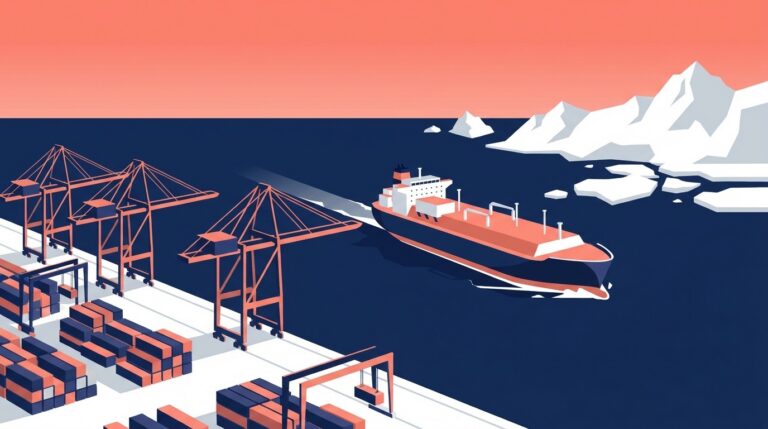
Phase 1: Empathy — Navigating Frozen Waters in a Korean Boardroom
안녕하세요! 매일한글 에디터입니다. (Hello! I am your Daily Hangul Editor.) Picture this: you are sitting in a sleek glass conference room in Busan, or binge-watching a tense chaebol boardroom scene in a K-Drama. Suddenly, the director mentions melting polar ice, the Northern Sea Route (NSR), and icebreaking LNG carriers—and your Level 6 Korean brain hits an iceberg! Even advanced learners tell me they freeze when geopolitical maritime buzzwords fly across the table. Built from real learner feedback, this guide turns intimidating shipbuilding jargon into your sharpest career asset. Ready to navigate Korean boardrooms like a native strategist?
Phase 2: Deep Dive — 3 Essential Level 6 Expressions
1. 지정학적 변수로 부상하다 (jijeonghakjeok byeonsuro busanghada)
- Pronunciation:
ji-jeong-hak-jeok byeon-su-ro bu-sang-ha-da(Imagine bu-sang sounding like a submarine bursting up through ice: “BOO-sahng!”)- Meaning: Literally “to float up as a geopolitical variable.” In practice, it means “to emerge as a pivotal geopolitical factor/wildcard.”
- K-Culture Moment: Think of a high-stakes evening news briefing on JTBC or a corporate war-room scene in Reborn Rich (재벌집 막내아들) where an analyst points at an Arctic map and warns the chairman about shifting global trade routes.
- Editor’s Insight: Beginners use
중요해지다 (jungyohaejida - to become important), which sounds flat.부상하다 (busanghada)carries the dramatic imagery of something rising from beneath the surface to dominate everyone’s radar—especially apt when discussing melting polar ice!- Situation Spectrum: Casual 🚫 | Semi-formal ✅ | Formal ✅
- 🤔 Think About It: Notice how Korean prefers
변수 (byeonsu - variable)over simple “change.” Korean business culture obsessively tracks unpredictable variables to manage collective risk. How does your native language frame sudden geopolitical shifts—as opportunities, threats, or math-like variables?2. 쇄빙 상선 건조에 박차를 가하다 (swaebing sangseon geonjoe bakchareul gahada)
- Pronunciation:
swae-bing sang-seon geon-jo-e bak-cha-reul ga-ha-da(Bak-cha snaps like a whip hitting a galloping horse: “BAHK-chah!”)- Meaning: Literally “to apply spurs to the building of icebreaking merchant ships.” Idiomatically, “to accelerate / step on the gas in constructing icebreaking vessels.”
- K-Culture Moment: Picture an executive briefing in a Korean shipyard drama or documentary covering Geoje Island’s mega-docks, where engineers race against winter deadlines to build polar-class LNG carriers.
- Editor’s Insight: Note that
건조 (geonjo)means “dry” in daily life, but in shipbuilding (using the Hanja 建造), it exclusively means “ship construction.” Combining it with박차를 가하다instantly makes you sound like an industry veteran.- Situation Spectrum: Casual 🚫 | Semi-formal ✅ | Formal ✅
- 🤔 Think About It: Korean business idioms love kinetic energy (
박차를 가하다, spurring a horse). It reflects Korea’s famous ppalli-ppalli (hurry-hurry) execution speed. Does your culture value speed or caution more when entering uncharted territory like Arctic shipping?3. 해상 물류의 판도를 뒤바꾸다 (haesang mullyuui pandoreul dwibakkuda)
- Pronunciation:
hae-sang mul-lyu-ui pan-do-reul dwi-ba-kku-da(Pan-do sounds like flipping a heavy board game “PAHN-doh” upside down in one sweep!)- Meaning: Literally “to overturn the board layout of maritime logistics.” Nuance: “to completely reshape the global shipping game.”
- K-Culture Moment: In Misaeng (미생) or modern startup dramas like Start-Up (스타트업), characters drop
판도를 뒤바꾸다whenever a game-changing innovation—like cutting the Asia-Europe sea route by 30% via the NSR or adopting green ammonia fuels—makes old rivals obsolete.- Editor’s Insight: While
바꾸다simply means “to change,”뒤바꾸다adds the visceral prefix뒤-(over/reverse), signaling total disruption. It’s the ultimate boardroom power verb.- Situation Spectrum: Casual ⚠️ (dramatic, used in gaming/sports) | Semi-formal ✅ | Formal ✅
- 🤔 Think About It:
판 (pan)originally refers to a chess/Go (baduk) board or market arena. Korean speakers subconsciously view global trade as a strategic baduk match. How does your language use board-game or sports metaphors in business?
Phase 3: Textbook Korean vs. Real Korean
Situation 1: Explaining the 30% Distance Reduction on the Northern Sea Route
- 📖 교과서 한국어 (Textbook Korean):
북극항로를 이용하면 항해 거리가 30% 이상 단축될 것으로 예상됩니다.(Bukgeukhangnoreul iyonghamyeon hanghae georiga 30% isang danchukdoel geoseuro yesangdoemnida. – Utilizing the Northern Sea Route is expected to shorten sailing distance by over 30%.) - 🗣️ 진짜 한국어 (Real Korean):
북극항로만 뚫리면 물류 거리가 3분의 1은 확 줄어든다고 봐야죠.(Bukgeukhangnoman ttullimyeon mullyu georiga 3bunui ireun hwak jureodeundago bwayajyo. – Once the Arctic route opens up, you’ve got to figure logistics distance gets slashed by a solid third.) - 💡 왜 다를까? (Why the Difference?): In live discussions, native strategists replace stiff passive phrasing (
단축될 것으로 예상됩니다) with visceral verbs like뚫리다(to break open/clear) and확 줄어들다(to plummet), ending with-다고 봐야죠to sound decisive yet collaborative.
Situation 2: Discussing Rising Demand for Eco-Friendly & Icebreaking LNG Vessels
- 📖 교과서 한국어 (Textbook Korean):
친환경 추진선과 쇄빙선에 대한 시장 수요가 증가하고 있습니다.(Chinhwangyeong chujinseongwa swaebingseone daehan sijang suyoga jeunggago itseumnida. – Market demand for eco-friendly propulsion ships and icebreakers is increasing.) - 🗣️ 진짜 한국어 (Real Korean):
요즘 글로벌 선사들 수주 물량이 친환경 쇄빙선 쪽으로 싹 쏠리는 추세예요.(Yojeum geullobeol seonsadeul suju mullyangi chinhwangyeong swaebingseon jjogeuro ssak ssollineun chuseyeyo. – Lately, global shipping lines’ order volumes are completely flooding toward eco-friendly icebreakers.) - 💡 왜 다를까? (Why the Difference?): Real maritime insiders rarely say
수요가 증가하다. They use수주 물량(order intake volume) and쏠리다(to tilt/surge heavily in one direction), painting a dynamic picture of capital shifting across shipyards.
Phase 4: K-Culture Deep Dive & Non-Verbal Manners
4-1. 눈치 (Nunchi) & Gestures in Maritime Strategy Meetings
When discussing sensitive topics like melting polar ice, green ammonia retrofits, and Arctic geopolitics with Korean executives, verbal fluency is only half the battle:
* The Two-Handed Pointer: When gesturing toward a map of the Northern Sea Route on a screen, avoid pointing with a single index finger—it looks aggressive. Keep your fingers together with an open palm angled upward.
* Strategic Pausing & Eye Contact: When a senior director shares a cautious point about ice-class hull costs, maintain steady eye contact and offer a slow, deliberate nod (고개를 천천히 끄덕이다) before replying. Jumping in immediately—even with brilliant data—can read as poor nunchi.
4-2. Cultural Code Analysis: From Chaebol K-Dramas to Busan’s Maritime Soul
If you’ve watched Korean corporate dramas like Agency (대행사) or Misaeng, you know that strategy talks don’t end in the meeting room—they continue over late-night hoesik (company dinners). In Korea’s southeastern shipbuilding belt (Busan, Geoje, Ulsan), pride in maritime engineering runs deep. Korea transformed from a war-torn peninsula into the world’s top builder of high-tech LNG carriers and green ammonia vessels through sheer grit. Dropping a thoughtful remark about how Busan Port serves as the gateway to the Arctic route earns instant respect, especially over a bowl of Busan’s famous dwaeji-gukbap (pork rice soup)!
Phase 5: Real-Life Roleplay Scenario
Setting: A glass-walled strategy lounge overlooking Busan North Port. Giant cranes move like steel giraffes against the sunset while iced Americanos sit beside a tablet displaying polar sea-ice charts.
NPC: Kang Min-jun (강민준 팀장), a razor-sharp Maritime Logistics Team Lead known for rapid-fire questions and dry humor.
- Min-jun:
🎭 (tapping the Arctic map on his tablet with his pen)이번 겨울 해빙 속도가 예상보다 훨씬 빠르네요. 북극항로 상용화가 코앞으로 다가왔어요. (Ibeon gyeoul haebing sokdoga yesangboda hwolssin ppareuneyo. Bukgeukhangno sangyonghwaga koapeuro dagawasseoyo.– Polar ice melt is way faster than projected this winter. Commercializing the Northern Sea Route is right around the corner.) - You:
🎭 (leaning forward attentively, open-handed gesture toward the chart)맞습니다, 팀장님. 아시아-유럽 항해 거리가 30% 이상 단축되니 해상 물류의 판도를 완전히 뒤바꿀 만한 사안이죠. (Matseumnida, timjangnim. Asia-Yureop hanghae georiga 30% isang danchukdoeni haesang mullyuui pandoreul wanjeonhi dwibakkul manhan saanijyo.– Agreed, Team Lead. Since it cuts Asia-Europe sailing distance by over 30%, it’s an issue capable of completely reshaping maritime logistics.) - Min-jun:
🎭 (raising an eyebrow, impressed, taking a sip of iced Americano)오, 핵심을 짚으셨네요. 그런데 러시아나 연안국 규제 같은 지정학적 리스크가 만만치 않잖아요? (O, haeksimeul jipeusyeotneyo. Geureonde Reosia-na yeonanguk gyuje gateun jijeonghakjeok riseukeuga manmanchi anchanayo?– Oh, you hit the nail on the head. Still, geopolitical risks like Russian or coastal-state regulations are no joke, right?) - You:
🎭 (nodding thoughtfully with steady eye contact)네, 바로 그 점이 지정학적 변수로 부상하고 있습니다. 그래서 단순한 운임 절감보다 쇄빙 상선 기술력과 친환경 연료 확보가 관건인 것 같습니다. (Ne, baro geu jeomi jijeonghakjeok byeonsuro busanghago itseumnida. Geuraeseo dansunhan unim jeolgamboda swaebing sangseon gisullyeokgwa chinhwangyeong yeollyo hwakboga gwangeonin geot gatseumnida.– Yes, that exact point is emerging as a geopolitical variable. That’s why icebreaking vessel tech and green fuel security seem more crucial than simple freight savings.) - Min-jun:
🎭 (leaning back, smiling slightly)역시 우리 조선소들이 친환경 암모니아 추진선이랑 쇄빙 LNG선 건조에 박차를 가하는 이유가 다 거기 있군요. (Yeoksi uri joseonsodeuri chinhwangyeong ammonia chujinseonirang swaebing LNGseon geonjoe bakchareul gahaneun iyuga da geogi itgunyo.– Indeed, that’s exactly why our shipyards are accelerating construction of green ammonia ships and icebreaking LNG carriers.) - You:
🎭 (checking notes briefly, speaking crisply)네, 쇄빙 기능에 탄소 중립까지 갖추면 유럽 선사들의 수주 물량이 한국으로 쏠릴 수밖에 없죠. (Ne, swaebing gineunge tanso jungnipkkaji gatchumyeon Yureop seonsadeurui suju mullyangi Hangugeuro ssollil subakke eopjyo.– Right, once we combine icebreaking capability with carbon neutrality, European shipping lines’ orders will inevitably pour into Korea.) - Min-jun:
🎭 (glancing at his watch as the room darkens)좋습니다. 내일 본부장님 보고 때 지금 말씀하신 포인트 꼭 넣읍시다. 근데… 오늘 저녁 부산역 근처에서 국밥 한 그릇 어때요? (Jotseumnida. Naeil bonbujangnim bogo ttae jigeum malsseumhasin pointeu kkok neoeupsida. Geunde... oneul jeonyeok Busannyeok geuncheoeseo gukbap han geureut eottaeyo?– Great. Let’s definitely include your points in tomorrow’s director briefing. By the way… how about a bowl of gukbap near Busan Station tonight?) - You:
🎭 (smiling warmly)[Choose your response below!]
🔀 Interactive Branching Point: How do you reply to Min-jun’s dinner invite?
- Option A:
좋죠! 아까 말씀하신 쇄빙선 프로젝트 얘기도 편하게 더 나누고 싶습니다.(Jotjyo! Akka malsseumhasin swaebingseon peurojekteu yaegido pyeonhage deo nanugo sipseumnida.– Sounds great! I’d love to casually chat more about the icebreaker project you mentioned earlier.)- Feedback (Best ✅): Top-tier nunchi! You accept warmly while signaling enthusiasm for teamwork without sounding overly stiff.
- Option B:
죄송한데 근무 시간 외에는 업무 관련 식사를 안 합니다.(Joesonghande geunmu sigan oeeneun eommu gwallyeon siksareul an hamnida.– Sorry, I don’t do work-related meals outside working hours.)- Feedback (Bad 🚫): While personal boundaries are respected more in modern Korea, shutting down a friendly informal gukbap offer so bluntly can damage rapport right after a great meeting.
- Option C:
네, 대신 오늘은 제가 살게요! 팀장님 월급 적으시잖아요.(Ne, daesin oneureun jega salgeyo! Timjangnim wolgeup jeogeusijanayo.– Sure, I’ll pay today instead! Your salary is small anyway, Team Lead.)- Feedback (Risk ⚠️): Trying to outpay your senior with a joke about his salary is a major hierarchy faux pas in Korea. Let the senior treat first, or politely offer to buy the post-dinner coffee (
커피는 제가 살게요)!
- Feedback (Risk ⚠️): Trying to outpay your senior with a joke about his salary is a major hierarchy faux pas in Korea. Let the senior treat first, or politely offer to buy the post-dinner coffee (
Phase 6: 10-Second Emotion Shadowing Drill
Read aloud cleanly, pausing briefly at every / and matching the emotional cue:
[🧐 Analytically & sharply]해빙 속도가 빨라지면서 / 북극항로가 / 새로운 지정학적 변수로 / 부상했습니다. (Haebing sokdoga ppallajimyeonseo / bukgeukhangnoga / saeroun jijeonghakjeok byeonsuro / busanghaetseumnida.– As ice melt accelerates, / the Northern Sea Route / has emerged as / a new geopolitical variable.)[🔥 Decisively & urgently]한국 조선업계가 / 친환경 쇄빙선 건조에 / 박차를 가해야 할 / 시점입니다. (Hanguk joseoneopgyega / chinhwangyeong swaebingseon geonjoe / bakchareul gahaeya hal / sijeomimnida.– Now is the moment / for Korean shipbuilders / to accelerate construction of / eco-friendly icebreakers.)[😊 Confidently with visionary pride]이 기술력이면 / 글로벌 해상 물류의 판도를 / 충분히 뒤바꿀 수 있습니다. (I gisullyeogimyeon / geullobeol haesang mullyuui pandoreul / chungbunhi dwibakkul su itseumnida.– With this technology, / we can thoroughly reshape / the global maritime logistics landscape.)
Phase 7: K-Culture Mini Dictionary (4 Core Keywords)
- 북극항로 (Bukgeukhangno) | Northern Sea Route (NSR) | Used constantly in Korean economic news and policy papers to describe the Arctic sea corridor linking East Asia and Europe.
- 쇄빙 상선 (Swaebing sangseon) | Icebreaking merchant vessel | Combines
쇄빙(crushing ice) and상선(commercial ship). Essential when discussing polar LNG carriers built in Geoje or Ulsan. - 친환경 추진선 (Chinhwangyeong chujinseon) | Eco-friendly propulsion vessel | Covers ships powered by green ammonia (
그린 암모니아), methanol, or LNG—Korea’s biggest export weapon in global shipbuilding. - 수주 잔량 (Suju jallyang) | Order backlog | Literally “remaining order volume.” If you want to sound fluent in Korean business circles, ask about a shipyard’s
수주 잔량rather than just “sales.”
Phase 8: Survival Kit for Travelers (Busan & Geoje Maritime Hubs)
Top 3 Survival Expressions
- 부산항 국제여객터미널로 가 주세요. (
Busanhang Gukjeyeogaekteomineollo ga juseyo.) — “Please take me to Busan Port International Passenger Terminal.” Pro Tip: Busan taxi drivers speak fast with a melodic Gyeongsang dialect—speaking clearly and showing the Korean address on your phone prevents detours. - 여기 선박 박물관 입장권 한 장 주세요. (
Yeogi seonbak bangmulgwan ipjanggwon han jang juseyo.) — “One ticket for the Maritime/Ship Museum here, please.” Pro Tip: Visit the Korea National Maritime Museum in Yeongdo, Busan, to see real icebreaker models up close! - 근처에 현지인 맛집 추천해 주실 수 있나요? (
Geuncheoe hyeonjiin matjip chucheonhae jusil su innayo?) — “Could you recommend a local favorite restaurant nearby?” Pro Tip: Asking for a현지인 맛집(local-approved spot) instead of a tourist spot leads to unforgettable fresh sashimi near Jagalchi Market.
Editor’s Travel Note
- Essential Navigation: Before boarding the bullet train south, Download the Naver Map App for English Busan Transit—Google Maps has limited walking and bus routing in Korea.
- High-Speed Rail & Payment: Book your Seoul-to-Busan seat ahead of time via the KORAIL KTX English Ticket Reservation Portal. Grab a rechargeable T-money card at any convenience store (GS25 or CU) inside Seoul Station; it works seamlessly on Busan subways, harbor buses, and even taxis!
Phase 9: “One Step Deeper” — A Mini Humanities Essay
Why does a relatively small country on the southern tip of the Korean peninsula obsess over melting polar ice thousands of miles north? In Korean society, survival and community (공동체) have historically depended on anticipating external waves before they crash ashore. That collective vigilance fuels Korea’s unique blend of hyper-speed adaptation (빨리빨리) and meticulous engineering. When global rules shift—whether through Arctic routes or strict carbon-neutral shipping mandates—Korean shipbuilders don’t merely react; they treat the crisis as a shared national mission to reinvent the future. Understanding this cultural engine reveals why Korean business language sounds so urgent, dramatic, and relentlessly forward-looking.
💬 Your Turn: In your country, how is the tension between climate change (melting polar ice) and economic opportunity (shorter Arctic trade routes) discussed in the news? Drop your thoughts in the comments!
Phase 10: FAQ & Myth-Busting
Q: Why does Korean use 해빙 (haebing) for sea ice melting when 해빙 also means thawing frozen food or spring thaw?
A: Great catch! 해빙 (解氷) uses the Hanja characters for “untie/melt” (解) and “ice” (氷). At Level 6, context is king: paired with 기후 온난화 (global warming) or 북극 (the Arctic), it refers strictly to polar sea-ice melt, whereas 해동 (haedong) is more common when defrosting meat in the kitchen.
Q: Can I use 부상하다 (busanghada) to describe a friend becoming popular on social media?
A: Not quite! 부상하다 feels too journalistic and formal for casual gossip. For a friend going viral, natives say 떡상하다 (tteoksanghada - to skyrocket) or 뜨다 (tteuda - to rise/blow up). Save 부상하다 for geopolitics, markets, or serious news analyses.
Q: Is 암모니아 추진선 always understood without adding 친환경 (eco-friendly)?
A: Technically yes, in engineering circles, because ammonia contains zero carbon. However, in Korean public discourse, people often worry about ammonia’s toxicity, so speakers intentionally pair it with 친환경 or 그린 암모니아 to emphasize its zero-carbon environmental benefit.
🚨 Common Mistakes Warning Board
- Mistake: Saying
북극 길 (Bukgeuk gil)for the Northern Sea Route.- Correct Action: Always use
북극항로 (Bukgeukhangno)—항로specifically means a maritime or aviation route, whereas길means a walking road or street.
- Correct Action: Always use
- Mistake: Confusing
건조하다 (geonjohada - to be dry)with건조하다 (geonjohada - to construct a ship)in conversation.- Correct Action: Attach the object
선박을or상선을right before건조하다(e.g.,쇄빙 상선을 건조하다) so listeners immediately recognize the shipbuilding Hanja.
- Correct Action: Attach the object
- Mistake: Using
판도를 바꾸다in overly casual texts about trivial choices (like changing lunch menus).- Correct Action: Reserve
판도를 뒤바꾸다for major structural changes—tech breakthroughs, geopolitical shifts, or industry disruptions—so its dramatic punch stays intact.
- Correct Action: Reserve
Phase 11: Action Mission & Engagement
- 🥉 Bronze Mission (Solo Practice): Record a 15-second voice memo on your phone summarizing why the Northern Sea Route matters, using all three Phase 2 expressions (
지정학적 변수로 부상하다,박차를 가하다,판도를 뒤바꾸다). - 🥈 Silver Mission (Community Share): Post one sentence on Instagram, Threads, or LinkedIn in Korean about eco-friendly ships (
친환경 추진선) and tag a Korean study buddy to check your nuance! - 🥇 Gold Mission (Real-World Use): Find a recent article on Naver News searching
북극항로 쇄빙선and leave a respectful, Level 6 summary comment in Korean—or use one expression in your next Korean tutor session!
🎮 K-Culture Mission: Watch an episode of a Korean financial news segment on YouTube (like SBS Biz or KBS News) or a corporate K-Drama scene, and catch how anchors or executives drop 변수, 박차를 가하다, or 판도 within just 5 minutes!
Phase 12: Interactive Quiz Challenge
Quiz 1 (Situation Judgment): You are presenting to senior Korean maritime directors about rising European orders for green ammonia icebreakers. Which phrase sounds most natural and authoritative?
* A) 요즘 배를 만드는 주문이 많이 늘어나고 있어요.
* B) 글로벌 선사들의 수주 물량이 친환경 쇄빙선 쪽으로 쏠리는 추세입니다.
* C) 배가 얼음을 깨고 가는 게 인기가 엄청 많아요.
Quiz 2 (Fill-in-the-Blank): Complete the sentence with the most natural Level 6 verb phrase:
“기후 변화로 인해 북극항로가 새로운 지정학적 변수로 ( ________ ).”
Quiz 3 (True / False Cultural Quiz): In a Korean corporate dinner (hoesik) following a successful strategy briefing, joking that your team lead earns less than you so you will pay the bill is seen as charming modesty.
🔓 Click to Reveal Answers & Deep-Dive Explanations
- Quiz 1 Answer: B. Option A is grammatically okay but sounds like a beginner’s textbook. Option C is far too childish for a boardroom. Option B uses insider industry terms (
수주 물량,쏠리는 추세입니다) that match TOPIK Level 6 standards. - Quiz 2 Answer:
부상하고 있습니다or부상했습니다(busanghago itseumnida/busanghaetseumnida). Paired with지정학적 변수로,부상하다is the gold-standard collocation in Korean geopolitics and economics. - Quiz 3 Answer: False. Hierarchy and face (chemyeon) remain central at Korean business dinners. Making a joke about a senior colleague’s salary—even playfully—crosses a line. Offer to buy coffee afterward instead!
🎬 Watch Our Daily Videos! (Daily Hangul Official Instagram)
Review the expressions you learned in this article with our fun daily short videos! Check out native pronunciation and real-life nuances in action.
- Instagram @dailyhangul_en







