

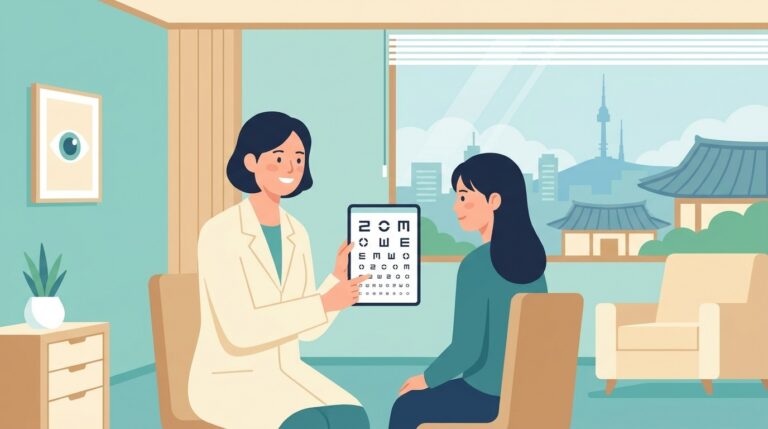
Phase 1: Welcome to Seoul’s Brightest (and Priciest) Glow-Up
안녕하세요! 매일한글 에디터입니다. (Hello! I’m your Daily Hangul editor.) Imagine stepping into a dazzling Gangnam eye clinic that looks more like a K-drama CEO’s penthouse than a hospital. You’re finally ready to ditch your glasses with SMILE or LASIK surgery! After high-tech pre-op scans, the coordinator drops a reality bomb: refractive vision correction isn’t covered by Korean national or private indemnity insurance because it’s classified as elective. Watching learners freeze at words like 비급여 (bigeupyeo, non-covered) inspired this real-feedback guide. Mastering these B2 expressions will save you from surprise bills and help you discuss side effects with confidence!
Phase 2: Deep Dive into Top 3 Expressions
1. 비급여 항목으로 분류되다 (bigeupyeo hangmogeuro bunryudoeda — to be classified as a non-covered item)
- Pronunciation: [bi-geup-yeo hang-mog-eu-ro bun-ryu-doe-da] (Think of “bee-gup-yuh” where “bee” means “non-” like a strict referee waving off an insurance claim, and “boon-ryoo” sounds like sorting files into a blue bin.)
- Meaning: Literally “to be sorted into the non-benefit category.” In real life, it means you pay 100% out of pocket because the National Health Insurance Service (NHIS) won’t pitch in a single won.
- K-Culture Moment: Picture an office drama where the exhausted protagonist visits a clinic for chronic fatigue or posture therapy, only to hear the receptionist gently say, “비급여 항목으로 분류돼서요” (bigeupyeo hangmogeuro bunryudwaeseoyo — because it’s classified as non-covered), triggering a dramatic close-up of their trembling wallet.
- Editor’s Insight: At B2 level, using the passive verb 분류되다 (bunryudoeda, to be classified) instead of just 안 되다 (an doeda, doesn’t work) makes you sound polished and informed—like someone who actually understands medical policy rather than just complaining about the price.
- Situation Spectrum: Casual ⚠️ (too stiff with close friends unless quoting a doctor) / Semi-formal ✅ (conjugate to 분류돼요, bunryudwaeyo) / Formal ✅ (conjugate to 분류됩니다, bunryudoemnida)
- 🤔 Think About It: In English, we often say “elective” or “out-of-pocket,” focusing on the patient’s choice or wallet. Why do you think Korean medical terminology frames it through 급여 (geupyeo, benefits/salary) vs. 비급여 (bigeupyeo, non-benefits)?
2. 실손보험 적용이 안 되다 (silsonboheom jeogyongi an doeda — not to be covered by private indemnity insurance)
- Pronunciation: [sil-son-bo-heom jeog-yong-i an doe-da] (“Sil-son” sounds like “shill-sohn”—short for actual loss—and “bo-heom” sounds like “boh-hum.”)
- Meaning: Literally “actual-loss insurance application does not happen.” In Korea, people buy private 실손보험 (silsonboheom) to reimburse what NHIS misses, so confirming this tells you whether your private insurer will pay you back later.
- K-Culture Moment: In realistic slice-of-life K-dramas or Korean YouTube vlogs documenting LASIK journeys, creators always warn viewers right after the consultation scene: “실손보험 적용이 안 되니까 예산 넉넉히 잡으세요!” (Silsonboheom jeogyongi an doenikka yesan neongneokhi jabeuseyo! — Since indemnity insurance doesn’t apply, budget generously!)
- Editor’s Insight: Native speakers almost always shorten 실손보험 (silsonboheom) to just 실손 (silson) or 실비 (silbi) in everyday conversation. Hearing “실비 청구 안 돼요” (Silbi cheonggu an dwaeyo — You can’t file an indemnity claim) means the exact same thing!
- Situation Spectrum: Casual ✅ (use 안 돼, an dwae with friends) / Semi-formal ✅ (안 돼요, an dwaeyo) / Formal ✅ (적용되지 않습니다, jeogyongdoeji anseumnida)
- 🤔 Think About It: Many countries bundle medical coverage into one private policy, whereas Korea splits coverage into public NHIS and private 실손보험 (silsonboheom). How does your home country distinguish between public and supplemental insurance?
3. 미용·편의 목적으로 간주되다 (miyong·pyeoni mokjeogeuro ganjudoeda — to be regarded as being for cosmetic/convenience purposes)
- Pronunciation: [mi-yong-pyeon-i mok-jeog-eu-ro gan-ju-doe-da] (“Mi-yong” sounds like “mee-yohng,” and “gan-ju” sounds like “gahn-joo”—smooth and decisive.)
- Meaning: Literally “to be deemed as having beauty/convenience as a goal.” This is the official rationale explaining why LASIK, LASEK, and SMILE aren’t subsidized: glasses exist, so surgery is treated as convenience rather than medical necessity.
- K-Culture Moment: Think of K-pop idols or actors casually mentioning in interviews how they got vision correction so they wouldn’t have to wear colored contacts on stage anymore—classic 편의 목적 (pyeoni mokjeok, convenience purpose)!
- Editor’s Insight: 간주되다 (ganjudoeda, to be regarded/deemed as) is a fantastic B2 verb used in legal, medical, and business contexts when a rule defines how something is officially treated.
- Situation Spectrum: Casual 🚫 (way too formal for casual chat) / Semi-formal ✅ (간주돼요, ganjudwaeyo) / Formal ✅ (간주됩니다, ganjudoemnida)
- 🤔 Think About It: Even though terrible eyesight impacts daily safety, Korean health policy treats glasses as sufficient treatment. Does your culture view laser eye surgery as medical care or a lifestyle upgrade?
Phase 3: Textbook Korean vs. Real Korean
Situation 1: Confirming insurance coverage at the consultation desk
- 📖 Textbook Korean: 이 수술은 국민건강보험 적용이 됩니까? (I susureun gungmingeongangboheom jeogyongi doemnikka? — Is this surgery covered by National Health Insurance?)
- 🗣️ Real Korean: 혹시 이 시술 실손이나 건보 처리 전혀 안 되나요? (Hoksi i sisul silsonina geonbo cheori jeonhyeo an doenayo? — By any chance, is this procedure not eligible for indemnity or national insurance at all?)
- 💡 Why the difference? Koreans rarely say the full six-syllable 국민건강보험 (gungmingeongangboheom) out loud at a clinic—they abbreviate it to 건보 (geonbo) and pair it with 처리 (cheori, processing) plus 혹시 (hoksi, by any chance) to soften a money-related question.
Situation 2: Asking about side effects after confirming it’s elective
- 📖 Textbook Korean: 부작용이 발생할 가능성이 있는지 설명해 주십시오. (Bujagyongi balsaenghal ganeungseongi inneunji seolmyeonghae jusipsio. — Please explain whether there is a possibility of side effects occurring.)
- 🗣️ Real Korean: 안구건조증이나 빛번짐 같은 부작용은 어느 정도 감안해야 할까요? (Angugeonjojjeungina bitbeonjim gateun bujagyongeun eoneu jeongdo gamanhaeya halkkayo? — To what extent should I factor in side effects like dry eyes or light glare?)
- 💡 Why the difference? Rather than asking a yes/no question (every surgery has risks!), savvy B2 speakers name specific common symptoms like 빛번짐 (bitbeonjim, halos/glare) and use 감안하다 (gamanhada, to take into account) to sound realistic and well-researched.
Phase 4: K-Culture Deep Dive & Non-Verbal Manners
4-1. Nunchi (눈치) & Gestures at a Korean Eye Clinic
Korean eye clinics—especially in Gangnam’s medical district—run like high-speed luxury concierges. You’ll meet an optometrist (검안사, geomansa) for 10+ machine tests, a coordinator (상담실장, sangdamsiljang) for pricing and scheduling, and finally the surgeon (원장님, wonjangnim). Use your best 눈치 (nunchi, social awareness): hand over your Alien Registration Card or passport with two hands at reception, and save detailed pricing or 비급여 (bigeupyeo) questions for the coordinator rather than the surgeon. When the coordinator slides the tablet over with surgery tiers, maintain polite eye contact, nod thoughtfully, and say 아, 그렇군요 (a, geureokunyo — oh, I see) before asking about side effects—never sound accusatory about the lack of insurance coverage, since it’s national policy, not clinic greed!
4-2. Cultural Code Analysis: The Gangnam Glow-Up & K-Medical Transparency
If you watch Korean vlogs or K-dramas, you’ve probably noticed how normalized vision correction is—almost like getting braces or skincare! Because Korea’s healthcare system strictly separates 질병 치료 (jilbyeong chiryo, disease treatment) from 미용·편의 목적 (miyong·pyeoni mokjeok, cosmetic/convenience purposes), elective clinics compete fiercely in the private market. That’s why Korean eye clinics look like boutique hotels, offer same-day pre-op exams (당일 검사, dangil geomsa), and provide transparent package quotes upfront. Knowing that you’re stepping into a competitive consumer-medical space helps you ask smarter questions about aftercare and potential side effects!
Phase 5: Practical Roleplay Scenario
Setting: A sleek, sunlit eye clinic in Gangnam smelling faintly of eucalyptus. Soft acoustic pop plays in the background while robotic eye-scanning machines hum quietly.
NPC: Coordinator Ji-young (지영 실장님), warm, crisp, holding a glowing iPad with your corneal thickness scan results.
- Ji-young: 🎭 (Smiling warmly while flipping the iPad toward you) 검사 결과는 아주 좋으세요. 각막 두께도 충분해서 스마일라식 가능하세요. (Geomsa gyeolgwaneun aju joeuseyo. Gangmak dukkedo chunghunhaeseo seumaillasik ganeunghaseyo. — Your exam results are great. Your corneal thickness is sufficient, so SMILE LASIK is possible.)
- You: 🎭 (Leaning in attentively with a slight nod) 다행이네요! 그런데 비용 관련해서 확인하고 싶은 게 있어요. (Dahaengineyo! Geureonde biyong gwanryeonhaeseo hwaginhago sipeun ge isseoyo. — What a relief! By the way, there’s something I want to confirm regarding the cost.)
- Ji-young: 🎭 (Adjusting her pen politely) 네, 말씀하세요. 어떤 부분이 궁금하신가요? (Ne, malsseumhaseyo. Eotteon bubuni gunggeumhasingayo? — Yes, go ahead. What part are you curious about?)
- You: 🎭 (Gesturing gently toward the price sheet) 시력교정술은 비급여 항목으로 분류되어서 국민건강보험 적용이 안 된다고 들었어요. 실손보험도 역시 안 되나요? (Siryeokgyojeongsureun bigeupyeo hangmogeuro bunryudoeeoseo gungmingeongangboheom jeogyongi an doendago deureosseoyo. Silsonboheomdo yeoksi an doenayo? — I heard vision correction is classified as non-covered so national health insurance doesn’t apply. Doesn’t indemnity insurance apply either?)
- Ji-young: 🎭 (Nodding sympathetically) 맞아요. 미용·편의 목적으로 간주되기 때문에 건강보험이나 실손보험 모두 적용이 어렵습니다. (Majayo. Miyong·pyeoni mokjeogeuro ganjudoegi ttaemune geongangboheomina silsonboheom modu jeogyongi eoryeopseumnida. — That’s right. Since it’s regarded as being for cosmetic/convenience purposes, neither health insurance nor indemnity insurance can be applied.)
- You: 🎭 (Taking a mental note, looking genuinely curious) 그렇군요. 그럼 수술 후에 안구건조증 같은 부작용이 생기면, 그 치료비는 보험 적용이 되나요? (Geureokunyo. Geureom susul hue anhugeonjojjeung gateun bujagyongi saenggimyeon, geu chiryobineun boheom jeogyongi doenayo? — I see. Then if side effects like dry eyes occur after surgery, is that treatment covered by insurance?)
- Ji-young: 🎭 (Looking impressed by your sharp question) 네, 맞습니다! 수술 후 안약 처방이나 건조증 치료는 일반 진료라 건강보험이 적용돼요. (Ne, matseumnida! Susul hu anyak cheobangina geonjojjeung chiryoneun ilban jillyora geongangboheomi jeogyongdwaeyo. — Yes, exactly! Post-op eye drop prescriptions or dry-eye treatment count as regular medical care, so health insurance applies.)
- You: 🎭 (Smiling with relief) 아, 그건 정말 안심이 되네요. 자세히 설명해 주셔서 감사합니다! (A, geugeon jeongmal ansimi doeneyo. Jasehi seolmyeonghae jusyeoseo gamsahamnida! — Oh, that’s really reassuring. Thank you for explaining in detail!)
🔀 Interactive Branching Point
Right after Turn 5, when Ji-young confirms that neither insurance covers the surgery, how should you respond to ask about payment or discounts smoothly?
- Option A: “혹시 현금 결제나 카드 무이자 할부 혜택도 있나요?” (Hoksi hyeongeum gyeoljena kadeu muija halbu hyetaekdo innayo? — By any chance, are there cash payment or interest-free card installment benefits?)
- Feedback (Best ✅): Natural, polite, and super Korean! Asking about 무이자 할부 (muija halbu, interest-free installments) or payment options using 혹시 (hoksi) shows cultural fluency without sounding pushy.
- Option B: “왜 보험이 안 돼요? 너무 비싼 거 아니에요?” (Wae boheomi an dwaeyo? Neomu bissan geo anieyo? — Why isn’t it covered? Isn’t it way too expensive?)
- Feedback (Bad ❌): Sounds confrontational and puts the coordinator on the defensive over a government classification she can’t change. You’ll lose goodwill immediately!
- Option C: “그럼 그냥 제 서류에 질병 치료라고 적어 주시면 안 돼요?” (Geureom geunyang je seoryue jilbyeong chiryorageo jeogeo jusimyeon an dwaeyo? — Then can’t you just write ‘disease treatment’ on my paperwork?)
- Feedback (Risk 🚨): Big red flag! Asking a clinic to alter medical records for insurance reimbursement is illegal insurance fraud (
보험 사기, boheom sagi) in Korea and will instantly freeze the room.
- Feedback (Risk 🚨): Big red flag! Asking a clinic to alter medical records for insurance reimbursement is illegal insurance fraud (
Phase 6: 10-Second Emotion Shadowing Drill
Read aloud using the / marks for natural pauses and channel the emotion in brackets!
- [🧐 Thoughtful & Confirming]
시력교정술은 / 미용·편의 목적이라서 / 비급여 항목으로 분류된대요.
(Siryeokgyojeongsureun / miyong·pyeoni mokjeogiraseo / bigeupyeo hangmogeuro bunryudoendaeyo. — They say vision correction is classified as a non-covered item because it’s for cosmetic/convenience purposes.) -
[😟 Slightly Worried, Seeking Clarity]
실손보험 적용이 안 된다고 하니 / 총비용이 얼마나 나올지 / 미리 확인해 보고 싶어요.
(Silsonboheom jeogyongi an doendago hani / chongbiyongi eolmana naolji / miri hwaginhae bogo sipeoyo. — Since indemnity insurance doesn’t apply, I want to check in advance how much the total cost will be.) -
[😊 Relieved & Grateful]
부작용 치료는 / 보험이 적용된다니 / 한시름 놓았네요!
(Bujagyong chiryoneun / boheomi jeogyongdoendani / hansireum noanneoyeo! — Hearing that side-effect treatments are covered takes a huge load off my mind!)
Phase 7: K-Culture Mini Dictionary
- 정밀 검사 (jeongmil geomsa) | Comprehensive pre-op exam | Used whenever basic screening isn’t enough—from Gangnam eye clinics measuring corneal thickness to comprehensive health checkups (
종합검진, jonghapgeomjin). - 부작용 (bujagyong) | Side effect / Adverse reaction | Essential in medical consultations, skincare reviews (
화장품 부작용), and even workplace slang when a new policy backfires. - 국민건강보험 (gungmingeongangboheom) | National Health Insurance (NHIS) | Korea’s universal healthcare system; mandatory for residents staying over 6 months, often shortened to 건보 (geonbo) in daily speech.
- 각막 두께 (gangmak dukke) | Corneal thickness | The make-or-break metric during LASIK/LASEK/SMILE consultations that determines which surgery is safe for your eyes.
Phase 8: Survival Kit for Travelers
Top 3 Survival Phrases
- 사전 검사 비용은 무료인가요? (Sajeon geomsa biyongeun muryoingayo? — Is the pre-op exam free?) Pro Tip: Many Korean clinics waive the exam fee if you get surgery, or charge a small fee if you just do the exam—always ask upfront!
- 회복 기간이 얼마나 걸리나요? (Hoebok gigani eolmana geollinayo? — How long is the recovery period?) Pro Tip: Crucial if you’re on a tight trip—SMILE heals in 1–2 days, while LASEK takes 5–7 days.
- 영문 진단서 발급 가능할까요? (Yeongmun jindanseo balgeup ganeunghalkkayo? — Can you issue an English medical certificate?) Pro Tip: Handy if you need proof of surgery for your home doctor or employer.
Editor’s Travel Note
Before heading to Gangnam or Myeongdong for your consultation, download the Naver Map app for accurate clinic directions since Google Maps walking routes don’t work well in Korea. You can also check verified Korean clinic reviews on the Goodoc app before booking. Keep in mind that while plastic surgery and dermatology offer VAT tax refunds for tourists, refractive eye surgery is generally excluded, so confirm the final tax-included price (부가세 포함, bugase poham) in advance. Also, avoid taking the subway right after dilated eye-drop tests (산동 검사, sandong geomsa)—your vision will be blurry for hours, so grab a taxi via Kakao T!
Phase 9: One Step Deeper
Korea’s National Health Insurance is famous worldwide for making doctor visits surprisingly affordable—a regular cold checkup can cost less than a fancy iced latte. Yet that very generosity is why Korean medical law draws a sharp, non-negotiable boundary around 미용·편의 목적 (elective beauty and convenience) procedures. To keep essential cancer treatments and emergency surgeries heavily subsidized for everyone in the community, non-essential upgrades like LASIK or teeth whitening stay strictly in the 비급여 (non-covered) lane. Understanding this balance helps you appreciate why clinic staff state those insurance rules so clearly—and reminds you why formal honorifics carry mutual respect in Korean medical spaces.
💬 Your Turn: Have you ever been surprised by what is or isn’t covered by health insurance in Korea or your home country? Drop your story or question in the comments below!
Phase 10: FAQ & Myth-Busting
Q: Why did my Korean friend say they got money back from insurance after eye surgery, while the clinic told me it’s not covered?
A: They might have had a genuine medical condition like cataracts (백내장, baengnaejaeong) or severe keratoconus, or they were talking about post-op dry-eye prescriptions rather than the LASIK surgery itself. Purely refractive surgery for vision convenience is classified as 비급여 (bigeupyeo, non-covered) and isn’t eligible for national or standard indemnity insurance.
Q: If I have a Korean private indemnity insurance policy (실손보험, silsonboheom) as an expat, does it cover SMILE or LASIK?
A: No. Both the National Health Insurance Service and standard Korean indemnity policies exclude refractive vision correction because it is legally regarded as an elective cosmetic/convenience procedure (미용·편의 목적), unless a doctor certifies an exceptional medical necessity.
Q: Are pre-op eye exams (사전 정밀 검사) also considered non-covered?
A: Usually yes, when bundled as a refractive surgery consultation! However, many clinics offer complimentary or low-cost pre-op exams as a promotional benefit if you book a consultation directly, whereas standalone diagnostic tests for suspected eye diseases are covered by NHIS.
🚨 Common Mistakes
- Mistake 1: Saying “보험 안 돼요?” (Boheom an dwaeyo?) without specifying which insurance. -> Correct Action: Clarify
국민건강보험(national) vs.실손보험(private indemnity) so the coordinator gives you an exact answer. - Mistake 2: Assuming “elective” means “zero insurance forever,” even if complications occur. -> Correct Action: Confirm whether post-op side-effect treatments like dry eyes (
안구건조증) or inflammation qualify for normal건강보험(NHIS) visits. - Mistake 3: Forgetting to ask if the quoted price includes 10% VAT (
부가세, bugase). -> Correct Action: Always ask “부가세 포함 금액인가요?” (Bugase poham geumaegingayo? — Is this amount VAT-included?) since non-covered procedures add 10% tax.
Phase 11: Action Mission & Engagement
- 🥉 Bronze (Solo Practice): Record a 15-second voice memo on your phone practicing all three Phase 2 expressions smoothly without looking at the Romanization.
- 🥈 Silver (SNS Share): Share one surprising fact you learned about Korean
비급여(non-covered) vs.건강보험(national insurance) rules on your studygram or language-exchange chat! - 🥇 Gold (Real-Life Usage): Next time you visit a clinic, pharmacy, or dental office in Korea, ask politely: “혹시 이건 건강보험 적용이 되나요, 아니면 비급여인가요?” (Hoksi igeon geongangboheom jeogyongi doenayo, animyeon bigeupyeoingayo?)
- 🎮 K-Culture Mission: Search “라식 브이로그” (LASIK vlog) or “스마일라식 후기” (SMILE LASIK review) on YouTube and try to spot how many times the creator mentions
정밀 검사(pre-op exam),부작용(side effects), or비급여(non-covered)!
Phase 12: Interactive Quiz Challenge
1. Situational Judgment: You’re at a Seoul eye clinic and want to verify politely whether private indemnity insurance covers SMILE surgery. Which sentence is most natural and accurate at B2 level?
* A) 시력교정술은 미용·편의 목적이라 실손보험 적용이 안 되나요?
* B) 왜 건강보험 공짜로 안 해 줘요? 빨리 적용해 주세요.
* C) 각막 두께가 얇아서 부작용이 무조건 생기나요?
2. Fill in the Blank: Complete the sentence below:
“시력교정술은 _____ 항목으로 분류되어서 국민건강보험 혜택을 받을 수 없어요.” (Vision correction is classified as a _____ item, so you cannot receive National Health Insurance benefits.)
3. True or False (Culture Quiz): In Korea, even if LASIK itself isn’t covered by insurance, post-surgery dry-eye drops prescribed during a regular follow-up exam can typically be covered by National Health Insurance. (True / False)
Click to reveal answers & explanations
- Quiz 1 Answer: A! Option A (
Siryeokgyojeongsureun miyong·pyeoni mokjeogira silsonboheom jeogyongi an doenayo?) politely states the policy reason and asks a clear question. Why the others are wrong: Option B is rude and demands free coverage illegally; Option C asks about thin corneas causing guaranteed side effects, which misses the insurance question completely. - Quiz 2 Answer: 비급여 (bigeupyeo).
비급여 항목으로 분류되다is the exact standard phrase for items excluded from national insurance benefits. - Quiz 3 Answer: True! While the refractive surgery itself is an elective
비급여procedure, treating actual post-op symptoms like안구건조증(dry eyes) or inflammation falls under regular medical care (일반 진료) and is eligible for NHIS coverage.
🎬 Watch Our Daily Videos! (Daily Hangul Official Instagram)
Review the expressions you learned in this article with our fun daily short videos! Check out native pronunciation and real-life nuances in action.
- Instagram @dailyhangul_en







